
The 2023 NBA Draft class looked like an all-timer. Victor Wembanyama was one of the most-hyped prospects ever. Scoot Henderson and Brandon Miller had All-Star potential, and the wild-card athleticism of the Thompson twins made for a world of potential at the top of the class. But it wasn't just top-heavy — there was depth too, with a slew of intriguing prospects, from projects to finished products — who seemed ready to pop.
But over the first two years, it was a bit of a mixed bag. Wemby has been as good as advertised, and Amen Thompson is already a key contributor on a contender. But Henderson has been injured and invisible, Miller has scored without really moving the needle in Charlotte, and Ausar looks more like a high-level role player than a future star. And while other first-rounders like Cason Wallace, Dereck Lively II and Ben Sheppard found roles right away, it seemed like Amen and Wemby might have been the only two players with an All-NBA or All-Star selection in the future.
But midway through year three, we've seen a half-dozen players take enormous leaps, addressing key weaknesses, building on strengths and expanding their games. All of a sudden the pool of future All-Stars in the 2023 NBA Draft class is looking a whole lot deeper.
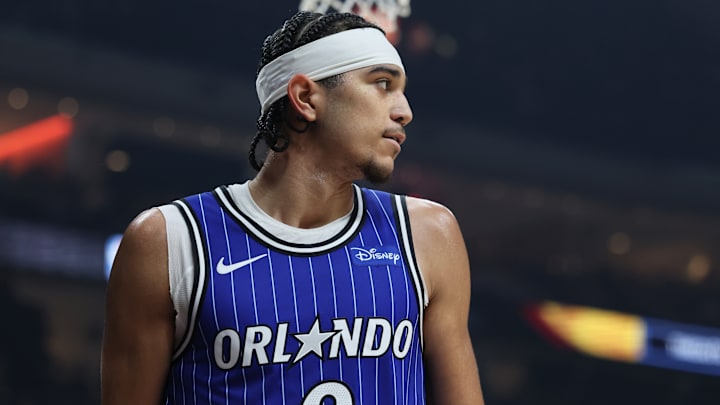
Anthony Black, Orlando Magic
Black may have had the play of the year, breaking a 107-107, fourth-quarter tie with the Grizzlies by dunking all over four defenders at the same time.
That was just the exclamation point on what has been a remarkable breakout season for Black. He's nearly doubled his production from his first two seasons, averaging 15.9 points, 4.1 rebounds, 4.0 assists and 1.3 steals per game on respectable shooting splits. He was able to carve out a supporting role in his first two seasons with his defense and size at point guard, but he's blossomed into a reliable complementary scorer and creator this year, giving the Magic offense a huge boost.
So far this season, Black is shooting 50.3 percent on drives, up from 42.7 last season and 36.8 percent as a rookie. He's passing on a much lower percentage of those drives than he did in either of his two previous seasons, attacking the basket looking to score and actually finishing when he gets there. The other big difference is finally knocking down spot-up 3s, hitting 38.1 percent of his catch-and-shoot attempts this season. His reputation as a shaky shooter means he isn't stretching the defense, something the Magic desperately need, but that will come if he keeps making them.
The one thing standing between him and really starring as a primary creator is his inconsistent shooting off the dribble. If he can start making enough pull-ups to punish defenses for going under screens or playing drop coverage, then you have a 6-foot-7, three-level scorer starting at point and, perhaps, the element that can finally unlock Paolo Banchero, Franz Wagner and the rest of this Magic offense.
Toumani Camara, Portland Trail Blazers

Camara, a late second-round pick, earned a spot in the Blazers' rotation as a rookie with his aggressive defense. His value still comes primarily at that end of the floor, but he's growing at the other end of the floor and adding more and more to his skill set.
He's probably never going to be a player who consistently creates his own offense, but he's become a more willing 3-point shooter, drawing more attention on the perimeter. His percentages are down a bit this year, but over seven attempts per game are going to create some gravity. And while most of his assists are still simple reads, Camara looks increasingly comfortable attacking closeouts and swinging the ball to open shooters.
If he's hitting 3-pointers at a high volume, even at a league average clip, it's not hard to imagine him as a next-generation Shawn Marion — controlling a game with his defense, connecting plays on offense and pushing toward 20 points per game with buckets in transition, off cuts, and a handful of simple creation opportunities against a bent defense.
Jaime Jaquez Jr., Miami Heat

Like Camara, Jaquez was a rotation player right from the jump, in his case because of his solid finishing and high basketball IQ as an offensive connector. His leap this year has been in playmaking and efficiency, and he could be ready to outgrow the label of high-level role player.
Jaquez is handling the ball a ton this year — second on the Heat in time of possession behind Davion Mitchell and leading the team in drives per game. He's a master of the drive-and-kick and passing on nearly half his drives, a similar percentage to players like Josh Giddey and TJ McConnell, and the end result is 4.8 assists per game.
In addition to his passing, he's become one of the most reliable finishers in the league inside of the arc, shooting over 70 percent in the restricted area and 60 percent on long 2-point jumpers. The efficiency around the basket is particularly impressive for a 6-foot-6 forward with average length, athleticism and vertical pop. He's probably more a star in his role more than an out-and-out star, but Jaquez's unique blend of finishing, playmaking, savvy and versatility make him the kind of player any contending team would love to have.
Keyonte George, Utah Jazz

It's not clear how much his production is and will contribute to winning games in the future, but George is putting up some numbers. George is averaging 24.4 points, 6.7 assists and 4.0 rebounds per game this year, on 46/38/90 shooting splits. Some of the jump in per-game production is coming from playing more minutes with more offensive primacy. But he shot under 40 percent from the field in this first two seasons, and just 33.9 percent from beyond the arc. This year, he's a powerful offensive engine and devastating scorer from all three levels.
He's a shaky defender, a bit turnover prone and putting up these numbers for one of the worst teams in the league. But also, his individual numbers are ahead of where Donovan Mitchell was in his third season and the team might see similar results — the Jazz were 44-28 that season and the No. 6 seed in the West — if they were starting Rudy Gobert, Mike Conley and Bojan Bogdanović alongside him, instead of Lauri Markkanen, Jusuf Nurkić and Svi Mykhailiuk.
George finally looks like a player you could build a winning team around. Now the Jazz need to upgrade the roster and test that hypothesis.
Brandin Podziemski, Golden State Warriors

Brandin Podziemski's numbers are that different from last season — 12.3 points, 4.4 rebounds, 3.2 assists per game. They don't scream "future star" and they've been largely invisible among the rest of the chaos in the Western Conference. But the difference between Podz this year and his first two seasons is the way he's cleaned up all of the little things, improving at the margins and setting the stage of big things to come.
He made 37.8 percent of his 3s in his first two seasons, but he's above 40 percent right now. He's made a career-best 74.5 percent of his shots at the rim. He's in the 91st percentile in scoring efficiency on isolations and the 84th as the ball-handler in the pick-and-roll. And he looks so much more under control, getting into the teeth of the defense, making the easy reads and, increasingly, the more difficult, second-level ones.
The Warriors still rely a lot on his offensive versatility, with Podz moving both on and off the ball a ton depending on who else is on the floor with him. But with what he's shown so far this season, it's not hard to imagine him putting up Tyler Herro-like numbers in a situation where he is the primary offensive creator and ball-handler. Who knows if he'll ever get the chance to do that with the Warriors, but right now he's giving them exactly what they need in a supporting role and making clear he's ready for more if the situation calls for it.
More NBA news and analysis:
 Add us as a preferred source on Google