
Key Points
Bullet point summary by AI
- The Dallas Mavericks' young forward narrowly edged out his former Duke teammate from the Charlotte Hornets for the NBA's top rookie honor this season.
- One candidate delivered historic individual numbers on a struggling team while the other was instrumental in transforming a franchise's fortunes just six games above .500.
- This year's voting highlighted the enduring debate over whether awards should prioritize raw production or a player's direct impact on team success.
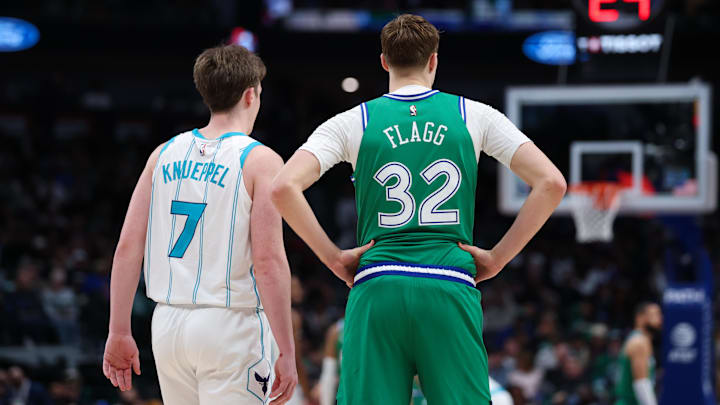
Dallas Mavericks forward Cooper Flagg was officially named NBA Rookie of the Year on Monday. He narrowly wins the award over Charlotte Hornets wing (and former Duke teammate) Kon Knueppel, whom many believed was the frontrunner. Flagg received 56 first-place votes to Knueppel's 44.
A global media panel of 100 voters selected the 2025-26 Kia NBA Rookie of the Year.
— NBA Communications (@NBAPR) April 27, 2026
The 26-point gap between the top two finishers is the second smallest since the current voting format began in 2002-03, behind only a 15-point gap in 2021-22.
Complete voting results ⬇️ pic.twitter.com/LFW4a0m6g5
This was the tightest Rookie of the Year race since 2003; there was a real split in opinion. In reality, this was a litmus test for how voters value raw production versus "winning impact." Flagg put up historic numbers on a lousy Mavs team. Knueppel, meanwhile, was essential to a Hornets team that finished six games above .500 and earned a spot in the Play-in Tournament.
Is Cooper Flagg a deserving ROY winner?

My personal, unofficial vote was for Kon Knueppel. He was incredible all season. The winning is part of it — Charlotte's turnaround coinciding with Knueppel's arrival was not a coincidence — but Knueppel's case had merits beyond the win-loss columns. He was so steady, so consistent. His production and efficiency as a rookie was deeply uncommon.
That said, Flagg was plenty worthy of this accolade. There's a reason folks genuinely believed a tie was possible, even deserved. Flagg went through more ups and downs than Knueppel, but that was partially a function of his situation: The Mavs immediately crowned Flagg as The Guy on a team with a very limited support system. Kyrie Irving was hurt. Dereck Lively was hurt. The Mavs basically asked Flagg to sink or swim on his own.
Despite lulls in scoring efficiency and ball security, Flagg overwhelmingly kept his head above water. He became the youngest player in NBA history to drop 50 points in a game. As the youngest player in the league, he averaged 21.0 points, 6.7 rebounds and 4.5 assists on 54.8 percent true shooting.
The understandable (and correct) consensus is that Flagg will emerge, sooner than later, as the bellwether talent of this rookie class. There's plenty of hype around Knueppel, VJ Edgecombe and Dylan Harper, and to be sure, all the top-four picks enjoyed incredible seasons. But Flagg is on a generational path. The speed at which he adjusts and powers up is unbelievable. We saw it at Duke and we saw it in Dallas. He's an ever-evolving basketball organism.
That is why, a decade from now, the broader basketball-watching public will almost certainly look back on this as the correct choice, even if it was not technically — by whatever personal metrics you invoke — the correct choice. History will smile on rewarding the ultra-productive future superstar on the Hall of Fame stepladder. Knueppel might be a multi-time All-Star. He could take several leaps of his own. In the grand scheme of NBA history, though, Flagg will be remembered as the hallmark of the 2025 draft. Now the history books will reflect that.
Why Kon Knueppel's case was more than wins and losses

While this is technically a regular season award, it wouldn't be the least bit shocking if Charlotte's failure to secure a postseason spot through the Play-in Tournament ultimately impacted the vote against Knueppel. There is a vast ocean in perception between Knueppel guiding the Hornets to the playoffs and Knueppel playing really well for the ninth-place team in a supposedly weak Eastern Conference. It is what it is.
That said, Knueppel was not just a "best player on the best team" pick. This philosophical debate infects virtually every awards race every season. We see it all the time with MVP voting: Is it the most impactful player or the best player on the No. 1 seed? It was a common thread in Nikola Jokić and Shai Gilgeous-Alexander debates a year ago. It was central to the LeBron James-Derrick Rose debate once upon a time. That narrative is always prevalent.
Recent trends tend to devalue the best player on best team argument; the broader voting body just has a more advanced understanding of certain metrics and how to quantify a specific player's impact than it did even a decade ago. It really is not that relevant to Knueppel's case, though.
Knueppel was absolutely playing in a different context than Flagg. Whereas the latter was asked to learn point guard on the fly as a 6-foot-9 forward with compromised spacing, Knueppel was an immediate star in his more limited role. He was an elite spot-up scorer, playing next to established stars (or star-adjacent players) like LaMelo Ball and Brandon Miller.
And yet, it's not like Knueppel didn't receive his fair share of opportunities are the drink-stirrer in Charlotte. Miller and Ball both missed time early in the season. Plenty of lineup configurations allowed Knueppel to feature more prominently as a driver and a facilitator, both of which he's quite good at.
There's an erroneous perception out there of Knueppel as a catch-and-shoot guy in the mold of JJ Redick or Kyle Korver. And while Knueppel is unquestionably a lights-out shooter off the catch, he exhibits real craft and ability as a ball-handler. He uses his strong frame to absorb contact and create driving angles. He's a great two-foot finisher below the rim. He can thread advanced passes through a tight window on the move. He's much closer to full-blown offensive stardom than a lot of folks realize.
Flagg is a beast, a special two-way talent who absolutely wrecks opponents as a help-side rim protector and who can beat them every which way as a scorer. Again, he will emerge as the better player long term. Knueppel's case, however, resided in the fact that he was generating star-level outcomes for a winning team — not that he was a great role player on a winning team. Knueppel drove winning for the Hornets; he was not a simple cog in the machine. That is why this debate was so compelling.
Who should have won Rookie of the Year?

This is not the point in the article where I concede that Flagg was actually the correct winner all along. A tie would've been a nice acknowledgement of two all-time great rookie seasons. Forced to choose, however, my pick was Knueppel, and I'll stick to it. I'll hold strong. And in five years, when Flagg is an MVP candidate and public perception as crowned him as the chosen prince of the 2025 draft (as it did on draft night, to be fair), I will hopefully maintain the force of will to say: No, Knueppel was still the right pick for this season's award.
Knueppel made history of his own, lest we forget. He wasn't a great shooter; he was the greatest rookie shooter of all time. He set the rookie record for made 3s at 273. The previous record-holder was Keegan Murray at 206. That is partially a function of the NBA's increasing league-wide affinity for the 3-point shot. It's a new era; Stephen Curry made "only" 166 triples as a rookie in 2010. But it's also a testament to how involved Knueppel was in Charlotte's offense.
He was the No. 3 scorer on a Hornets team that set the NBA record for point differential in wins. Charlotte's offense was an absolute buzzsaw. Knueppel's volume and variety as a shot-maker, paired with his supercomputer brain — his knack for connecting dots and making the right play in a timely fashion — was essential to unlocking the Hornets' transformation.
Knueppel finished third among rookies in usage rate (22.3), not all that far behind Flagg (26.9) or second-ranked Jeremiah Fears (25.5), a ball-dominant point guard on a real stinker of a Pelicans team. The Hornets entrusted Knueppel to set up plays and initiate offense on a regular basis. It's impossible to separate player from team in these debates, of course. Knueppel is not a "best player on best team" pick, but it'd be disingenuous to ignore (or pretend to ignore) the far superior nature of Charlotte's team.
In a Freaky Friday alternate timeline, Knueppel's efficiency and perceived "impact" in Dallas probably plummets. Meanwhile, Flagg is probably shooting more efficiently on better looks in Charlotte, and empowered more as a defender because he's not expending so much energy pulling teeth as the only dependable creator.
We are not evaluating made-up scenarios or hypotheticals, however. Knueppel made the most of a great situation. Plenty of rookies perform admirably on winning teams and don't come close to achieving what Knueppel did as a 20-year-old. We have two prime examples in this very draft class in Harper and Edgecombe — two great rookies on competitive teams who weren't remotely qualified to win this award.
Rookies are dealt a challenging hand in the NBA. The difference in speed and physicality between college basketball and professional basketball is night and day. Flagg's early-season lumps were totally understandable. Knueppel, though, was right on the money from day one. His poise and execution, on a Hornets team that was still far from perfect, deserves a spotlight. The Hornets won 19 games a year ago and won 44 games this season. Knueppel, again, was not the only reason, but he was a major reason. Easily the most identifiable change, aside from better health and perhaps the natural progression of Charles Lee's culture change.
So we arrive back at an earlier point: the difference between contributing to winning and driving winning. A lot of rookies contribute to winning but should not win over the great players on losing teams. Knueppel drove winning, which in this writer's personal opinion, sets him apart from Malcolm Brogdon over Joel Embiid and other past winners (or runners-up) whom he will invariably be mentioned alongside in the years to come.
Flagg, again, is an acceptable, deserving winner. He's on a rocket-like ascent. Nobody can complain about this outcome with a straight face. And yet, Knueppel was the better player this season, and whether that's situational or not is immaterial. It's easy to forget that, a year ago, we all had Charlotte pegged for another top-five pick. Knueppel's baseline this season was higher than Flagg. Maybe not his peak, but his baseline. And that's how the award should be judged, without taking long-term expectations into account.
More NBA news and analysis:
 Add us as a preferred source on Google