
Key Points
Bullet point summary by AI
- The Houston Rockets have slipped to fourth in the Western Conference with a 3-4 record in their last seven games.
- Kevin Durant admitted after a recent loss that he feels he is the sole offensive focus for the team.
- This reliance on one star highlights the Rockets' struggles to create balanced scoring without key contributors.
After spending most of the year near the top of the Western Conference standings, the Houston Rockets are falling fast, currently sitting fourth in the playoff race, with only 2.5 games separating them and the seventh-seed (which would mean participation in the Play-In Tournament).
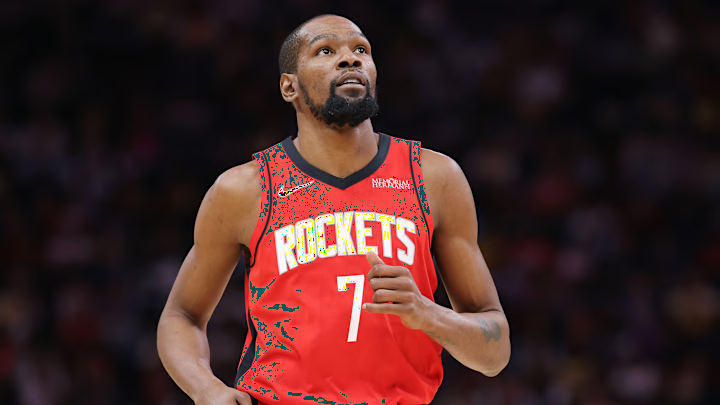
They are 3-4 in their last seven games. Most recently, they dropped a game they were winning with six minutes remaining to the Los Angeles Lakers. After the game, Kevin Durant offered some insight, per ESPN, that explains everything that is wrong with the Rockets right now.
"I just felt like I lost the game for us tonight," said Durant, who scored only two of his 18 points in the second half and committed seven of the Rockets' 24 turnovers. "It's that simple. Of course we probably could make more 3s, but it's on me. I mean, to be honest, I'm the offense and the opposing team is going to use all their resources and not let me get comfortable."
The Houston Rockets are putting too much on Kevin Durant
That last sentence about Durant being "the offense" is what we really want to focus in on. Heading into the season, we always knew that Houston would be a good defensive team that struggled with spacing and ball handling outside of Durant (especially after Fred VanVleet went down for the season).
However, during the early portion of the season, Houston was able to make up for their offensive shortcomings by being arguably the greatest offensive rebounding team in NBA history.
Through their first 40 games of the season, the Rockets had an offensive rebounding rate of 41 percent -- the best mark on record according to NBA.com's database (which extends back to 1996-97). This allowed them to have the third-best offense and fourth-best net rating in the entire league.
Their ability to create second chance opportunties was largely tied to the force and tenacity of Steven Adams. Unfortunately, right around the time we are referencing, he sustained a severe ankle sprain that prematurely ended his season.
Since he went down, Houston's offensive rebounding rate has dropped to an elite, but not historically-great, 36.6 percent. As a result, the Rockets' offensive rating has dropped to 21st in this stretch and their overall net rating is down to a pedestrian 16th.
Without Adams' game-changing presence on the boards, Durant is correct. He is their only hope for offense. Before, Houston had a good thing going. Chuck up a shot and chances are, if it doesn't go in, Adams will nab the ball or create an opportunity for a teammate to do it with his interior gravity.
But now, that is happening far less often. So, their first shot offense is far more important. Meaning that Durant needs to be the one taking a majority of these looks, since he is their best shot-maker.
In theory, given Durant's scoring prowess, this should still create good offense. On the season, Durant is in the 96th percentile in scoring volume and the 88th percentile in scoring efficiency (per Dunks & Threes). Pretty much any shot he creates for himself is great halfcourt offense for the Rockets. So, teams have to send extra attention his way.
This is a similar blueprint to the one the Los Angeles Clippers have been following with Kawhi Leonard since they traded away James Harden. The key difference though is that the Rockets don't have the shooters to really burn teams for playing this way. On the season, the Rockets are 27th in 3-pointers made and 29th in 3-point attempts. So, teams can suffocate Durant without paying the tax that usually comes with this type of coverage.
Even without Adams, Houston is still a good defensive team (eighth in defensive rating). But as our Eamon Cassels' highlighted in a recent post, Alperen Şengün's vertical limitations on that end keep them from being stout enough to make up for a subpar offense.
A good (but not great) defense and below average is hardly the recipe for a deep playoff run, which, whether he knew it or not, is what Durant was trying to tell us with his recent postgame remarks.
More Houston Rockets news and analysis:
 Add us as a preferred source on Google