
Key Points
Bullet point summary by AI
- The Lakers entered the playoffs with questions about their supporting cast, despite a potent offensive trio led by Luka Dončić, LeBron James and Austin Reaves.
- Through two playoff games against the Rockets, Luke Kennard, Marcus Smart and Deandre Ayton have stepped up in huge ways.
- The team's improved depth and complementary play have allowed them to build a 2-0 series lead, buying crucial time to get healthy and margin for error.
No one could deny the Los Angeles Lakers talent coming into this season, the question was fit. Luka Dončić, LeBron James and Austin Reaves made for one of the most potent offensive trios in the league, but they had the potential to be a disaster on defense and vulnerable to packing the paint without complementary shooters. They did their best to address those potential weaknesses in the offseason, with mixed results.
They added Jake LaRavia — a respectable shooter and wing connector who struggled on defense. Marcus Smart — an experienced veteran, relentless point-of-attack defender and 32.4 career 3-point shooter. Deandre Ayton — a talented big man with offensive upside and a penchant for lackluster interior defense. These were the Lakers big offseason roster additions and they all sort of helped ... on paper ... if you kind of squinted right and assumed the rosiest possible outcome. Turning Gabe Vincent into Luke Kennard was at the trade deadline was a win, but again upgrading shooting and playmaking at the expense of defense.
It could all have been a disaster and the results were rocky during the regular season. But through two playoff games, it's working better than the Lakers ever could have hoped.
The Lakers depth has become their biggest strength

The Lakers won the first two games of their series against the Houston Rockets, holding them to 98 and 94 points. Kennard was the story of Game 1, and rightfully so, stepping into the starting lineup and putting up 27 points on just 13 shots. He followed that up in Game 2 with 23 points, 6 rebounds, 2 assists and 3 steals, and has now made 8-of-11 from beyond the arc in the series. His shooting and complementary playmaking has been huge as the Lakers wait for Dončić and Reaves to rehab from injuries. But Kennard isn't the only Laker stepping up.
Ayton scored 19 points on 10 shots in Game 1, along with 11 rebounds. His defense hasn't been exceptional but it's been good enough and, along with Jaxson Hayes, the LA bigs have helped limit the Rockets to just 26 shots per game within eight feet of the basket, shooting just 57.7 percent on those shots. (Houston averaged 34.7 per game during the regular season, making 59.6 percent).
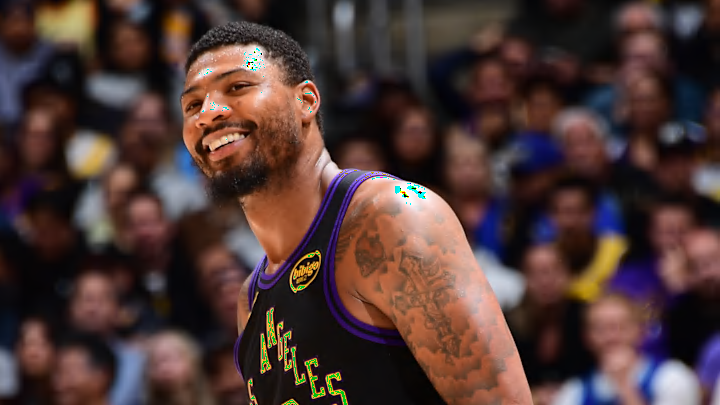
LaRavia was plus-9 in 18 minutes, filling out the box score with 6 points, 3 assists, 2 rebounds, a steal and a block. Smart was terrific in Game 1 with 15 points and 8 assists, and followed that up with 25 and 7 in Game 2. So far in the series, he's 6-of-12 from beyond the arc with 6 steals and 3 blocks. His defense on Kevin Durant snuffed out any offensive rhythm the Rockets tried to muster in Game 2 and reminded fans just how impactful he can be even without the ball in his hands.
Marcus Smart and Luke Kennard send a double team at Kevin Durant… YIKES 🤦♂️ pic.twitter.com/Sxpr7agcBx
— SM Highlights (@SMHighlights1) April 22, 2026
LeBron James is 41 but still plenty good enough to carry the primary creation load when he has a supporting cast shooting this well, and playing this aggressively and connected at the other end of the floor. There are no real updates on Dončić or Reaves and the Lakers could be without them for this entire first-round series, especially if they keep playing like this.
Things will get tougher as the series moves to Houston and the Rockets get another chance to re-integrate Durant. But the formula is finally working for Lakers, they've already given themselves a 2-0 advantage and even if there is some regression to the mean coming they've bought themselves time and a significant margin for error that they didn't appear to have coming into the playoffs.
More NBA news and analysis:
 Add us as a preferred source on Google