
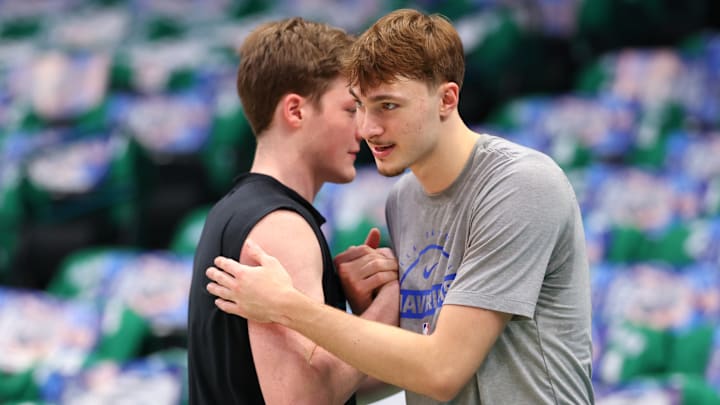
The NBA has officially revealed the full participants for Friday's Castrol Rising Stars, an All-Star Weekend tournament comprised of four seven-player teams — three NBA teams, comprised of the best rookies and second-year players, and one G League team. Austin Rivers will coach the G League team, while Carmelo Anthony, Tracy McGrady and Vince Carter drafted from the 21-player NBA pool.
There are thus 28 participants in total (plus one injury replacement, as of now). Here's what you need to know about each one — and we ranked them, because why not?
29. Sean East II, Salt Lake City Stars
Sean East is a classic point guard, listed 6-foot-3 with jitterbug handles and nifty footwork, which allows him to get where he wants on the floor. He's a solid distributor and a dynamic pull-up shooter, with the sort of in-between game that could spur a rise to the next level one of these days. East is a limited defender and he doesn't offer a ton of standout traits, but his productivity in the G League clearly has him on NBA radars.
28. Mac McClung, Chicago Bulls

Mac McClung has been dominating the G League for a while now, but aside from a few Slam Dunk titles, he hasn't done much at the NBA level. There are real pluses here — McClung is a spring-loaded athlete, a prolific shooter and a high-volume distributor — but small guards tend to get the short end of the stick in today's NBA and McClung is running out of bites at the apple, with no team giving him an earnest shot.
27. David Jones García, San Antonio Spurs
David Jones was an underrated prospect coming out of Memphis, where he led the AAC in scoring as a senior. He has put up monster numbers in Summer League and caught on with a couple NBA teams as a two-way guy, but his opportunities beyond the G League have thus far been limited. That said, there are real pro traits here. Jones is a slick transition scorer and halfcourt slasher, with active hands on defense. If he can stabilize as a 3-point shooter, there's a potential NBA future here.
26. Yanic Konan Niederhauser, Los Angeles Clippers
Yanic Konan Niederhauser as the 30th overall pick in the 2025 NBA Draft, which felt like a substantial reach at the time. A late bloomer at Penn State who rocketed up draft boards after the Combine and individual workouts, Konan Niederhauser is a long, fluid lob threat and shot-blocker, whose athletic traits helped convince scouts in lieu of better foundational stats. NBA reps are predictably scarce in L.A. right now, but the Swiss 7-footer has not his share of dunking, swatting and rebounding in the G League.
25. Ron Harper Jr., Boston Celtics

Ron Harper Jr., son of Bulls legend Ron Harper and older brother of No. 2 pick Dylan Harper, has been around the block a few times, playing 20 NBA games across four pro seasons. He's starting to crack Boston's rotation as the Celtics navigate trades and injuries, but the G League production is elite. He's a prolific shooter with solid connective instincts on the wing. There's a reason he keeps sticking around.
24. Tristen Newton, Houston Rockets
Tristen Newton was part of a special UConn team before becoming the 49th overall pick in 2024. He has bounced between a couple NBA teams, spending most of his time in the G League, but 6-foot-5 guards with Newton's feel and stat-stuffing capacity don't grow on trees. He's a poised distributor with a scalable offensive skill set and active hands on defense. If he can start hitting 3s with more consistency, there's an NBA path.
23. Alijah Martin, Toronto Raptors
Alijah Martin was essential to Florida's national championship run last March before coming off the board 39th overall to Toronto in the 2025 draft. He was No. 43 on FanSided's final big board. Martin is an energizing defender who plays much taller than his listed height on both ends. More of a connector than a point guard, Martin has proven that he can bury 3s, score on cuts, and make the right passing reads in the flow of an offense.
22. Yang Hansen, Portland Trail Blazers

Portland's decision to select Yang Hansen 16th overall was truly shocking, but he became a fast fan favorite in Summer League with his Jokić-lite court vision and feather-soft touch around the rim. There's a lot of fun potential here given Yang's court-mapping and playmaking utility at the five. He needs to get stronger and more dexterous, and prove he can handle the rigors of NBA defense, but he's doing more than enough in the G League to win over Blazers fans.
21. Egor Dëmin, Brooklyn Nets
Egor Dëmin has buried the shooting concerns that plagued him at BYU, but it's still difficult to justify Brooklyn's decision to invest with the eighth overall pick. Dëmin occupies a compelling archetype as a 6-foot-8 "point forward," but he struggles to turn the corner and score efficiently inside the arc. He's also a weak link on defense. Right now, he's mostly a solid spot-up shooter playing outsized minutes on a bad team. That's enough for Rising Stars recognition, but Dëmin has a lot to prove before he's a foundational piece in Brooklyn.
20. Jaylen Wells, Memphis Grizzlies
Jaylen Wells was basically an immediate fixture in the Grizzlies' starting lineup after being selected 39th overall in 2024. He finished third in Rookie of the Year voting, one of the best NBA storylines last season, and has largely maintained his production in year two. Wells' efficiency is down a hair, but he's a versatile off-ball scorer and a committed defensive stopper on the wing. Memphis threw a dart in the second round and came up with an everyday rotation wing, which is just good business.
19. Jeremiah Fears, New Orleans Pelicans

Jeremiah Fears is an elite conceptual prospect. He moves and acts like a future star, with an explosive first step, shifty handles and effervescent creativity. He needs to improve as a defender and up his scoring efficiency, but the tools are all readily apparent watching him command the offense. New Orleans has smartly let Fears test his powers by trial and error. He's probably a couple years away from really breaking out, but the numbers are impressive for a rookie and he should put on a nice show in the Rising Stars setting.
18. Tre Johnson, Washington Wizards
Tre Johnson was an elite shooting prospect at Texas, which has carried right over to the NBA. Johnson's dynamism on- and off-ball gives him a clear role as Washington attempts to thread the needle between a bright young core and a more immediate win-now timeline, led by Anthony Davis and Trae Young. There are still questions in need of answering on defense, and he's not much of a facilitator, but the man gets buckets. Plain and simple.
17. Collin Murray-Boyles, Toronto Raptors
Collin Murray-Boyles has embraced a chameleonic role in the Raptors frontcourt, oscillating between small-ball center and bulldozing power forward. He's a slick interior scorer and connective passer, showing essential, rapid growth as a 3-point shooter. CMB butters his bread on defense, though, with the agility to guard out on the perimeter and the blend of strength, athleticism and instincts necessary to anchor the interior, too. He's still putting all the pieces together, but Murray-Boyles' physicality and IQ put him on a lofty track.
16. Kel'el Ware, Miami Heat

Kel'el Ware has overcome the standard work ethic questions of an underperforming five-star recruit to emerge as a pivotal cog in Miami's rotation (and the centerpiece of Giannis trade rumors). Ware can be hit-or-miss as an interior enforcer on defense, but he's inhaling rebounds on both ends at a staggering rate. He's also hitting 40.1 percent of his 3s, catching lobs, and flashing the sort of dexterous face-up scoring that has some Heat fans convinced Ware is a future All-Star.
15. Cedric Coward, Memphis Grizzlies
Cedric Coward began his college career at D-III Willamette before spending two years at Eastern Washington. He transferred to Washington State as a senior, only to suffer a season-ending injury after six games. Rather than spend a fifth collegiate season at Duke, Coward declared for the draft and rose throughout the Combine and workout process, with Memphis rolling the dice 11th overall. That gamble has paid off. Coward is an effective spot-up shooter and wing connector whose pterodactyl wingspan leads to impressive moments on defense. Memphis' scouting department stays winning.
14. Dylan Harper, San Antonio Spurs
Dylan Harper's rookie season has not gone exactly to plan, but patience is an important virtue in Spurs fandom. A crowded backcourt and a real spacing crunch has made it difficult to Harper to establish himself on a contending team, but the talent is wildly evident. Harper lives at the rim, able explode downhill and slice through the defense with a strong, aerodynamic frame. He can change speed and direction on a dime. The finishing package is excellent. If Harper can't shoot 3s, it's going to make life a little difficult on San Antonio. But he's a good player and his moment in the sun will arrive soon enough.
13. Cam Spencer, Memphis Grizzlies

Cam Spencer went from Loyola to Rutgers to UConn, where he won the national championship as a senior. Memphis made him the 53rd overall pick, another credit to their ability to locate obvious NBA talent hiding in plain sight. Spencer was never a glitzy athlete, but he's not a stick in the mud either, and his competitive verve is top notch. He's also an elite spot-up shooter and a high-feel connective piece off the bench, morphing into a legitimate pick-and-roll facilitator as Memphis refocuses its timeline. Spencer was a winning player in college and he's a winning player in the NBA. How we didn't all realize this is unclear.
12. Derik Queen, New Orleans Pelicans
The Pelicans gave up their unprotected 2026 first-round pick to move up 10 spots, from No. 23 to No. 13, and draft Derik Queen. It was an all-time unforced error from the Joe Dumars front office, but Queen has rewarded their faith with a supremely fun and highly encouraging rookie season. Queen exhibits some genuine star traits on offense as a big-bodied slasher and funky, off-beat finisher who occasionally doubles as a point center, essentially giving New Orleans its Zion-lite. He's a better defender than he gets credit for and if he can start hitting 3s with any regularity, the sky is the limit. He was not worth potentially missing out on Cam Boozer or Darryn Peterson, but Queen has at least made the trade a little bit more palatable for dismayed Pelicans fans.
11. Donovan Clingan, Portland Trail Blazers
Donovan Clingan is an excellent nuts-and-bolts defensive anchor for Portland. Listed at 7-foot-2 and 280 pounds, Clingan is an impossibly large human, and he uses those broad shoulders and gaping arms to effectively wall off the paint. He's a top-shelf rim deterrent, fundamentally sound and properly scary to opponents attempting to drive the lane. He inhales rebounds on both ends. He's an efficient rim finisher and now, all of a sudden, a credible spot-up shooter on the perimeter, which was not in his bag at all in college. Clingan won't self-create, he's not a star in the traditional sense, but he's one hell of a star in his role, with more room to grow.
10. Kyshawn George, Washington Wizards

Kyshawn George has quietly become an essential piece to the puzzle in DC, offering a prototypically modern skill set on the wing. His 2-point efficiency still isn't great, as George lacks burst and physicality attacking the rim, but he's a proper volume shooter with secondary playmaking chops. Perhaps his best attribute right now, however, is defense. George uses his length to full effect, mucking up passing lanes and sticking to a variety of matchups on the perimeter. If the Wizards are actually contending next season, George will play a huge role in that ascent as the glue between AD and Trae Young.
9. Matas Buzelis, Chicago Bulls
Matas Buzelis has emerged as the Bulls' best defender — a hellacious weak-side shot blocker. He was in the Dunk Contest last year for a reason; Buzelis can get off the floor and he's extremely coordinated, with perfect size and mobility for a big wing. He's starting to put it all together on offense, too. The Chicago native has upped his 3-point volume, he's a more willing and able passer, and he's slowly adding strength to help finish around the rim. Every team wants a 6-foot-9 guy who can impact both ends like Buzelis. He's one of the few bright spots on the Bulls team right now.
8. Alex Sarr, Washington Wizards
After a borderline disastrous rookie campaign, Alex Sarr has really come into his own as a sophomore. He put up numbers as a rookie, but this season Sarr is playing winning basketball. He's tapping into the full breadth of his defensive skill set, switching all over the floor and erasing shots from the weak side. On offense, he's cutting out low-quality attempts, taking fewer 3s and improving his 2-point percentage by almost nine ticks. He's a fun passer. There is still tantalizing perimeter skill. Of all the young dudes in Washington, Sarr probably benefits the most when Davis and Young join the fray next season.
7. Jaylon Tyson, Cleveland Cavaliers

A quiet rookie season left folks unprepared for this kind of leap from Jaylon Tyson, who's suddenly an essential starter for a team with championship aspirations in the East. Tyson checks all the right boxes. He's a versatile, high-energy defender. He's a slick drive-and-kick weapon on the wing, hitting 47.8 percent of his 3s this season, for good measure. A bit of shooting regression will hit eventually, but Tyson is such a versatile, scalable cog in this Cleveland lineup. He's a Most Improved Player candidate and one of the most underrated performers in the league right now.
6. Reed Sheppard, Houston Rockets
Reed Sheppard was buried on the Rockets bench as a rookie, but the Fred VanVleet injury opened the door to a consistent role, which Sheppard has taken full advantage of. Sheppard was a somewhat unique top-3 pick, but historically great shooting at Kentucky, paired with incredible stock rates and defensive metrics, allowed Houston to look past a smaller frame. Sheppard is a prolific shot-maker and a functional backup point guard, exhibiting advanced feel for the game and elite instincts on defense, even if he's a weaker link in one-on-one situations.
5. Ajay Mitchell, Oklahoma City Thunder
Sam Presti can't keep getting away with it, and yet, he does. OKC made Ajay Mitchell the 38th overall pick in 2024, only for him to gradually carve out a role and provide essential bench support in the Finals. Now, he's the frontrunner for Sixth Man of the Year — a dynamic downhill scorer with a deep bag of tricks, and the perfect fit for OKC's relentless drive-and-kick offense. Mitchell blends his explosiveness with elite deception, able to shift gears and carve out space with robust footwork on the block. He's a solid distributor and another chaos agent in OKC's unrivaled battalion of perimeter defenders. Chalk up another draft win for the Thunder.
4. VJ Edgecombe, Philadelphia 76ers

VJ Edgecombe has been a full-blown miracle for the Sixers, who desperately needed a shot in the arm after last season's journey of the soul. Edgecombe still needs to progress as a ball-handler and finisher, but he's already such an impactful fourth option on a winning team. Edgecombe explodes up the floor in transition, he's a sharp connective passer, he has some Wade-esque flourishes in the halfcourt, and he's already Philadelphia's best perimeter defender by a comfortable margin. The intangibles and mental makeup are off the charts. Edgecombe is such a clear star in the making, with all the traits you'd want in a long-term organizational pillar. If this is another lost season, at least Philly found this guy.
3. Stephon Castle, San Antonio Spurs
Stephon Castle won Rookie of the Year by a comfortable margin and has only built on that success as an NBA sophomore. San Antonio's backcourt logjam is definitely a problem, and Castle still takes a backseat to De'Aaron Fox, but too many quality guards is not a bad problem. Castle is still an inconsistent shooter on the perimeter, but he's a deadly slasher and an improving facilitator, with the defensive chops to stick around in a smaller role, depending on how this Spurs roster evolves. Castle is another plus-plus intangibles guy and the Spurs' track record of player development is sparkling, which means good things lie ahead for Castle.
2. Kon Knueppel, Charlotte Hornets
Kon Knueppel arrived in Charlotte with the air of a 10-year NBA vet. He was always going to produce straight out of the gate, but the scale of Knueppel's impact caught many by surprise. If the season ended today, he'd have a strong case for Rookie of the Year — an elite volume shooter with real playmaking chops and an underrated dribble-drive game, which was on full display at Duke for those able to look beyond the Cooper Flagg show. Knueppel can fit within practically any scheme, any lineup. He has set the bar extremely high, with room left to grow.
1. Cooper Flagg, Dallas Mavericks

A recent string of four straight 30-plus point games (including 49 points in a head-to-head battle against Knueppel and Charlotte) was proof enough that Cooper Flagg has entered the Matrix. He's got this thing figured out. Always a high-energy defender and strong offensive connector, Flagg is now obliterating teams in isolation. He has counters for everything the defense throws at him. He's not even two months past his 19th birthday, yet Flagg is processing the game so much faster than the majority of his opponents. Like at Duke, Flagg just needed a third of the season to get his bearings. Now he has arrived at full-fledged stardom, and this is just the beginning.
More NBA Draft news and analysis:
 Add us as a preferred source on Google