
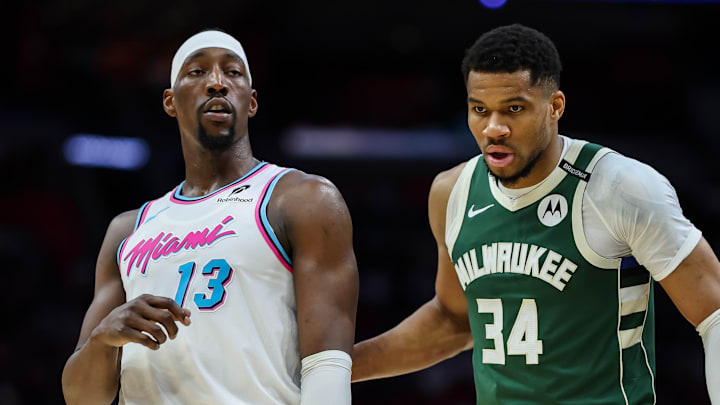
Giannis Antetokounmpo and the Milwaukee Bucks hold the keys to the 2026 NBA Trade Deadline. It is, of course, entirely possible that the Bucks simply hold off on moving the currently injured Antetokounmpo before Feb. 5, but the former MVP is clearly the biggest domino that could move. In addition to the clear implications for Milwaukee, there are down-ballot impacts on other teams who may not want to make other moves in preparation for Antetokounmpo becoming available.
One such team is the Miami Heat. Miami has always been interested in adding big-name talent, dating all the way back to the well-chronicled "Heatles" era with LeBron James, Chris Bosh, and incumbent star Dwyane Wade. The Heat are seemingly always on the list for superstars who might change teams, and a recent example is a months-long daliance with Damian Lillard before he ended up in Milwaukee.
As such, the Heat are a potential sleeping giant for Antetokounmpo, but there also might be an argument against Miami putting everything it can offer on the table for the Greek star. Giannis is only 17 months from potential free agency after the 2026-27 season, with the Heat potentially able to set things up to lure him without having to give up anything in terms of trade capital. Granted, 17 months is a lifetime in the NBA, but a similar situation from decades past could foreshadow things for Miami.
Comparing Giannis-to-Miami and Carmelo-to-NY
In 2011, the New York Knicks traded a considerable package to lure Carmelo Anthony. The results were pretty strong for Anthony in New York, including a 54-win season in 2012-13, but there has been a long-held debate about whether the Knicks gave up too much and/or whether they simply could have waited a few more months and signed Anthony in free agency.
The Knicks gave up Danilo Gallinari, Wilson Chandler, Raymond Felton, Timofey Mozgov, and a bevy of future draft capital that included an eventual lottery pick in 2014 and a 2016 pick swap that eventually landed Jamal Murray in Denver. That is a king's ransom by any description and, while the Anthony era did go well, New York's roster was weakened because of what they sent out in the deal.
Of course, that does not mean that the Heat should refrain from considering a trade for Giannis, as he remains one of the best players in the NBA and a potential franchise changer for any organization that lures him. With that said, the worry for Miami might be that the price is so high that having Giannis, along with only the remaining talent on the roster, would not be enough to seriously challenge at the top levels of the sport.
The Heat might be able to work a deal without having to give Bam Adebayo, Tyler Herro, or Norman Powell, which would mean adding an MVP and having a real "top four" to build around. In that scenario, players like Kel'el Ware, Jaime Jaquez, and/or Nikola Jovic would probably wind up going elsewhere, but one could at least argue that Miami would be in a better place than Milwaukee currently is with Antetokounmpo. It is also worth noting that, well, the current Bucks are nowhere near good enough to contend for a championship, leading to this potential impasse in the first place.
Still, there are potential lessons to draw from what happened with Anthony and the Knicks. For a player on the level of Antetokounmpo, it is easy to argue that giving up a "kitchen sink" package is justified. After all, there is no equivalent in the NBA world to a dominant, tent-pole player in the middle of the operation. It would be wise for Miami to consider the next steps, though, as giving the future and the present for a 31-year-old Antetokounmpo might be more trouble than its worth without the ability to put a title-contending support cast around him.
More NBA news and analysis:
 Add us as a preferred source on Google