
Key Points
Bullet point summary by AI
- The NBA Draft Combine's measurements this week will test vertical leaps and wingspans against historic benchmarks.
- Some past outliers have seen little NBA success, while others became key contributors despite modest numbers.
- This year's class will be compared to legends, with debates sure to arise over which numbers truly matter.
The NBA Draft combine lasts for a week and includes all sets of events — biometric and athletic measurements, 5-on-5 scrimmages, media availabilities, skill testing and more. But even with all that rigamarole they bit that draws the most attention is the player measurements, max vertical leap and wingspan in particular.
These measurements, by themselves, don't have much to do with a player's succcess or failure in the NBA. But when wrapped in with the rest of a player's draft profile a surprisingly strong (or poor) measurement can make or break a prospect's draft stock. This is expected to be a historically talented draft class but there are no obvious outliers we expect to join these historic lists.
Combine measurements will be announced throughout the day on Tuesday, May 12, and these are the legends (both famous and infamous) that the 2026 class will be compared to.
Biggest vertical leaps in NBA Draft Combine history
PLAYER | MAX VERT | YEAR |
|---|---|---|
1. Keon Johnson | 48.0 in. | 2021 |
2. Kenny Gregory | 45.5 in. | 2001 |
3. Hamidou Diallo | 44.5 in. | 2017 |
4. Jericho Sims | 44.5 in. | 2021 |
5. Pat Connaughton | 44.0 in. | 2015 |
6. Kay Felder | 44.0 in. | 2016 |
7. Shane Larkin | 44.0 in. | 2013 |
8. Cassius Stanley | 44.0 in. | 2020 |
9. Tyler Bey | 43.5 in. | 2020 |
10. Tim Bowers | 43.5 in. | 2004 |
Clearly, there's not an enormous correlation between raw leaping ability and NBA success. Hamidou Diallo and Jerico Sims have both competed in Slam Dunk Contests but Connaughton is the only player on this list with an actual NBA career to speak of — averaging 5.8 points, 3.3 rebounds and 1.3 assists per game across 11 seasons with the Trail Blazers, Bucks and Hornets.
Let's also take a moment to pour one out for Kenny Gregory — a legendary leaper who had the misfortune of playing basketball before the advent of short-form video and social media. He played four years for Kansas, making a pair of All-Big-12 teams, but never caught on in the NBA. All we're left with of his dunking exploits is footage like the 1997 McDonald's High School All-American Dunk Contest.
Smallest vertical leaps in NBA Draft Combine history
PLAYER | MAX VERT | YEAR |
|---|---|---|
Mike Smith | 21.0 in. | 2000 |
Pavel Podkolzin | 22.5 in. | 2003 |
Nikola Vucevic | 25.0 in. | 2011 |
Uche Okafor | 25.0 in. | 2002 |
Dakari Johnson | 25.0 in. | 2015 |
Jackie Butler | 25.0 in. | 2004 |
Nick Sheppard | 25.5 in. | 2000 |
DeSagana Diop | 25.5 in. | 2001 |
Nate Williams | 26.0 in. | 2004 |
Jared Reiner | 26.0 in. | 2004 |
Lazaros Papadopoulos | 26.0 in. | 2001 |
As you'd expect the players with the smallest vertical leaps ever are usually plodding big man who win with size and strength rather than explosive athleticism. There aren't a ton of household names here but it is interesting to see Nikola Vučević who has played 15 seasons for the 76ers, Magic, Bulls and Celtics, averaging 17.1 points and 10.3 rebounds per game for his career.
Biggest wingspans in NBA Draft Combine history
PLAYER | MAX VERT | YEAR |
|---|---|---|
Tacko Fall | 8-foot-2.25 | 2019 |
Zach Edey | 7-foot-10.75 | 2024 |
Zach Edey | 7-foot-10.5 | 2023 |
Mo Bamba | 7-foot-10 | 2018 |
John Riek | 7-foot-8.75 | 2008 |
Rudy Gobert | 7-foot-8.5 | 2013 |
Mouhamed Sene | 7-foot-8.5 | 2006 |
Chris Marcus | 7-foot-8 | 2003 |
Zhou Qi | 7-foot-7.75 | 2016 |
Doug Wrenn | 7-foot-7.5 | 2003 |
Tacko Fall was simply enormous and the difference between his wingspan and the second-biggest ever measured at the combine is the same as the difference between the second-biggest and the 10th-biggest. There are a few caveats here, though. First, we have Zach Edey appearing twice — he declared for the draft and went through the combine in 2023 before opting to return to Purdue for his senior season. He grew enough that his wingspan increased by a quarter of an inch in that year.
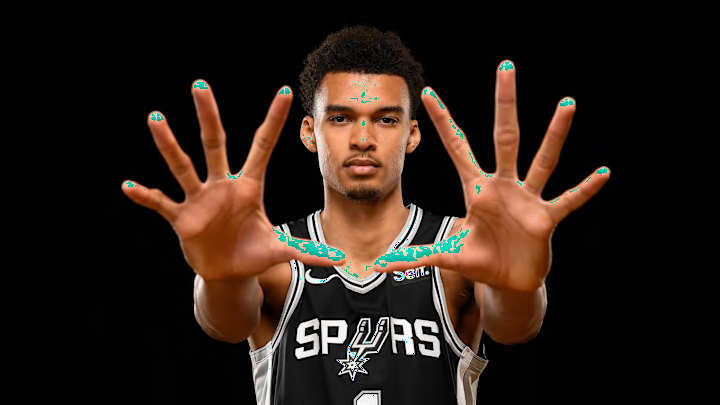
The other callout is that many prospects don't appear at the combine and get measured. For example, Victor Wembanyama has been measured with an 8-foot wingspan, which would be the second-biggest in combine history. But he wasn't actually measured at the combine so it doesn't appear on our list here.
Smallest wingspans in NBA Draft Combine history
PLAYER | MAX VERT | YEAR |
|---|---|---|
Pierre Jackson | 5-foot-10 | 2013 |
Shaheen Holloway | 5-foot-10 | 2000 |
Shane Larkin | 5-foot-10.75 | 2013 |
Teddy Dupay | 5-foot-10.75 | 2002 |
Omar Quintero | 5-foot-11.5 | 2004 |
T.J. Ford | 5-foot-11.5 | 2003 |
Daryl Dorsey | 5-foot-11.5 | 2005 |
Steve Logan | 5-foot-11.75 | 2002 |
Travis Diener | 5-foot-11.75 | 2005 |
John Lucas III | 6-foot-0 | 2005 |
Little guards with T-Rex arms and TJ Ford is the only one here who had a meaningful NBA career. You can also see how teams have increasingly valued backcourt size over the past few years, with the tiny point guard archetype slowly fading out. No one in the top-10 went through the combine in the last decade and just two players came through the past 20 years.
More NBA news and analysis:
 Add us as a preferred source on Google