
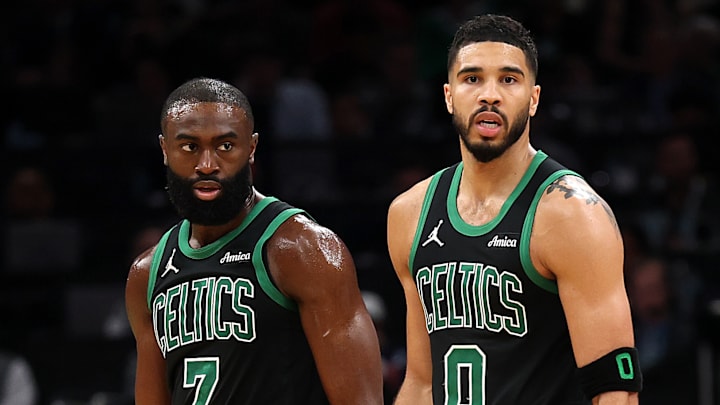
There's no denying that the Boston Celtics have exceeded any and all expectations this season. Boston's preseason over-under was set at 41.5 wins -- they have almost cleared this number already with 39 wins. Furthermore, they are on pace for just seven fewer wins than last season. Doing so with the loss of five key rotational players, including Jayson Tatum, is truly an amazing feat.
Jaylen Brown is playing at an MVP level, averaging 29.2 points while being a true two-way force. Joe Mazzulla is also proving that he is one of the league's elite coaches. In addition to the Celtics' success in the standings, they rank top 10 for both offensive and defensive rating, including ranking second for ORTG, a clear testament to Mazzulla.
The Ewing Theory is a phenomenon popularized by Bill Simmons in which a team performs better without its star player. Ironically, people are now wondering if this theory applies to Tatum and Simmons' favorite team. But I don't think this is a fair claim.
The Celtics' success without Jayson Tatum shouldn't be a negative reflection of him
At the surface level, the Celtics are marginally worse (with their offense being statistically better) without Tatum, and Brown looks to be every bit of an elite first option. As such, I get why people are wondering if Tatum was all that to begin with. However, I also think this statement is an overgeneralization that misses the forest for the trees.
What has always made the Celtics so dangerous is the Jays, not just Tatum. A common misconception about the Celtics is that their offense is centered solely around 3-pointers. Yes, they have shot 3s at a historical rate since Mazzulla took over, but the reality is that his system is built around advantage creation and exposing mismatches. Oftentimes, this results in open 3s, but their system is around attacking mismatches, drawing double teams, and creating efficient shots.
"[The Celtics] absolutely are the biggest surprise. ... You've got Jaylen Brown operating at an MVP level, and the Joe Mazzulla system that really thrives in mismatches."
— NBA on ESPN (@ESPNNBA) February 19, 2026
—@chiney on the Celtics' success even without Jayson Tatum 👀 pic.twitter.com/fOZOGfVh7d
This system has always empowered both Tatum and Brown as primary creators while surrounding them with elite spacing, and it helped them win the championship two years ago. Many teams have built similar offensive systems in the modern NBA, but none of them work to the degree that Boston's does. My point is that the Celtics' system was never overly reliant on Tatum; it was built around both star wings.
Throughout his career, Brown has routinely stepped up when Tatum has been sidelined. Leading up to this season, he had averaged 28.1 points in the Mazzulla era during games where Tatum was out. The system was always built to maintain success if one of these stars were out. As such, should it be this shocking that the Celtics offense has remained elite?
Now, if you're a Tatum skeptic, you might not be convinced by this argument. I can hear you saying: Exactly, he was always a product of a great system.
But the truth is, Tatum has proven he can be successful in multiple systems. The first year he made an All-NBA First Team and NBA Finals appearance was under Ime Udoka -- which was a wildly different offensive system. So was Brad Stevens' system, where Tatum blossomed into stardom. Tatum is one of the most malleable stars in the league, and his success in three different systems is proof of this.
On top of Mazzulla's system, he deserves credit for developing diamond-in-the-rough players, including Neemias Queta, Baylor Scheierman, and Jordan Walsh.
You can give Mazzulla credit for building a perfect system and Brown credit for leveling up his game (again) without viewing Tatum in a different light. And despite the Celtics' remarkable season, they won't come close to sniffing another championship if Tatum doesn't return.
The parallels between the 1993-94 Bulls and the 2025-26 Celtics

This is going to sound like a crazy comparison, but please stay with me for a second. When Michael Jordan left the Chicago Bulls to play baseball in 1993-94, they won two fewer games. Scottie Pippen looked like a true No. 1 option, and they defied all expectations. However, they lost in the second-round of the playoffs.
To get back to their championship standards, they needed Jordan. During Jordan's first full season back, they won a record-breaking 72 games and won their fourth championship.
Today, nobody looks back at this regular season success without Jordan as a knock on his legacy -- at least they shouldn't. The truth is that great players often benefit from great systems. It's also simply easier to build an effective system around elite players.
To be clear, I'm not saying that Tatum is Jordan -- that would be very far-fetched. Nevertheless, the 1993-94 Bulls are the closest comparison we have to this year's Celtics squad. Both Tatum and Brown are capable of having high-level regular-season success without the other. Still, much like Jordan and Pippen, they need each other to win at the highest level, and in my eyes, that shouldn't be a detriment to them as great players.
More Boston Celtics news and analysis:
 Add us as a preferred source on Google