
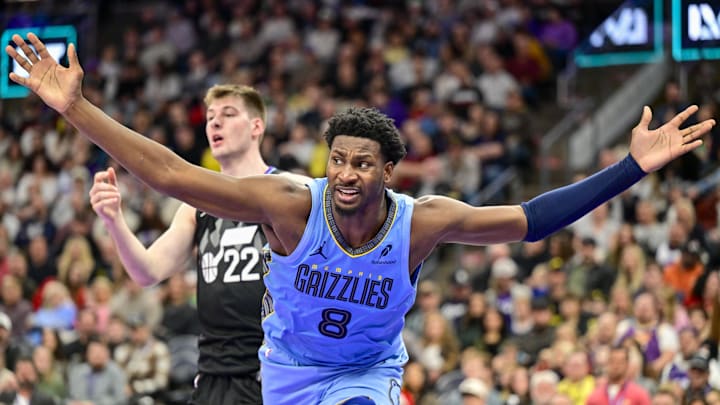
The Utah Jazz rocked the NBA with an out-of-nowhere trade Tuesday.
BREAKING: The Memphis Grizzlies are trading star forward Jaren Jackson Jr., John Konchar, Jock Landale and Vince Williams Jr. to the Utah Jazz for Walter Clayton Jr., Kyle Anderson, Taylor Hendricks, Georges Niang and three future first-round picks, sources tell ESPN. pic.twitter.com/ax6oQpZx0S
— Shams Charania (@ShamsCharania) February 3, 2026
According to longtime NBA insider Jake Fischer, the Jazz are trading the most favorable of their 2027 first-round picks, the Cleveland Cavaliers' 2027 first-round pick or the Minnesota Timberwolves' 2027 first-round pick along with a top-four-protected 2027 first-round pick from the Los Angeles Lakers and a fully unprotected 2031 first-round pick from the Phoenix Suns. They're also including Walter Clayton Jr., whom they selected 18th overall in this past year's draft, and Taylor Hendricks, the No. 9 overall pick in 2023.
The Jazz can't pay everyone

The Jazz have by far the NBA's worst defense this year. Jackson, a two-time blocks champion and the 2022-23 Defensive Player of the Year, will help fix that. However, his arrival in Utah raises more questions than answers given the current state of the roster.
The biggest one: Is this a precursor to a Walker Kessler trade between now and Thursday's trade deadline?
Jackson signed a new four-year, $205 million contract as part of a renegotiation and extension with the Memphis Grizzlies this past summer. He'll go from earning $35 million this season to $49 million next year. Lauri Markkanen will also earn roughly $46.1 million in 2026-27, so those two alone will account for more than $95 million next season.
The Jazz also have two young players who are rapidly approaching new contracts. Kessler is set to become a restricted free agent this offseason, while Keyonte George will become extension-eligible. Of the two, the Jazz figure to prioritize George, who's averaging a career-high 24.2 points, 6.6 assists, 4.0 rebounds and 1.1 steals per game this season.
If he sustains that level of production moving forward, George might be looking at a max or near-max contract. It's too early to accurately project what a max contract will cost in 2027-28, but a max deal in 2026-27 for someone with 0-6 years of NBA experience is currently projected to start at around $41.5 million. Add that to Markkanen and Jackson, and the Jazz would already have more than $135 million tied up in those three alone.
That brings us back to Kessler. The typical price tag for a solid starting center is mostly hovering between $20-25 million annually. Ivica Zubac and Naz Reid landed in that range, while Jarrett Allen, Myles Turner and Jakob Poeltl fetched slightly more. With the salary cap projected to rise by at least $10 million this offseason, a $25 million annual salary may be Kessler's floor heading into negotiations.
Much like the Grizzlies just did with Jackson, the Jazz could always re-sign Kessler this offseason with the intention of trading him down the road. It's unrealistic to expect them to be able to afford all four of Jackson, Markkanen, George and Kessler long-term, though.
What was the hurry?

That begs the question: Why did the Jazz feel the need to swing a blockbuster now?
George's contract is expiring, while Anderson's is fully non-guaranteed next season, so they might have felt pressure to make use of those deals while they still could. They were poised to have a ton of financial flexibility in the offseason, though.
Spotrac's Keith Smith initially projected the Jazz to have nearly $50 million in spending power this summer. He now expects them to operate as an over-the-cap team. Perhaps the Jazz weren't high on the 2026 free-agent class, but they could have used that cap space to facilitate trades as well.
George won't turn 23 until November. Bailey is still 19. Kessler is turning 25 in July. Markkanen, who turns 29 in May, is the only member of their core who's on the older side. The Jazz still had time working in their favor.
Jazz will have a tougher time improving via the NBA Draft than expected

Beyond the financial balancing act that this trade will force the Jazz to endure over the coming months, this also puts them in a tricky spot for the rest of this season. They owe their 2026 first-round pick to the Oklahoma City Thunder if it lands outside the top eight. They currently have the NBA's sixth-worst record, although the Grizzlies could enter free fall in the wake of this deal.
If the Jazz do finish with the sixth-worst record, they'd have a 96.2 percent chance of keeping their pick this year, per Tankathon. If they drop to seventh-worst, they'd have a roughly 86 percent chance of keeping it. And if they drop to eighth-worst, they'd have just over a 60 percent chance.
Unless Jackson develops a mysterious ailment upon his arrival in Utah, this trade should immediately make the Jazz better. Jock Landale is having a career year and could give the Jazz some much-needed insurance at center, particularly if they're open to moving Jusuf Nurkić between now and Thursday's trade deadline. Vince Williams Jr. is on a near-minimum contract for the next two years and shouldn't be overlooked in this deal, either.
If the Grizzlies, Milwaukee Bucks and/or Dallas Mavericks pass the Jazz in the race to the bottom of the standings, it could have devastating consequences for their chances of keeping their 2026 pick. That's another potential drawback of doing this deal now rather than in the offseason.
The Jazz might have felt urgency to accelerate their rebuild given how well George and Markkanen are playing this year, but this trade is bound to have domino effects on the rest of their roster.
More NBA news and analysis:
 Add us as a preferred source on Google