
Key Points
Bullet point summary by AI
- Michigan reaches the Final Four led by three future NBA draft picks and a dominant frontcourt.
- The Wolverines face a high-stakes battle against top-ranked Arizona, featuring a clash of giant centers.
- This run marks a dramatic shift from 2018, with superior size and a more potent offense under second-year coach Dusty May.
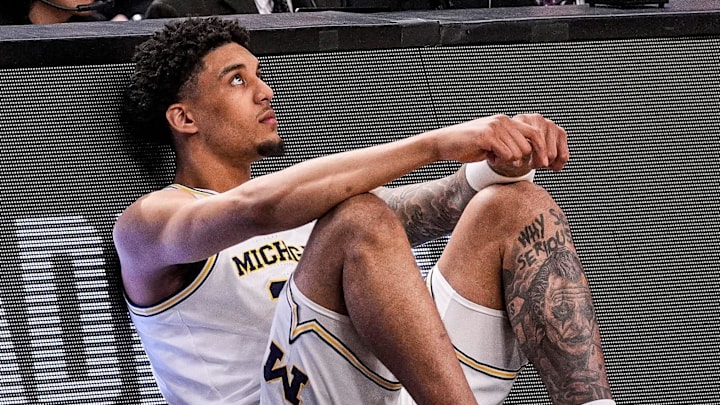
Michigan dances into the Final Four after back-to-back commanding victories over Alabama and Tennessee on the second weekend of March Madness. The Wolverines are a talented, experienced bunch, led by three future first-round picks, including senior forward and potential Wooden Award finalist Yaxel Lendeborg.
The Wolverines will face fellow No. 1 seed Arizona, a battle of (literal) giants. Aday Mara (7-foot-3) versus Motiejus Krivas (7-foot-2) at center. Yaxel Lendeborg (6-foot-9, 230 pounds) versus Koa Peat (6-foot-8, 250 pounds) on the wing. Arizona ranks fourth in offensive efficiency and first in defensive efficiency, per KenPom. Michigan ranks sixth and second, respectively. This is the best matchup of the college basketball season to date.
When's the last time Michigan made the Final Four?

Michigan's last Final Four run came in 2018, in John Beilein's penultimate season as Wolverines head coach. Moritz Wagner led a talented roster full of future NBAers, including Duncan Robinson, Jordan Poole and Isaiah Livers.
It was an incredibly fortunate bracket for No. 3-seed Michigan, who didn't face a seed higher than No. 6 until the championship game, which it lost to No. 1-seed Villanova, 79-62. Robinson, Poole and Michigan's ancillary gunners all went cold. Aside from Wagner and senior point guard Muhammad-Ali Abdur-Rahkman, the Wolverines' all-time leader in games played, Michigan couldn't muster much offense against Nova's top-ranked defense. Mikal Bridges, Donte DiVincenzo and Omari Spellman weren't easy to score back in the day.
A year later, Michigan lost to Texas Tech in the Sweet 16. Beilein was subsequently hired as head coach of the Cleveland Cavaliers, one of the more ill-fated decisions in recent memory. Michigan hired ex-Wolverine star Juwan Howard to replace Beilein, which lead to five turbulent years in Ann Arbor. In 2024, current head coach Dusty May was hired from Florida Atlantic upon Howard's exit.
Michigan basketball's March Madness history: Best runs in program history

NCAA Tournament appearances | Elite Eight appearances | Final Four appearances | NCAA Championship appearances | NCAA Championship victories |
|---|---|---|---|---|
33 | 16 | 9 | 7 | 1 |
This is Michigan's third Final Four run since 2013 (2013, 2018 and 2026). Both previous berths ended with a loss in the title game.
Trey Burke was the ringleader back in 2013, but his memorable tournament run ended with 24 points in a heartbreaking 82-76 loss to Rick Pitino's Louisville. From that team, Burke, Nik Stauskas, Glenn Robinson III, Tim Hardaway Jr. and Caris LeVert all went on to noteworthy NBA careers.
Michigan's lone championship victory came all the way back in 1989, when the Wolverines defeated Seton Hall in an 80-79 thiller. Futue Hall of Famer Glen Rice led the way with 31 points and 11 rebounds, earning the tournament's Most Outstanding Player award. Fellow guard Rumeal Robinson chipped in with 21 points and 11 assists.
Perhaps the most memorable of Michigan's March Madness exploits, however, came in 1992 and 1993, when the "Fab Five" — Chris Webber, Jalen Rose, Juwan Howard, Jimmy King and Ray Jacksen — arrived on campus and set the college basketball world ablaze. All five members of that illustrious core went on to have NBA careers, with Webber, Howard and Rose all becoming lottery picks down the road.
With five freshman starters in 1992, Michigan stormed all the way to the championship round as a No. 6 seed, only to lose 71-51 to Duke. The Wolverines couldn't buy a shot from the perimeter.
The next year, Michigan's Fab Five was right back in the NCAA Tournament, this time as a No. 1 seed. The Wolverines needed two OT victories — over UCLA in the second round and Kentucky in the Final Four — to reach the championship round, but it ended with another loss in the final, this time 77-71 to North Carolina. Webber and Riley both left for the NBA months later.
What changed for Michigan between 2018 and 2026 Final Four runs

Yaxel Lendeborg has already said he wants the 2026 Wolverines to represent the greatest basketball team in Michigan history. In order to join that conversation, the Wolverines need to run the table and bring a second championship to Ann Arbor. If Michigan goes the distance, it will be hard to refute Lendeborg's bold statement.
Michigan is certainly better equipped to finish the deed now than they were eight years ago. That Wolverines team was simply dominant on defense (No. 3 nationally, per KenPom) but the offense (No. 35 nationally) was far less potent.
The Wolverines pack a lot of size right now. That 2018 team had its share of size and physicality. Mo Wagner was an absolute monster at the college level. It pales in comparison to what Michigan is working with this time around, though. Aday Mara anchors the paint at 7-foot-3, the tallest Final Four center of consequence since Zach Edey. Yaxel Lendeborg and Morez Johnson Jr., both 6-foot-9 and 230-plus pounds, would be playing center on other teams.
Michigan's defense overwhelms its opponents with length, timing, agility. Johnson and Lendeborg can both switch all over the floor; Johnson is a brick wall at the point of attack, while Lendeborg can is an elite helper, consistently pouncing from the weak side for steals or blocks. Mara is a god-tier rim protector, simply too massive and too coordinated for most college opponents. He gets into foul trouble sometimes, and Arizona poses a serious physicality challenge in the Final Four. But Michigan has the size and strength advantage, always.
Dusty May really deserves credit for the job he has done, too. Michigan dominated the transfer portal this past summer; Lendeborg, Mara and Johnson all came over from other programs. Same for lead guard Elliot Cadeau, who flamed out under Hubert Davis at North Carolina before finding new life setting up Michigan's elite interior scorers.
Only 49 years old, May should lead this Michigan program for a long, long time. He built a great system at Florida Atlantic, helping the Owls consistently punch above their weight in March. Now he has Big Ten resources and there's no reason to expect anything but consistent success in Michigan moving forward. It could start with a title run in just his second year at the helm.
More March Madness news and analysis:
 Add us as a preferred source on Google