
Key Points
Bullet point summary by AI
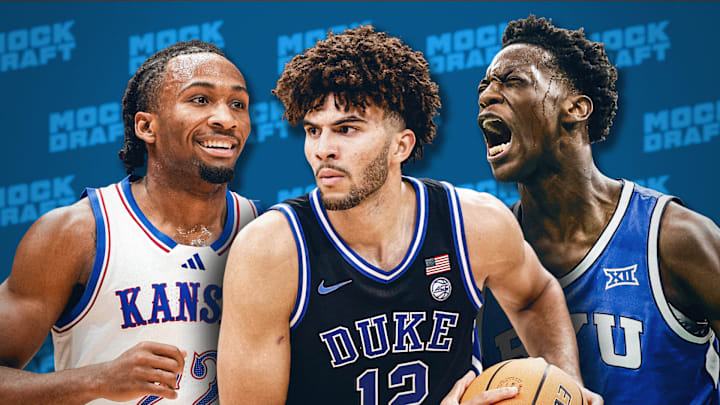
- The Wizards could pick AJ Dybantsa a dynamic, versatile forward to pair with Trae Young and Anthony Davis in their push for contention.
- Memphis takes Darryn Peterson, a polished scoring guard with elite shot-making ability to reshape their backcourt.
- Dallas secures Cameron Boozer, a versatile forward with superb feel and scoring versatility, aiming to bolster their roster.
The first weekend of March Madness has come and gone, with the field officially whittled down to 16. The next wave of games will feature many of the best and biggest names in the NBA Draft conversation, although AJ Dybantsa and Darryn Peterson — two of three potential No. 1 pick candidates — will be conspicuously absent.
There's a lot to look forward to, but let's pause and take stock of how the draft landscape shapes up after a busy week of high-stakes college hoops:
1. Washington Wizards — AJ Dybantsa, F, Brigham Young

AJ Dybantsa's season ended with a 35-point masterclass in BYU's first-round loss to Texas. The current favorite to go No. 1 overall, Dybantsa did everything he could to drag a shorthanded Cougars team across the finish line. He led college basketball in scoring as a freshman on impressive efficiency, showcasing important growth as a decision-maker and passer. The defense is still problematic, but Dybantsa has every tool to become an impact player on that end, if he so chooses.
Washington lands No. 1 here after acquiring Anthony Davis and Trae Young at the deadline, hoping to fast-track their ascent to contention. Dybantsa figures to benefit from the gravity and easy setups Young provides, while Davis can clean up messes on defense. Factor in an elite off-ball shooter like Tre Johnson, in addition to rangy, versatile defenders like Alex Sarr and Bilal Coulibaly, and the Wizards start to feel like a dynamic, balanced group.
>> Read our AJ Dybantsa scouting report
2. Memphis Grizzlies: Darryn Peterson, G, Kansas

Darryn Peterson looked healthier than he's been all season down the stretch. He put his shot-making talent on full display in Kansas' first-round win over Cal Baptist, scoring 28 points. He scored 21 against a stout St. John's defense in round two, helping the Jayhawks overcome a sizable deficit, only to lose at the buzzer. Peterson's ancillary stats continue to lag behind, but there's evidence on the high school tape to suggest that he can become a franchise-caliber lead guard.
Memphis seems ready to shed Ja Morant, but Peterson is a natural fit regardless. He's comfortable on- or off-ball, but one of the most polished scoring repertoires for a guard in recent memory. The movement 3s, the quick rim attacks against closeouts, the impossibly efficient mid-range game. Peterson has it all in his bag, with refined handles and a high release on his jumper. He also gets after it on defense. The Zach Edey-Darryn Peterson actions could work like gangbusters for the Grizzlies moving forward.
>> Read our Darryn Peterson scouting report
3. Dallas Mavericks: Cameron Boozer, F, Duke

Duke flirted with disaster in the first round, but Cameron Boozer battered an undersized Siena frontcourt into submission. TCU also gave Duke a run in round two, but Boozer scored 17 of his 19 points in the second half, the most comfortable he has looked in the tournament thus far. Teams are throwing the kitchen sink at Boozer, and understandably so, but he has proven too smart and too tough.
Dallas practically wins the lottery twice in a row; the No. 3 pick in this draft is as good as the No. 1 pick in most other classes. Boozer actually ranks No. 1 on FanSided's draft board. He lacks the flashy athleticism of Dybantsa and Peterson, but his incredible feel and versatility on offense speaks to a superstar ceiling. He's a 40 percent 3-point shooter, he functions as a ball-handler or a screener in the pick-and-roll, and his patient, forceful post work should translate to the next level, especially against mismatches. The Mavs end up with a pair of Duke forwards who can beat a defense in multiple ways and put Dallas back on a contending track.
>> Read our Cameron Boozer scouting report
4. Sacramento Kings: Caleb Wilson, F, North Carolina

Caleb Wilson's absence loomed large over UNC's secold-half collapse in their upset loss to No. 11 VCU. The talented forward finished second to only Cam Boozer in freshman BPM (12.8), but an untimely hand fracture held him out of the Tar Heels' March Madness run. It should not impact his draft stock. Wilson did more than enough over the course of the regular season to punch his ticket as a top-five pick.
The Kings get a real tone-setter and culture-builder in the No. 4 spot, which is a nice consolation prize for tumbling out of the prized top-3 range. Wilson's length, agility and instincts on defense pop consistently, even if he's still cleaning up a few fundamentals. He's a monster athlete, able to attack mismatches and dunk everything near the rim. He's a better passer than he gets credit for, too, with enough funky mid-range jumpers to produce confidence in his ability to stabilize as a 3-point shooter in due time. Sacramento's entire roster is liable for turnover, but Wilson is a building block for the future.
>> Read our Caleb Wilson scouting report
5. Los Angeles Clippers (via IND): Kingston Flemings, G, Houston

Kingston Flemings' poise and dynamism has been on display all season long, and it was no different in Houston's first weekend of March Madness. The speed, creativity and vision is everything you'd want in a point guard prospect.
The Clippers are stuck picking between a lot of quality guards in this spot, which is complicated somewhat by their deadline move to acquire Darius Garland. Still, it's best player available this high in the draft, especially for an L.A. team with an eye on the future. Flemings has spent all season playing next to other talented guards in the Houston backcourt. He's enough of a shooter and point of attack defender to make it work next to Garland. Flemings' constant rim pressure and high-level decision-making can immediately boost the Clippers offense, especially if Kawhi Leonard sticks around for one last run.
6. Brooklyn Nets: Darius Acuff Jr., G, Arkansas

Darius Acuff Jr. put up a workmanlike 24 points and seven assists in Arkansas' blowout win over Hawai'i to open the tournament. It's what he has done all season, just surgically picking apart his opponents. He did more of the same against High Point, dropping 36 points on 50 percent shooting and six assists, with only two turnovers. The defense is legitimately awful, but he's making up for it with historic offensive production right now.
The Nets selected several guards in last year's draft, but a low hit rate, plus the shape of this draft class, leads GM Sean Marks to target a proper franchise point guard in the No. 6 spot. Acuff is a malleable offensive weapon; he's elite out of the pick-and-roll, with his hands on the control, but he's also a prolific off-ball shooter. Acuff can share the floor with Nolan Traoré or Egor Dëmin. His leadership qualities and consistent crunch-time execution should pay dividends for a Nets team hoping to establish a winning culture next season. Brooklyn does not own its 2027 first-round pick outright.
>> Read our Darius Acuff Jr. scouting report
7. Utah Jazz: Keaton Wagler, G, Illinois

Keaton Wagler dropped 18 points and seven assists, with four made 3s, in Illinois' first-round demolition of Penn. He dropped a quieter 14 points against VCU, but the size, skill and IQ always pops. Wagler wasn't a top-100 recruit coming into the season, but he quickly climbed the ladder with the Illini, becoming a consensus top 10 pick.
NBA teams value feel more than ever, and for good reason. Wagler is a limited athlete, not particularly strong or bursty, but he processes the floor at light speed. He is also extremely creative, able to patiently create and exploit angles as a ball-handler. Better yet, he's a knockdown shooter, whether he's pulling up or flying around screens and spotting up along the perimeter. After tripling down on frontcourt depth with the Jaren Jackson Jr. trade, Utah targets Wagler to run next to Keyonte George in the backcourt long term.
8. Atlanta Hawks (via NOP): Mikel Brown Jr., G, Louisville

Mikel Brown Jr. missed the first weekend of March Madness with a back injury, but the Louisville guard shouldn't suffer much in the draft conversation because of it. Brown plays an extremely favorable style of basketball for the modern age. He gets up a ton of 3s, both off the catch and off the dribble, with pull-up range well beyond the NBA line. The mid-range numbers are troubling, but Brown is efficient at the rim and he draws a ton of fouls with physical, herky-jerky drives, despite a thinner frame. His bubbly confidence can lead to bad shots and unforced errors, but when he's on, Brown looks like a future superstar.
Atlanta replaces Trae Young with another volume-shooting point guard. While Brown shares a few bad habits with Young, he's several inches taller and a more active defender. He also looks significantly more comfortable without the basketball, a function of playing in a deep Louisville backcourt. Brown should fit like a glove in Atlanta's up-tempo offense, giving them another advantage creator and pressure applier next to Jalen Johnson.
9. Chicago Bulls: Brayden Burries, G, Arizona

Brayden Burries led Arizona with 18 points and four made 3s in its first-round win over Long Island. He added 16 points and a gritty nine rebounds in their next win over Utah State. It's becoming harder to deny what the freshman combo guard offers: efficient three-level scoring, active hands on defense, a low turnover rate. While Burries' shorter height and lack of true point guard designation is a factor, he's too well-rounded — and doing too much for a top-shelf team — for NBA scouts to quibble.
The Bulls are finally beginning to rebuild in earnest. It's hard to get a handle on Chicago's roster at the moment, which features very little positional size across the board and is overly reliant on mismatched guards. That is not necessarily an ideal setup for Burries, but he can fit in anywhere. The Bulls love to push the tempo; Burries rebounds, sprints the floor and knocks down open shots. In the halfcourt, he gives Chicago a more reliable three-level scorer than Josh Giddey, without sacrificing on the other end, which is invariably the case when the Bulls trot out Collin Sexton or Rob Dillingham.
10. Milwaukee Bucks: Jayden Quaintance, C, Kentucky

Jayden Quaintance will finish his sophomore campaign with just four games played, averaging 5.0 points and 5.0 rebounds in 16.8 minutes. After tearing his ACL as a freshman, Quaintance was unable to get right and stay right with Kentucky. It will be hard for teams to invest with full confidence in a raw, injury-prone big man. That said: he's also 18 years old, younger than all but a handful of 2026 prospects. He was an elite college rim protector as a 17-year-old freshman. There upside is considerable.
Milwaukee is basically waiting for Giannis to demand a trade. Maybe — maybe — an extension comes about and the Bucks remain in win-now mode for a while. It all feels very tenuous at the moment, however, so the front office ought to swing for the fences. Quaintance, when healthy, exhibits unreal agility and anticipation as a shot-blocker. He offers arguably the highest defensive ceiling in the draft, with enough flashes of ball skills to believe there's something there offensively, too.
11. Golden State Warriors: Labaron Philon Jr., G, Alabama

Labaron Philon dropped 29 points, eight rebounds and seven assists on Hofstra in Alabama's first-round victory after the Tide's No. 2 scorer, Aden Holloway, was arrested on drug charges. He was held to nine points in Alabama's 25-point win over No. 5 seed Texas Tech, but Philon mixed in 12 assists on a bad shooting night.
Golden State could really use another ball-handler behind Stephen Curry. The Dubs are generally looking for prospects who can thread the needle between future value and immediate impact; Philon might become their greatest success story on that front. He has improved so much in his second year at Alabama. Philon's 3-point numbers are up and he's handling physicality better on drives to the rim. His in-between game, his facilitating out of the pick-and-roll, remains excellent. The Warriors can let Philon lead the second unit or play off-ball next to Steph and Draymond; he has thrived in a variety of roles for Bama, which bodes well for his NBA translation.
12. Portland Trail Blazers: Nate Ament, F, Tennessee

Nate Ament went scoreless in 18 minutes against Miami OH in the first round as he worked his way back from leg soreness. He was able to follow it up with 16 points on 4-for-11 shooting in a rousing second-round win over Virginia. The highs this season have been incredibly high for Ament, reminiscent of the five-star recruit and projected top-five pick we all saw before the season. The lows, however, are quite troubling, and could impact his stock come June.
Ament is shooting sub-50 percent at the rim and sub-40 percent on layups, which is deeply concerning at his size — and especially when he just does not dunk in traffic. Concerns over his athleticism are easily offset when watching Ament drill silky jumpers and flash ball skills on the wing. He's physical enough on drives and gets to the free throw line a lot. He also defends well. Portland has loved these sorts of upside swings in the past, and Ament fits in a connective wing role between Donovan Clingan, Deni Avdija and Shaedon Sharpe. At least in theory.
13. Charlotte Hornets: Thomas Haugh, F, Florida

Thomas Haugh dished out a season-high seven assists in Florida's first-round victory over Prairie View A&M. He struggled with his shot a bit in the Gators' sobering loss to Iowa a couple days later, but Haugh still did so many positive things in the game. The junior was the spiritual ringleader for Florida, checking more than enough boxes to capture NBA attention. Rangy wings with Haugh's feel, shooting, finishing and defensive activity level are hard to pass up.
Charlotte's front office changed up stategies last season, focusing on win-now talent with high feel and malleable skill sets. Haugh can be an extension of that strategy, filling a very real need at power forward. His athleticism flashes on backdoor cuts and straight-line drives. He's a proficient spot-up shooter, and though he's not much of an on-ball weapon, Haugh's scalable, plug-and-play skill set can help from the jump as the Hornets continue to level up.
14. Oklahoma City Thunder (via PHI): Dailyn Swain, F, Texas

The 14-loss Longhorns are dancing into the Sweet 16 after upset wins over BYU and Gonzaga. Dailyn Swain did not explode in either victory, but he's stuffing the stat sheet and impacting the game in multiple ways. As always, it's hard to comprehend just how smoothly Swain moves with the basketball.
OKC has two first-round picks. Whether Sam Presti has space for two rookies is another matter entirely. That said, Swain is right up the Thunder's alley as a rangy, explosive slasher who can pressure a defense, pass on the move and hopefully hit enough spot-up 3s to keep the defense honest. The opportunities will be limited on such a deep and accomplished OKC team, but Swain fits their playstyle and figures to pounce on the opportunities that do arise.
15. Oklahoma City Thunder (via LAC): Yaxel Lendeborg, F, Michigan

Yaxel Lendeborg starred in two blowout victories for Michigan over the weekend, including 25 points on 13 shots and six rebounds against Saint Louis in the second round. He is older than most first-round picks, but he's so damn good — so well-rounded at the forward position — for it to matter all that much. Lendeborg has been essential to the most suffocating defense in college hoops and he does so much to connect dots offensively.
OKC can hope Lendeborg settles into an immediate 15-20 minute role with the second unit, adding a bit more size and versatility in the frontcourt behind the likes of Chet Holmgren, Isaiah Hartenstein and Jalen Williams. Lendeborg can switch one through five, he's a smart help defender, and he rebounds prolifically. On the other end, he can hit spot 3s, run DHOs with OKC's guards, pass on the short roll, and occasionally free-style with force and touch in the mid-range or post.
16. Miami Heat: Karim López, F, Mexico
With so many international prospects coming stateside due to NIL, it's easy enough to overlook Karim López in the Australian NBL. But he's quietly putting together one of the most impressive seasons from a teenager in their Next Stars program, averaging 11.9 points and 6.1 rebounds with excellent stock numbers in 25.8 minutes per game for the New Zealand Breakers.
López's overall defensive instincts and shot-making consistency merit scrutiny, but he's a powerful athlete and slasher, with the craft and dexterity to shed defenders and get all the way to the rim. Miami's wing rotation is a bit thin and López would benefit more than most from the Heat's laser-focus on details and execution.
17. San Antonio Spurs (via ATL): Hannes Steinbach, F, Washington

Hannes Steinbach and Washington did not crack the NCAA Tournament, but the German forward did more than enough to solidify his stock in the regular season, even in a losing environment. Steinbach has been a production machine dating back to last summer's U-19 FIBA World Cup. He's the best rebounder in the class, with a sturdy frame and an incredible appetite for dirty work.
The Spurs would benefit from a bit of muscle next to Victor Wembanyama in the frontcourt. Steinbach's lack of rim protection is a common knock against him, but those concerns melt away in San Antonio. He's not a bad defender either: Steinbach is a solid lateral mover with plus instincts; even if he doesn't block a ton of shots, he impacts plenty. On the other end, NBA teams probably want to see Steinbach ramp up the 3-point volume, but his soft touch and coordination around the basket bodes well for his development on that front.
18. Memphis Grizzlies (via ORL): Bennett Stirtz, G, Iowa

Stirtz has a couple short but impressive tournament runs under his belt now, which puts the senior in a good position for the pre-draft cycle. A lot of front offices tend to fade older guards, but Stirtz exhibits complete command over all factions of the Iowa offense. Moreover, there's reason to believe his skill set is more versatile than it would appear at first blush.
Memphis essentially reshapes its backcourt with two potential day-one starters in Bennett Stirtz and Darryn Peterson, depending on how the rest of the Grizzlies' offseason goes. Stirtz has dominated the basketball throughout his college career under Ben McCollum, whose snail-paced scheme does not really translate to the NBA. That said, when a guard is as smart and skilled as Stirtz, with a feather-soft jumper and supercomputer processing speed, it's unwise to bet against him figuring it out.
19. Charlotte Hornets (via PHX): Koa Peat, F, Arizona

Koa Peat is one of the more complex and interesting evaluations of the 2026 class — a real test case for how one weighs intangibles, production and reputation against archetypal value. Peat was sensational in the Big 12 title game and he carried that momentum into March Madness. But he's a 6-foot-8 power forward who doesn't really shoot 3s. Is there a home for players like that in today's NBA?
Charlotte is all-in on "winning" players, and however you'd define that term, Peat fits. The dude has won everything dating back to high school and he's clearly a force for good on both ends for Arizona, even if it doesn't always look sexy or particularly "modern." His soft mid-range touch is a positive signal for shooting development. His poor free throw numbers (60.7 percent) are not. But Peat's physicality on drives, his mismatch-hunting in the post and sharp connective passing, should all play on some level. He's a brusier on defense. He's selfless in his approach. Between him and Haugh, the Hornets can improve the weakest spot in their rotation at the four.
20. Toronto Raptors: Motiejus Krivas, C, Arizona

Motiejus Krivas continues to anchor a stifling Arizona defense. He has been one of the most dominant interior forces in college basketball this season, a mountain few opponents can navigate at the rim. He was quiet offensively in Arizona's March Madness opener, but he recorded four blocks. In their win over Utah State, the junior managed 11 points, 14 rebounds and three blocks. Not a bad week at the office.
Toronto has primary needs at point guard and center, as faith in Jakob Poeltl is wavering. Krivas offers a similar build and skill set, with younger legs and a chance to anchor a long, overwhelming Raptors defense for years to come. Krivas makes plenty of plays in drop coverage (7.7 BLK%, 1.5 STL%), but so much of his impact does not show up in the box score. He is so sharp with his execution, so wide and tall in the paint. There are so many altered shots that don't count as stocks. He's a bit more run-of-the-mill offensively, but Krivas sets thundering screens and finishes everything at the rim. He is also, helpfully, an elite offensive rebounder.
21. Denver Nuggets: Christian Anderson Jr., G, Texas Tech

Texas Tech overcame injuries and a late-season slide to obliterate Akron in the first round. Christian Anderson dropped a cool 18 points and five assists, with four steals to boot. A blowout loss to Alabama in round two saw Anderson hit a wall, as he shot 2-of-11 from the field and 1-of-7 from deep, but he added another four steals. The effort never waned.
Denver could use a proper backup point guard behind Jamal Murray and it's hard to imagine a better fit than Anderson. He has flown under the radar somewhat in a deep guard class, but Anderson's production stacks up with the best in college hoops. He's a prolific volume shooter, on- or off-ball, and his feel as a distributor (2.3 AST:TO) is what drives success for the Red Raiders offense. Anderson's lack of rim pressure is a concern, but he's so efficient as a pull-up shooter and a potential two-man dance partnership with Nikola Jokić would paper over a lot of flaws. His thinner frame will be tested on defense, but Anderson's effort and activity level gives him a puncher's chance every time.
22. Philadelphia 76ers (via HOU): Morez Johnson Jr., F, Michigan

Morez Johnson put up a team-best 21 points and 10 rebounds in Michigan's first-round blowout of Howard. He followed it with 15 points and eight rebounds in the dismantling of Saint Louis. A sophomore transfer from Illinois, Johnson has settled into beautifully with a deep, jumbo-sized Michigan frontcourt. He's one of the most disruptive and impactful defenders in college basketball, with an increasingly compelling offensive profile, to boot.
Philadelphia always needs more rebounding and defense next to Joel Embiid in the frontcourt. Johnson has potential utility as a power forward or as a small-ball backup five. His muscular frame, endless arms and impressive agility allow Johnson to handle all kinds of assignments. He's a legitimate help-side rim protector; he can switch out to the perimeter with success. His blunt-force approach and presence on the glass would be a welcomed addition to the Sixers frontcourt. Johnson needs to up his 3-point volume on the other end, but he's a useful complementary piece due to his prolific finishing at the rim. The fact that he's shooting 37.5 percent on his few 3s and almost 80 percent at the free throw line should mean he's a proper floor-spacer before long.
23. Atlanta Hawks (via CLE): Patrick Ngongba II, C, Duke

Ngongba missed Duke's opening round win over Siena, but returned in limited minutes against TCU in round two. His value, however, was best illustrated when he was absent. The middle of Duke's defense softened considerably. Ngongba does so many small things to fuel winning at the five spot; his NBA-ready frame and high basketball IQ, mixed with compelling flashes of skill, should keep scouts on the hook.
The Jonathan Kuminga-Kristaps Porzingis trade opens up a need in the frontcourt for Atlanta. Onyeka Okongwu has more than proven himself as a starting-caliber five, but the Hawks would benefit from a source of real size and rim protection. Ngongba's screening and short roll passing should play nicely in two-man actions with Jalen Johnson and Atlanta's guards. He can clean up on the glass, finish simple looks inside, and operate as the enforcer this Hawks team presently lacks.
24. Detroit Pistons (via MIN): Braylon Mullins, G, Connecticut

Braylon Mullins went 0-for-8 in UConn's first-round win over Furman. He followed it up with 17 points and a couple made 3s (but one assist to five turnovers) in their win over UCLA. Inconsistency has been a real problem for Mullins, whose numbers don't really line up with the pre-college indicators of his shooting potential.
That said, the idea of Mullins is still quite powerful, and every team can use a movement shooter to warp the defense and apply pressure off-ball. Detroit needs elite shooters and play-finishers even more than most. Mullins would look right at home on Motown, feasting on setups from Cade Cunningham and attacking closeouts, where he has the handle and passing chops to extend advantages. If he can add strength, get to the rim a bit more and accentuate his defensive IQ, there's a high role player ceiling here.
25. Los Angeles Lakers: Aday Mara, C, Michigan

Some matchups give Aday Mara more trouble than others. This weekend he did nothing but impress. Michigan's 7-foot-3 anchor was dominant against Howard (19 PTS, 7 REB, 6 AST, 3 BLK in 21 MIN), which he backed up with a similarly impressive outing against a more talented Saint Louis frontcourt (16 PTS, 5 REB, 5 AST, 4 BLK in 26 MIN). It's hard to find centers with Mara's intersection of size, defensive instincts and passing IQ.
Lakers fans probably envision an explosive run-jump athlete anchoring the frontcourt next to Luka Dončić, but Mara is worth a swing. He needs to foul less and prove his durability, but the ceiling here as an All-Defense caliber interior anchor. Mara can finish lobs, facilitate on the short roll and provide L.A. with rim protection they simply will not receive from Deandre Ayton, now or ever. You can never have too many good passers on the floor.
26. New York Knicks: Joshua Jefferson, F, Iowa State

Joshua Jefferson sprained his ankle against 15-seed Tennessee State and missed Iowa State's statement victory over Kentucky in the second round. The Cyclones are a deal, multi-faceted team, but don't let their success in Jefferson's absence fool you. He's one of the best and most impactful players in college basketball, having improved steadily across four years to become a legitimate first-round draft pick.
Mike Brown has brought a more offensive bent to the Knicks, and Jefferson's well-roundedness could prove nifty with the second unit. Jefferson is a genuine offensive hub for the Cyclones, able to map out the floor at the elbow, drive the lane with long, arrhythmic strides and drop impressive dimes on the move. He has upped his 3-point volume this season to complement his old-school post repertoire, and he defends with active hands (3.4 BLK%, 3.1 STL%). The Knicks get a potential day-one contributor late in the first round, a steal.
27. Boston Celtics: Amari Allen, F, Alabama

Amari Allen did what he does in Alabama's two opening weekend wins, stuffing the stat sheet with a little bit of everything in support of star point guard Labaron Philon. The freshman checks so many boxes as a dribble-pass-shoot wing. He rebounds, he defends, and there is reason to believe he could develop into something beyond his role-player trappings in the right organization.
Boston has buttered its bread for years with quality wing play. Jayson Tatum and Jaylen Brown will remain the primary engines of course, but Allen can come off the bench and give Boston a varied threat. He can knock down 3s when Boston decides to ratchet up the volume; he can attack closeouts and even isolate on occasion when the Celtics decide to mix it up. Allen is a great positional rebounder, a legitimate off-ball chaos agent on defense, and it's just hard to poke too many substantial holes in his skill set, especially at 19 years old.
28. Minnesota Timberwolves (via DET): Tyler Tanner, G, Vanderbilt

Tyler Tanner was outright sensational for Vanderbilt in their two tournament games, dropping 26 points on McNeese and 27 points on Nebraska — with a potential game-winning heave that rimmed out at the buzzer in heartbreaking fashion. There will be teams who cannot get over Tanner's smaller frame, which could set up an interesting stay-or-go decision. It could behoove him to test his luck in a weaker 2027 class. For now, though, it's hard to deny the scale of his impact. He does everything a smaller guard isn't supposed to do: defend, rebound, dunk.
The Wolves could have reservations after only recently whiffing on another small guard prospect in Rob Dillingham, but Tanner's defensive profile is the great separator. He's such a hellacious agitator on that end of the floor (4.1 STL%), with the athleticism to jump passing lanes and alter shots in a way you simply won't expect from a guard with his dimensions. On offense, Tanner's zippy handles, impressive court-mapping and versatile scoring — with the ability to alter his shot speed and mechanics based on where the nearest defender is — should translate. He's more efficient at the rim than all the other top guard prospects in this class. At some point you need to just trust the numbers and the eye test, which all point to Tanner as the lead ball-handler Minnesota desperately needs.
>> Read our Tyler Tanner scouting report
29. Cleveland Cavaliers (via SAS): Cameron Carr, G, Baylor

Cameron Carr errupted at Baylor after spending two years in the doghouse at Tennessee. The Bears struggled on the whole and fell short of the NCAA Tournament, but Carr did plenty to boost his individual stock. A long and explosive athlete on the wing, Carr is a legitimate weak-side shot blocker (3.8 BLK%) and defensive playmaker. He is also a prolific off-ball weapon offensively, whether that's sprinting into deep movement 3s or ducking backdoor to detonate on a lob.
With Donovan Mitchell and now James Harden, the Cavs don't really need a prospect who can self-create. Carr is not much of an iso weapon or passing artist at this stage of his development, but the gravity he exerts away from the basketball could prove immensely beneficial in Cleveland. Harden in particular has long elevated shooters in Carr's mold.
30. Dallas Mavericks (via OKC): Meleek Thomas, G, Arkansas

Meleek Thomas dropped 21 points on Hawai'i and 19 points on High Point, both on 50-plus percent shooting, as Arkansas surges into the Sweet 16. While it's Acuff who receives the overwhelming majority of the spotlight for the Hogs, Thomas has been an essential running mate all season — the sort of efficient off-guard who can perfectly complement a heliocentric superstar.
The Mavs add Thomas to a rotation that will include Cooper Flagg, Kyrie Irving and Cameron Boozer, in this hypothetical. Thomas is a 42 percent 3-point shooter, with the first step and wiggle necessary to attack closeouts, extend advantages and score at the rim. He's not a high-volume facilitator, but he plays within himself and does not turn the ball over much. On defense, he has the length to defend a couple positions and the hands to be a real disruptor. He should fit nicely into a revamped Mavericks backcourt.
Order | Team | Player | Position | School |
|---|---|---|---|---|
31 | Memphis Grizzlies (via IND) | Chris Cenac Jr. | C | Houston |
32 | New York Knicks (via WAS) | Zuby Ejiofor | C | St. John's |
33 | Brooklyn Nets | Henri Veesaar | C | North Carolina |
34 | Sacramento Kings | Braden Smith | G | Purdue |
35 | San Antonio Spurs (via UTA) | Isaiah Evans | F | Duke |
36 | Oklahoma City Thunder (via DAL) | Alijah Arenas | G | USC |
37 | Chicago Bulls (via NOP) | Tarris Reed Jr. | C | Connecticut |
38 | Los Angeles Clippers (via MEM) | Milan Momcilovic | F | Iowa State |
39 | Houston Rockets (via CHI) | Pryce Sandfort | F | Nebraska |
40 | Boston Celtics (via MIL) | Billy Richmond III | F | Arkansas |
41 | Miami Heat (via GSW) | Alex Condon | C | Florida |
42 | San Antonio Spurs (via POR) | Juke Harris | F | Wake Forest |
43 | Brooklyn Nets (via LAC) | Rueben Chinyelu | C | Florida |
44 | Sacramento Kings (via CHA) | Joseph Tugler | F | Houston |
45 | Phoenix Suns (via PHI) | Jeremy Fears Jr. | G | Michigan State |
46 | Denver Nuggets (via ATL) | Alex Karaban | F | Connecticut |
47 | San Antonio Spurs (via MIA) | Ryan Conwell | G | Louisville |
48 | Orlando Magic | Richie Saunders | F | BYU |
49 | Dallas Mavericks (via PHX) | Jaden Bradley | G | Arizona |
50 | Toronto Raptors | Sergio De Larrea | G | Spain |
51 | Chicago Bulls (via DEN) | JT Toppin | F | Texas Tech |
52 | Houston Rockets | Dash Daniels | G | Australia |
53 | Los Angeles Clippers (via CLE) | Baba Miller | F | Cincinnati |
54 | Washington Wizards (via MIN) | Emanuel Sharp | G | Houston |
55 | Golden State Warriors (via LAL) | Tamin Lipsey | G | Iowa State |
56 | New York Knicks | Bruce Thornton | G | Ohio State |
57 | Atlanta Hawks (via BOS) | Maliq Brown | C | Duke |
58 | New Orleans Pelicans (via DET) | Nate Bittle | C | Oregon |
59 | Minnesota Timberwolves (via SAS) | Keyshawn George | F | Auburn |
60 | Washington Wizards (via OKC) | Trevon Brazile | C | Arkansas |
More NBA Draft news and analysis:
 Add us as a preferred source on Google