
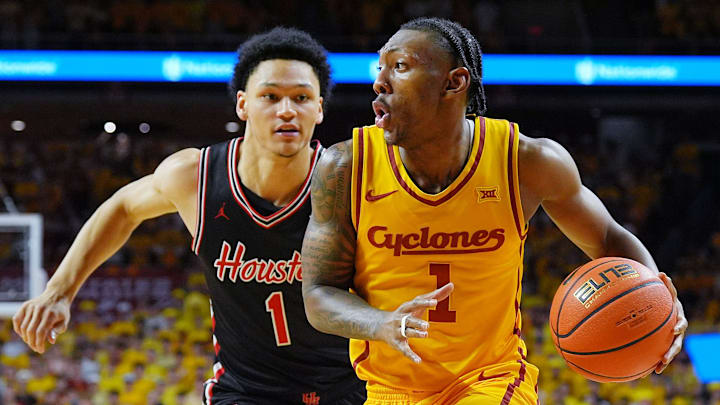
The men's NCAA Tournament selection committee revealed its current top 16 seeds on Saturday afternoon, just hours before two matchups featuring the top four teams in the AP Top 25 poll (Arizona-Houston and Michigan-Duke). There's a lot that can and will change between now and Selection Sunday, but this first look at what a projected March Madness field could look like is enlightening for bracketologists everywhere.
TOP 16 SEEDS REVEALED.
— Matt Norlander (@MattNorlander) February 21, 2026
The biggest shocker is Texas Tech being the best 4-seed in spite of no longer having JT Toppin for the remainder of the season.
Alabama and Arkansas were the first tow cuts, per chair Keith Gill. pic.twitter.com/ktGTclNiYJ
The full group of 16, as seen above in the tweet from CBS Sports' Matt Norlander, saw a few big surprises, including Iowa State claiming the final No. 1 seed over Houston and Texas Tech retaining a top-four seed despite the loss of leading scorer J.T. Toppin for the season with a torn ACL. The reveal, as well as Gill's commentary throughout the exercise, did share a lot of key information that could inform how the bubble plays out as well as who is destined for the top spots in the field of 68.
Key takeaways from the men's NCAA Tournament top 16 seed reveal
Head-to-head performance matters
One of the most controversial decisions from this exercise was the fact that Iowa State got the final No. 1 seed ahead of Houston, despite the latter being the better team in the eyes of many predictive metrics (although the Cyclones entered Saturday ahead of the Cougars in the all-important NET rankings). Keith Gill, the Sun Belt commissioner who is serving as the chair of this year's selection committee, indicated that Iowa State's head-to-head win over Houston on Wednesday pushed them ahead in the bracket exercise.
"The head-to-head on Monday between Iowa State and Houston and then UConn's loss to Creighton made Iowa State [the last No. 1 overall seed]."
— CBS Sports College Basketball 🏀 (@CBSSportsCBB) February 21, 2026
Keith Gill explained how IOWA STATE ended up as the last No. 1 overall seed in the NCAA Tournament as of today. @CycloneMBB pic.twitter.com/aobHN3lGyh
While head-to-head mattering again is important, it does seem a bit strange that a three-point victory at home for Iowa State was enough to secure the final spot on the top line. Head-to-head results could prove even more significant on the bubble, where a key head-to-head win could see the committee elevate one team into the field over another — something worth tracking as a lot of teams in the crowded middle classes of the Big Ten and SEC play each other down the stretch.
Who you beat matters more than who you lose to
Quality wins was a factor Gill often cited as a differentiator between teams, particularly in the case of UConn, which rated ahead of Houston on the S-curve due to the fact that their three best wins (Illinois on a neutral floor, at Kansas and at home against Florida) are better than the Cougars' three best wins (Arkansas and Texas Tech at home as well as Auburn on a neutral floor).
"UConn's three best wins are better than Houston's three best wins."
— CBS Sports College Basketball 🏀 (@CBSSportsCBB) February 21, 2026
Keith Gill explained how UConn earned the No. 5 overall seed over Houston. pic.twitter.com/rdXibpy5K6
Gill specifically cited Quad 1 and Quad 2 victories often during the exercise, noting that Arizona's 15 wins against the top two quadrants earned them a spot on the top line while adding that No. 1 overall seed Michigan's 19 victories against the top two quadrants were quite impressive. It sure seems as if those types of wins against tournament-caliber competition will matter more than predictive metrics when it comes time to fill out the final bracket.
"They have 15 wins in Quad 1 and 2."
— CBS Sports College Basketball 🏀 (@CBSSportsCBB) February 21, 2026
Keith Gill reveals that as of today the third overall seed in the NCAA Tournament is ARIZONA. @ArizonaMBB pic.twitter.com/iaaaHqV0xa
That emphasis on good wins is helpful if you're a bubbler from a league like the SEC or Big Ten, when you have plenty of opportunities to play competition from the top two quadrants in league play. Teams like TCU (6-8 vs. the Top 2 quadrants), Texas (7-8) and Georgia (10-7) are definitely happy to hear it, as it could boost their bubble candidacies.
But in a rather unsurprising development, this emphasis on top wins above all will hurt mid-majors on the bubble like New Mexico, Santa Clara, San Diego State and Saint Mary's. All of them are all doing well in predictive metrics, but they get far fewer opportunities to prove it against the types of competition the committee seems to be valuing. This could also indicate that Saint Louis (6-2 against Quads 1-2, with few such opportunities left) may be seeded lower than anticipated, and undefeated Miami of Ohio (which has just one Quad 2 win to its name) may well need to run the table and win the MAC Tournament to earn a bid.
Underachieving power conference teams also have to show that they can beat tournament-caliber teams, which isn't good news for the Big Ten's bubble trio of Ohio State (0-8 vs. Quad 1 foes), UCLA (2-7) and USC (1-6). One team that may benefit from the committee's current viewpoint is Stanford, which has some hideous losses on its resume but also some tremendous Quad 1 results against Saint Louis, North Carolina and Louisville.
Texas Tech may slide without J.T. Toppin
The big surprise from the committee's exercise was the presence of Texas Tech as the top-ranked four seed. It makes sense from a resume perspective, since the Red Raiders own wins over Houston, Arizona and Duke already. But all three of those wins came with the services of Toppin, who is now lost for the season.
Gill indicated that the committee dropped Tech from the three line to the four line once they learned the severity of Toppin's injury, which is important since the Red Raiders team that beat three of the committee's top six will never be fully assembled again. If Texas Tech starts dropping more games without Toppin, expect the committee to keep sliding them down the S-curve in the future.
 Add us as a preferred source on Google