
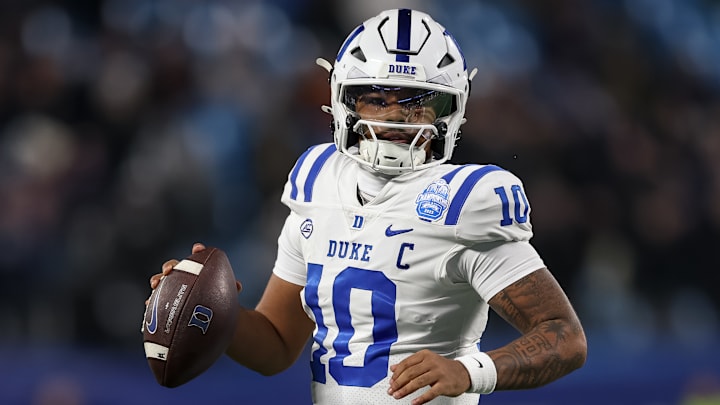
A month after committing to Duke amid a two-year NIL deal he signed last year when he left Tulane for the Blue Devils, quarterback Darian Mensah is back in the transfer portal. In fact, he waited until the last possible moment to enter his name, backing out of his commitment and contract with Duke. It’s easy to want to blame Mensah for essentially quitting on Duke for more money and a suspected move to Miami — an intra-conference foe.
Before you blame him, though, take a look at the system that’s enabled him and the rest of college football to make these decisions on a whim with dollar signs in their eyes.
Why the College Sports Commission is to blame for another chaotic transfer portal window

Mensah is doing what’s best for him and he shouldn’t be shunned for that. After all, college football coaches back out of their contracts to take bigger ones or take on bigger roles at new schools so players should be afforded that same benefit right? This isn’t about right and wrong though. This about a system, the College Sports Commission, that was supposed to regulate the transfer portal and NIL that is ultimately failing everyone involved.
The College Sports Commission was implemented to bring some clarity and order to this new era of player compensation. Instead, it has failed to enforce any sort of regulation, it’s failed to have any real jurisdiction over college football and it’s become more of a mockery than a real source of credibility. The CSC has monitored third-party NIL deals, checking teams that try to spend frivolously.
But the real problem is tampering.
That’s where the Mensah situation comes in. He only waited with hours left in the January transfer portal window to announce he was going back on his previous commitment. The only reason he would do that is if a better offer was out there. And if I’m not mistaken, a team talking with a player that is still under contract borders on tampering.
The CSC can’t pick and choose when it wants to enforce the rules. They need to be transparent when making their decisions and that starts with eliminating tampering as much as possible. Missouri coach, Eli Drinkwitz said it best:
Eli Drinkwitz says CFB is sick right now and says there are signs that the sport is cracking:
— SEC Mike (@MichaelWBratton) December 16, 2025
"Tampering is at the highest levels - there is no such thing as tampering, because there's no one that's been punished for tampering.
"Everyone on my roster is being called." pic.twitter.com/uNmqWi52YG
"Tampering is at the highest levels - there is no such thing as tampering, because there's no one that's been punished for tampering. … Everyone on my roster is being called."
If the CSC isn’t going to do anything about it, who will? And what will actually need to happen for the real change the CSC was supposed to enforce?
College football has to solve its tampering problem

One idea that could get college football one step closer to fixing its tampering problem is introducing a collective bargaining agreement. Sure, it’s not ideal and it will require work, patience and nitpicking, but it’s probably the best solution right now to figure out how teams can be punished for tampering. Athletes.org has drafted a 38-page CBA that, in a way, makes sense. It has clear stipulations that extend beyond just outside NIL money that’s not part of the revenue-sharing agreement.
This 👇. There is a pathway to build a much healthier environment for college athletics within the current laws of our country - it’s called collective bargaining. It will be complicated, hard, and likely not perfect, but it’s far past time that we roll up our sleeves and do the… https://t.co/koDoc2GEeF
— Danny White (@AD_DannyWhite) December 17, 2025
The NCAA opened this door when they approved NIL with loose rules in place. They probably didn’t expect it to truly be the wild west. Yet every year, more players enter the transfer portal than roster spots available. More players contemplate or even break their existing contracts, chasing “a better opportunity”.
Current college players are being set up to fail for the NFL for the ones that make it there. When things are rough, you aren’t getting a call from a team waiting to poach you. You either have to get traded, waived or become a free agent. Until college football is treated more like the NFL — regardless of how you feel about the current era of college football, this is probably the best solution — things will continue to get out of hand.
Until a governing body steps up to enact true change and regulations when it comes to NIL, revenue sharing and binding contracts, situations like Mensah’s will continue to poison college football.
More college football news and analysis
 Add us as a preferred source on Google