
Key Points
Bullet point summary by AI
- The New York Jets aggressively traded up in the fourth round to address their long-standing quarterback uncertainty.
- While Cade Klubnik comes with experience and recruiting pedigree, inconsistent processing abilities and a shaky recent trajectory could hold him back.
- This move raises questions about immediate roster priorities and future flexibility given existing veteran depth and upcoming draft classes.
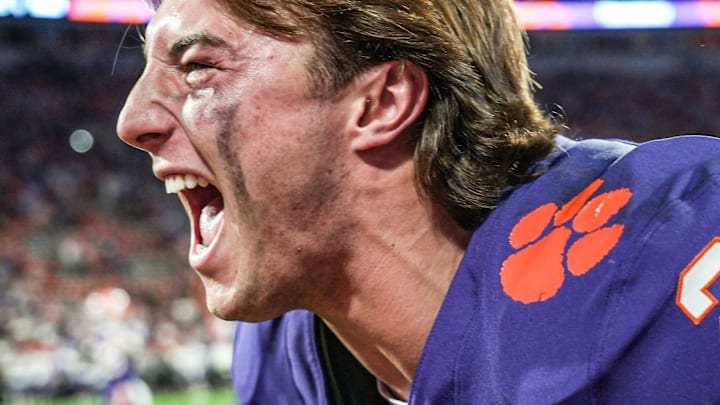
The New York Jets moved a few picks around on Saturday afternoon, moving up the NFL Draft board to select Clemson quarterback Cade Klubnik with the 110th overall pick. The Jets sent up the 128th and 140th picks, but also received the 199th pick from Cincinnati.
Klubnik spent four years at Clemson and was a full-time starter for three of 'em. He led the ACC in completions as a sophomore and, at certain points, felt like a future first-round pick. But ultimately his stock stagnated, in no small part due to Clemson's overall struggles this past season. The Jets need quarterback talent, but the process behind this selection merits skepticism.
Jets gave up too much for the wrong quarterback

With all due respect to Klubnik and the Jets ... c'mon. We know how this story goes. New York's track record of quarterback development over the years is abysmal. This is a newer staff, and Aaron Glenn deserves a chance to leave his imprint on the organization. But even if you're a full believer in Klubnik as a talent, it's hard to trust the Jets organization. Moreover, this pick simply feels ill-timed.
Klubnik joins a deep QB room. Geno Smith was just brought in to start and hopefully win football games. Last season was a mess in Las Vegas, but if there's anything the Jets have done well this spring, it's build up a solid offensive infrastructure. Between Garrett Wilson, Breece Hall, newcomer Kenyon Sadiq and a young, athletic O-line, Smith should have the weapons and the protection to achieve his best self.
If Smith is the bridge quarterback he's capable of being, that ices Klubnik out of immediate reps. There's also Brady Cook and Bailey Zappe, both of whom hold seniority (and therefore status) over a fourth-round rookie quarterback.
It's not bad to sit a rookie quarterback for a year, especially a rookie quarterback with Klubnik's developmental needs. But what happens in 2027, when Smith comes off the books and the Jets are presented with a loaded QB class? Arch Manning, Dante Moore, Trinidad Chambliss — New York will have much better odds of landing its franchise passer a year from now. Nobody expects the Jets to meaningfully contend in 2026, so there should be no shortage of quality options.
Maybe this is a simple case of New York targeting its long-term backup in the fourth round. That's hardly crazy. But in a year when Glenn and the coaching staff are under so much pressure, when progress feels like a top priority, it just feels wrong to give up multiple picks — multiple chances to upgrade a needy defense — for a middling backup without much of a future.
Cade Klubnik wasn't even the best quarterback on the board

Klubnik at 110 is not terrible value, but it's fair to question New York's evaluation here, even beyond the inequity of the trade. Was the Clemson quarterback actually the best available option at this own position? Probably not. There is very little consensus on quarterback prospects at this stage of the draft, but Klubnik's slow processing and weaker pocket presence don't project well at the next level. He will need to make serious strides without significant reps in New York.
Garrett Nussmeier, another former top prospect whose stock soured as a senior, was also available to the Jets. In fact, he is available well past the fourth round, meaning the Jets did not need to trade up for a quarterback with pedigree.
While Klubnik is a better athlete than Nussmeier, the latter is a far more polished presence in the pocket. Nussmeier delivers a clean ball and he gets it out quickly. He reads the field like a coach's kid, able to adjust in real time, whereas Klubnik can struggle under duress. Nussmeier's skill set points to a long future as a replacement-level backup. He can move the chains and keep an offense ticking, even if he won't blow the doors off with a splash throw downfield.
If the Jets plan to take a quarterback in 2027 — and folks, the Jets plan to take a quarterback in 2027 — Nussmeier would've made a lot more sense as a Day 3 investment. He can step in, keep a level head, and execute the playbook. Klubnik might pop more often, but he needs to play through the mistakes on a team willing to give him an extended runway. The Jets, barring a complete meltdown from Geno Smith, aren't in that position. And even if Klubnik takes the field in Week 12 with the Jets far removed from contention, he will promptly cede those reps to whomever New York acquires in 2027.
Nessmeier's workmanlike approach, without the sacrifice of a major trade-up, probably pans out better for the Jets. That's only in the realm of theory, though.
More NFL Draft news and analysis:
 Add us as a preferred source on Google