
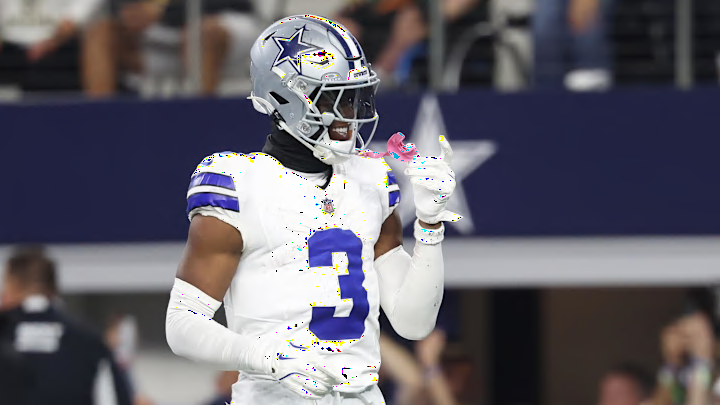
Before he ever hits free agency, the Dallas Cowboys and Jerry Jones are aiming to place the franchise tag on wide receiver George Pickens. Dallas, of course, traded a third-round pick to the Steelers for Pickens last offseason as he entered a contract year, and it worked beautifully. He was a natural fit alongside CeeDee Lamb with Dak Prescott. Now, it's hard to imagine the offense without him, hence the plan to franchise tag him and hold onto him for one more year or while working on a long-term contract.
Pickens isn't alone among the big-name free agents in the NFL, however, in likely seeing the franchise tag this offseason. For one reason or another, expect several of the most coveted players that could hit the market not to. Part of that is the cost of the franchise tag, part of it is the reasons behind each situation, but we've got all that to unpack.
What will the franchise tag cost for each position in 2026?

Position | Projected 2026 Franchise Tag Value |
|---|---|
Quarterback | $47.321 million |
Running Back | $14.536 million |
Wide Receiver | $28.824 million |
Tight End | $16.319 million |
Offensive Line | $27.924 million |
Defensive End | $27.322 million |
Defensive Tackle | $26.311 million |
Linebacker | $28.197 million |
Cornerback | $21.414 million |
Safety | $20.876 million |
Special Teamer | $6.9 million |
The NFL franchise tag values change annually as they are correlated with the salaries at a given position. Whatever the amount is, it's determined by the average of the top-five salaries at the position, or 120% of the player's previous salary — whichever number is higher. Meanwhile, players can be tagged up to three times. The second time signing the tag, it's a 120% increase from the previous year's value, and that number jumps to a 144% increase if tagged a third time. That last one, of course, is a near impossibility with the way front offices operate in reality.
One other thing that should be noted about the franchise tag is that players can negotiate a contract until a set deadline in mid-July, when they then must sign the tag to play the year on that deal. Players on the franchise tag can still be traded as the team retains their rights. On the most commonly used non-exclusive tag, though, other teams could, in theory, still negotiate with the free agent but would have to pay two first-round picks to the previous franchise if they signed the player. Obviously, that's not a path we see taken.
Reasons NFL teams will franchise tag a player

Increased time for long-term contract negotiations
The 2025 offseason and Pickens this offseason are good examples of where this comes into play. Tee Higgins and Trey Smith were the two players who had the franchise tag placed on this a year ago, and both eventually worked out long-term deals with the Bengals and Chiefs, respectively. As a tool, though, this can help alleviate some pressure in negotations on both sides of the situation.
Because of the hefty price for other teams to enter negotiations with a tagged player, it essentially creates an exclusive window for the team to try and retain a player. Even if they don't come to an agreement, it would still open the door to the other two reasons an organization might choose to tag a player in a given offseason.
To recoup value in a trade vs. free agency and comp picks
Due to the fact that players on the franchise tag can still be traded, some teams will use the tag to get value in return via trade, rather than letting a player walk in free agency and then having to wait on compensatory pick return the following year. Obviously, there's quite a bit to weigh when it comes to a situation like this. Other teams aren't giving up a king's ransom for a player who is currently only on a one-year deal and who will need an extension. But it is something that we do see from time to time.
Getting one more year, for whatever that reason might be
Whether it's because the team doesn't want to pay him for another year beyond this, but still sees a window of contention, because it's operating as a cost-effective prove-it option for an organization, or the end result of failed negotiations, we can't forget that NFL teams will sometimes use the franchise tag as a pseudo-one-year deal for players. To be sure, this can get ugly. We saw that most infamously with someone like Le'Veon Bell in Pittsburgh. But it can also be a bit less nefarious in nature, and some of this year's examples fit that bill.
George Pickens and 5 more NFL franchise tag candidates this offseason

WR George Pickens – Dallas Cowboys
We're not going to belabor the point when it comes to Pickens. Jones has already said he's giving him the franchise tag, and I'd suspect that the goal will be to buy time in contract negotiations. While I understand why Cowboys fans (and haters) would be quick to not believe that Dallas is going to offer him a long-term deal worth his value after how dismal the Micah Parsons situation became last offseason, everything about this has felt different.
Not only will Pickens get the tag, but I suspect he inks a four-year deal with the Cowboys and doesn't actually end up playing out the 2026 season on the tag.
RB Breece Hall – New York Jets
Especially after the flurry of trades before last year's deadline, the Jets aren't exactly overflowing with cornerstone pieces. More importantly, though, it does mean that they have ample cap space to work with this offseason to try and improve a roster that was, frankly, non-competitive. And keeping Breece Hall in the building would make a world of sense in trying to do so.
New York could realistically dole out the franchise tag to Hall or former first-round pick Alijah Vera-Tucker. Given the non-prohibitive cost of the running back tag, however, Hall would simply make more sense as a short-term commitment while potentially working out a smaller AAV but longer-term deal for their offensive lineman who missed the 2025 season due to injury.

TE Kyle Pitts – Atlanta Falcons
Fantasy football managers would probably wonder why the Falcons would want to keep Kyle Pitts around after his usage and production have been... spotty, to say the least. However, his history may haver overshadowed the fact that Pitts was quite productive this past year in Atlanta, catching 88 balls for 928 yards and five touchdowns.
Pitts may never live up to being the fourth overall pick from the 2021 draft, but he is proving that he's still a quality tight end in the league. More importantly, he's also still just 25 years old at this point his career and will be on Week 1 as well. For the Falcons, though, the franchise tag to retain him for at least one more year is a no-brainer. They can get a look to see if his ascension continues, but do so without a huge price tag (just $16ish million) and then potentially look toward a longer-term resolution next offseason, whether that means he stays or goes.
EDGE Trey Hendrickson – Cincinnati Bengals
Don't get it twisted, every indication is that the Bengals and Trey Hendrickson's relationship has fully run its course at this point. There doesn't feel like there's a world in which he returns to Cincinnati next season and will be playing somewhere else. However, this is also a Bengals team that, in the midst of Joe Burrow's prime with the investments made in the offense, can't afford to waste another season without immediate help.
Thus, it's no shock that reports have already emerged that the Bengals could franchise tag Hendrickson this offseason. To me, though, this is a blatant tag-and-trade situation in order to return some immediate draft return rather than waiting on a comp pick in 2027 for losing him. Maybe my read is wrong, but that seems like the most logical path for this team to be taking with their star edge rusher.

RB Kenneth Walker III – Seattle Seahawks
The future of Kenneth Walker III is so up in the air that Seahawks general manager John Schneider even alluded to contract negotiations while speaking at the team's Super Bowl parade. However, the Zach Charbonnet injury further complicates things and might increase the need to keep Walker, the Super Bowl MVP, in the building — if that newly earned title wasn't enough in itself.
Tagging him would ultimately make sense in that regard. The Seahawks are a smart enough organization to be quite hesitant to give out a long-term deal to a running back, especially at the AAV that Walker will likely demand. But doing so on a one-year deal could keep both parties happy for at least 365 days, and Seattle obviously proved that this band is largely worth keeping together.
QB Daniel Jones – Indianapolis Colts
Prior to Daniel Jones' Achilles injury, I would've banked on the Colts signing their quarterback to a long-term deal rather than resorting to the franchise tag. The injury changes things, though, in a situation that still might've warranted the tag, regardless of Indianapolis would've initially used it or not.
Yes, Jones was awesome early in the season — but let's not act like that's not the outlier. And as much as the Colts or any other team would want to find the "next Sam Darnold" investing in that immediately would be risky, to say the least. The franchise tag would protect Indianapolis long-term at quarterback and allow Jones to recover and then potentially earn a longer-term pact when he does return to the field.
 Add us as a preferred source on Google