
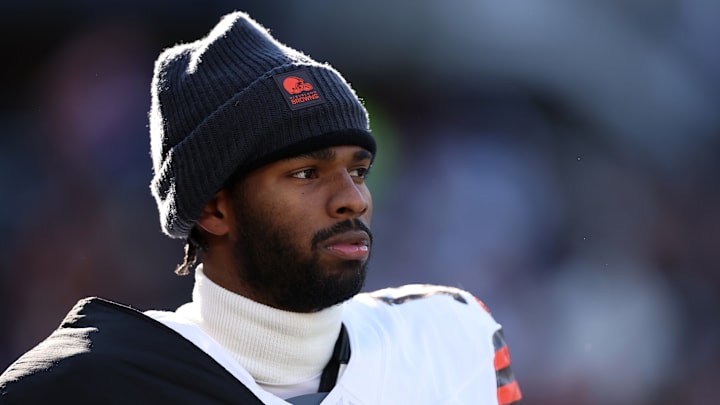
Shedeur Sanders moment in the spotlight is now. He may not start for the Browns beyond this season, but Cleveland fans sure assume he deserves that title. Sanders was dealt a tough hand. The Browns don't have the skill-position talent to help Sanders make the plays he once made look routine at Colorado.
However, the Browns failures are also on the NFL. Several of Sanders' interceptions so far in Cleveland went off a potential pass-catcher's fingertips. In other sports, that turnover would be awarded not to the quarterback, but to the player who dropped the pass. Instead, Sanders wears the blame and has to hear about it each week as he fights for his job.
Shedeur Sanders and the Browns highlight a big NFL problem

While advanced stats often take dropped passes and poor offensive line play into account, the most basic counting stats do not. In other leagues, such as MLB, NHL and NBA, the official scorer can assign turnovers or errors to just about anyone. Whoever is to blame, ultimately has that negative statistic added to their resume. In the NFL, any interception is on the quarterback, and that can impact their future contract or status on the team as a whole.
Frankly, this issue impacts not just Sanders, but star quarterbacks around the NFL. Interceptions are awarded to quarterbacks without a second thought. If a receiver drops a pass, and it leads to a pick – despite a perfectly-thrown ball, mind you – it's an interception. If the offensive line cannot protect the quarterback and gives him less than three seconds to throw the football, a sack and anything thereafter is awarded to the quarterback.
Sure, QBs tend to make more money than their counterparts, so they sign up for this. But at the same time, there ought to be more strict rulings on such an important statistic.
How the NFL can fix its official scorer problem, and taking some of the blame off QBs
MLB (surprisingly) does a decent job at this. For example, catchers are forced to frame every pitch from an unpredictable source. MLB pitchers frequently throw over 100 MPH these days. Those pitches are tough to catch on a consistent basis, especially if they don't hit their intended target.
Shedeur Sanders gets a registered interception but actually watching the game you see that Quinshon Judkins has a drop that tips to the Buffalo Bills. That has to be a catch. It’s not a perfect throw but can’t have that turnover.
— Brendan Abban (@BrendanAbban) December 21, 2025
pic.twitter.com/2ec6I6fWrJ
Thus, MLB has divided the wild pitch stat into two different categories. If the pitch is actually wild and unpredictable, then it's the pitcher's fault. If the catcher drops a routine pitch for next-to-no reason, then the catcher is blamed. The same can be said for errors, which are only given to the fielding player if a throw would've beaten the runner. Sure, it leaves a lot up to circumstance – and adds a lot of pressure on the official scorer – but it's important, no?
NFL's official scorer crisis can help with a future CBA
If the NFL could add similar statistics, especially for quarterbacks, it would aid the NFLPA and perhaps avoid future bargaining issues. Players would be paid more as a result of better statistics. As much as NFL teams rely on film when they sign or trade for players, stats definitely play a role.
Jerry Jeudys 10th drop of the year leads to an interception (leads league). Even more concerning, he has dropped 22.2 percent of the on-target passes thrown his way. This is who JJ is. He drops passes. pic.twitter.com/daBQf1P2Q6
— Typic4lbrownsfan (@typic4lbrownfan) December 15, 2025
If, say, Sanders and Dillon Gabriel were available, it's tough to know who to take a chance on. Yes, both players are rookies, but Gabriel (at least on the surface) looks like a QB who takes care of the ball. Sanders is a bit more loose with it because he takes chances. He's made some impressive throws for a Cleveland team that, frankly, hasn't done him many favors. But per his basic stat-line is (as it says now), five touchdowns and six interceptions with several fumbles to his name, he doesn't look like any team's quarterback of the future.
However, when Judkins' drop and a few others are factored in (you know who you are), it paints a different picture.
More NFL news and analysis:
 Add us as a preferred source on Google