
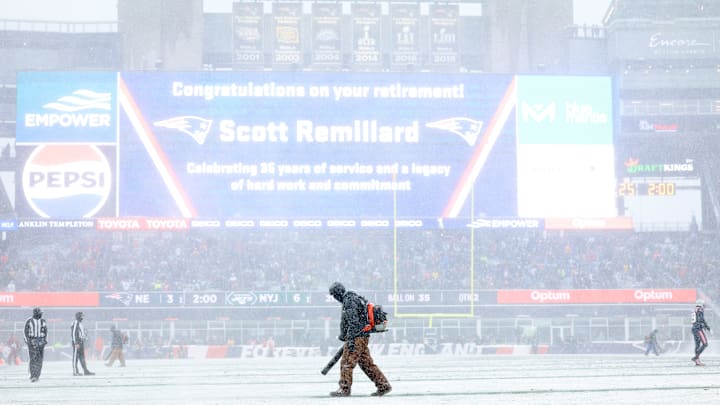
We're on to the Divisional Round of the NFL playoffs this weekend, and as the calendar takes us further into January, Mother Nature will play more and more of a role in the outcomes of these games. All four matchups are taking place in cold-weather markets with outdoor stadiums — including in Foxboro, where the No. 2 seed New England Patriots will welcome the No. 5 seed Houston Texans to Gillette Stadium on Sunday afternoon.
But while Pats fans are no strangers to snow games in the past — the more miserable the weather got, the happier Bill Belichick seemed to be — the truth is that NFL teams have gotten much better at handling the elements in recent years. And that's in large part to the advent of some very convenient technology that will be on display in New England this weekend.
Do the New England Patriots have a heated field?
Yes, the turf at Gillette Stadium is heated, part of a growing trend around the NFL. Asking teams to play football in New England in January would be pretty inhospitable without it, especially now that most teams around the league have moved to some type of artificial turf.
But what does that mean, exactly? How does heating an NFL field work, and what does and doesn't this technology do?
How do heated NFL fields actually work?

Pipes. Lots and lots of pipes. Miles of them, in fact, in a massive network lying underneath the playing surface (whether that surface is natural grass or artificial turf). But the pipes themselves aren't as important as what's in them: a mixture of water and glycol, which is essentially a type of antifreeze.
That glycol lowers the freezing point of water, and as a series of boilers and pumps send that warmer water through the pipe system, the radiant heat helps keep the playing surface above from freezing over. It doesn't mean that the field is heated in the way that, say, a heated floor or the heated seat of your car is heated — it's still winter in Massachusetts, and it still hurts to fall onto it — but it does enough to keep things safe for play.
Why heated fields don’t melt snow right away
Just because there's a heating system doesn't mean that the field is going to actually be warm. It'll just be warmer than it otherwise would, so that, for example, a playoff game at Arrowhead Stadium with a wind chill at kickoff of around -27 degrees Fahrenheit gets back toward something approaching reasonable.
Really, all the heating system does is generate some warmth and try to apply that warmth to the playing surface above. But the temperature outside is still the temperature outside; if it's significantly below freezing, there's only so much you can do, which means that the turf will still be plenty cold enough for snow not to melt.
Will the Patriots vs. Texans game have snow?

Unfortunately, it's looking like we won't get some good old-fashioned snow football this weekend. The forecast in Foxboro on Sunday afternoon calls for mostly cloud skies but no precipitation, with temperatures somewhere in the low- to mid-30s — dropping lower as the sun sets in the second half. If the NFL had made this game a Saturday kickoff, the forecast would be significantly gnarlier, with some mix of snow and rain expected throughout the day.
Which stadiums have heated fields?
As more and more NFL teams move toward domed stadiums, there isn't as much of a need for warming up the field. But there are still 13 outdoor stadiums in the league that are at risk of cold weather, and of those 13, 12 of them have some type of heating technology.
- Acrisure Stadium (Pittsburgh Steelers)
- Arrowhead Stadium (Kansas City Chiefs)
- Gillette Stadium (New England Patriots)
- Huntington Bank Field (Cleveland Browns)
- Lambeau Field (Green Bay Packers)
- Lincoln Financial Field (Philadelphia Eagles)
- M&T Bank Stadium (Baltimore Ravens)
- MetLife Stadium (New York Giants and Jets)
- Mile High Stadium (Denver Broncos)
- Northwest Stadium (Washington Commanders)
- Paycor Stadium (Cincinnati Bengals)
- Soldier Field (Chicago Bears)
The lone exception? Highmark Stadium in Buffalo, because as always, Bills fans are built different. (The actual answer is that Highmark Stadium is just pretty old, older than many of the technological advancements that other NFL teams enjoy today, which is a big part of the reason that the team is moving into a new — and heated — field for 2026.)
 Add us as a preferred source on Google