
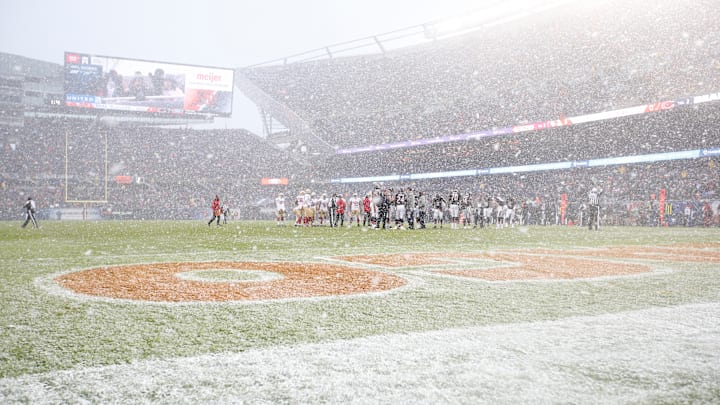
There’s a chance for some snow playoff football in Chicago this weekend, as the Green Bay Packers (9-7-1) and the Chicago Bears (11-6) meet for the third time this season. Saturday night's Wild Card matchup is an 8 p.m., 32-degree, snow-potential win-or-go-home game. Can you ask for a more Midwest experience? Before we start manifesting a snow globe at Soldier Field, there’s one thing we need to clear up.
Do the Chicago Bears have a heated field?
Yes, the Bears have a heated field. That doesn’t mean the snow will magically melt on contact, though. From a practical standpoint, heated NFL fields are designed to keep the ground from freezing and the grass alive, not to turn December games into slush bowls. Sometimes snow sticks. Sometimes it doesn’t.
Here’s how heated fields at Soldier Field and around the NFL actually work.
How do heated NFL fields actually work?
You know that cocky neighbor who always has a clean driveway when it snows, even though you’ve never seen them throw salt out? They probably have an electrically heated driveway. That’s not what NFL stadiums are doing.
All plants have something called a root zone. It’s the area where the roots actually absorb nutrients from the soil. In NFL stadiums, grounds crews intentionally build that root zone to be about a foot deep by laying a layer of gravel (or gravel-like material) beneath it. Below the gravel is where all the technical stuff is, like the drainage pipes, and in our case, the turf heating (and/or cooling) system. At Soldier Field, that system is nine inches below the root zone.
These pipes snake back and forth about a foot apart from each other, and they’re filled with water and a type of antifreeze. Boilers and pumps keep that water flowing. In theory, the heat from that moving water keeps the turf at a livable temperature. A livable temperature is above freezing (duh), which should make sure the ground is not frozen for the players.
Why heated fields don’t melt snow right away
We all remember the Chiefs' playoff game in 2023. It was -30 degrees. Arrowhead’s heating system was supposed to keep the field at 50 degrees. That’s impossible to do. That’s like pumping your thermostat up to 80 degrees when it’s 30 degrees outside, and opening all of your windows and doors. Sure, your furnace is going to keep pumping, but it’s never going to actually get to what you set it at.
That’s what you’ll see teams put big covers on their field before cold games. When they do that in baseball stadiums, it’s to keep the infield dry. In football stadiums, it’s to trap the warmth (like a thermal cover on a pool). So ...
- Are fields heated? Yes.
- Does that mean there’s going to be heat radiating off the field? Of course not.
- Can snow still accumulate? If the field is cold.
- How does the field get cold enough? If the weather is cold.
Will the Packers vs Bears game have snow?
That’s a hell of a question. AccuWeather says the temperature at game time is going to be 32 degrees with a RealFeel of 18 degrees, and that’ll go down to 29 degrees and 13 degrees, respectively. It also says that the snow is supposed to come before the game starts. Hopefully, they’re wrong. Hopefully, the air gets cold enough to nullify the heating system, and hopefully the game gets hammered with a blizzard in the second half. Hopefully, we're treated to a snow game.
Which stadiums have heated fields?
There are 13 outdoor NFL stadiums that are realistically threatened by super cold weather and/or snow. And 12 of those stadiums have some type of heated grass field.
- Acrisure Stadium (Pittsburgh Steelers)
- Arrowhead Stadium (Kansas City Chiefs)
- Gillette Stadium (New England Patriots)
- Huntington Bank Field (Cleveland Browns)
- Lambeau Field (Green Bay Packers)
- Lincoln Financial Field (Philadelphia Eagles)
- M&T Bank Stadium (Baltimore Ravens)
- MetLife Stadium (New York Giants and Jets)
- Mile High Stadium (Denver Broncos)
- Northwest Stadium (Washington Commanders)
- Paycor Stadium (Cincinnati Bengals)
- Soldier Field (Chicago Bears)
The one that doesn't? Highmark Stadium for the Bills. Buffalo has artificial turf, so they don’t need anything to keep the grass alive, so they just bought all the way into it and use the cold weather, cold ground, and snow as a home field advantage. That’s objectively sick.
But unless something wacky happens in the AFC playoffs, the Bills have played their last game at that stadium. Their new stadium (also named Highmark) is going to have natural grass. Since it’s in Buffalo, they’re going to have a heating system underneath it.
Are domed stadiums killing snow football?
There’s nothing in the world that’s more beautiful than snow football, and in 2026, it seems like the universe is trying to take those games away by building domes.
I don’t think that’s on purpose, though. Owners are always talking about how they want to build stadiums that can hold more events (NCAA basketball games, Super Bowls, more concerts), which makes sense.
 Add us as a preferred source on Google