
Key Points
Bullet point summary by AI
- The 2026 NFL Draft saw teams prioritize future assets over immediate needs. Smart front offices built foundational cores to support next year's rookie QB class.
- The New York Jets and Cleveland Browns dominated by adding elite linemen and pass rushers. Ty Simpson landed in a perfect developmental spot with the LA at 13.
- Building depth now ensures a better environment for 2027's top signal callers. This strategic patience marks a significant shift in NFL roster construction.
The 2026 NFL Draft landed in a unique way for teams, who clearly were keeping their powder dry for next year's class. No first-round 2027 picks changed hands on draft weekend, a sign that teams value the strength of the class (particularly at quarterback) enough to make short-term sacrifices in exchange for longer-term gains.
That didn't stop some head-scratching picks in Round 1, but smart teams were able to use the 2026 draft to build strong foundations to help rookie quarterbacks in the future. Let's take a look at the winners and losers of this draft, starting in New York with the Jets.
2026 NFL Draft - Winners
New York Jets
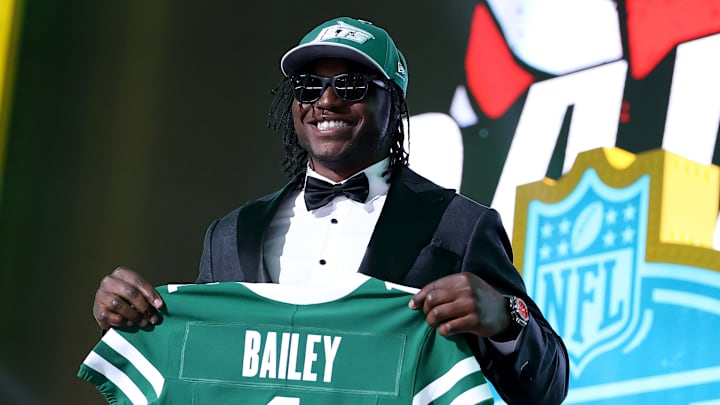
The Jets entered the draft with four picks inside the Top 44 and landed four foundational pieces for their rebuild. David Bailey gives them a strong floor with the draft's best pure edge rusher while Kenyon Sadiq and Omar Cooper add some much-needed firepower to a depleted offense.
The sneakiest value in the group may be cornerback D'Angelo Ponds on Day 2, who plays a lot like Jets' coach Aaron Glenn did as a player. Building a strong foundation now, to go along with three more first-round picks next season, allows New York to set up whatever quarterback they can target in next year's class with a better foundation than any rookie has had in New York since Mark Sanchez in 2009.
Ty Simpson

Most experts wondered whether Ty Simpson would be an option for the Jets at the top of the second round, but he was a big-time winner by going to the Los Angeles Rams at No. 13. Few teams are better at teaching quarterbacks than the Rams and Simpson will get to learn under the reigning MVP in Matthew Stafford as well as head coach Sean McVay.
The Rams are in win-now mode, so there is no pressure for Simpson to play right away, which is helpful since he only had 15 career college starts. Sitting and learning gives Simpson the best chance to establish himself as a starter in the league, making him a clear winner of the draft process.
Cleveland Browns
Much like the Jets, Cleveland found itself locked out of the Fernando Mendoza sweepstakes and wisely opted not to force the issue at quarterback. The Browns used their first few picks to bulk up their offensive line (Utah tackle Caleb Lomu, Florida tackle Austin Barber) and receiving corps (Texas A&M's KC Concepcion, Washington's Denzel Boston).
The defense also got a nice boost with safety Emmanuel McNeil-Warren, who can address one of the few weak spots in the unit. Building a stronger offensive foundation is the bigger deal, however, as it will let them make a more thorough evaluation of Shedeur Sanders before deciding how to attack the position in next year's draft.
Off-Ball Linebackers

NFL teams haven't made a tremendous investment in off-ball linebackers, but a strong class at the position was rewarded. Seven off-ball linebackers went within the first two rounds of the draft, including two in the top 10, with Ohio State teammates Arvell Reese and Sonny Styles going to New York and Washington respectively.
Seeing teams invest premium draft capital in off-ball linebackers is a nice change for a group that hasn't been paid handsomely over the years. If players like Styles, Jacob Rodriguez and Josiah Trotter live up to their draft status we could be looking at a linebacking renaissance in the league.
Steve Spagnuolo
The Kansas City Chiefs aren't used to drafting highly, so it was an open question how they would use their premium draft assets. The big winner here was defensive coordinator Steve Spagnuolo, who saw his unit receive a significant talent infusion with Kansas City's first four picks.
Three of those picks came within the top 40 as cornerback Mansoor Delane, defensive tackle Peter Woods and edge rusher R Mason Thomas bulked up a unit that suffered a talent drain over the past few years. While the Chiefs will ultimately go as far as Patrick Mahomes takes them, supporting him with a strong defense gives Kansas City its strongest chance at building a second wave for their dynasty.
2026 NFL Draft - Losers
Sean McVay

The scene at the Rams' press conference after the first round was certainly noteworthy as McVay looked visibly annoyed throughout the proceedings. While Simpson was a long-term play for the Rams to maintain competent quarterbacking after Matthew Stafford retires, it does little to help Los Angeles win this season.
Things will have gone quite wrong if the Rams need to use Simpson in 2026, likely meaning Stafford either got hurt or regressed from his MVP level of play. There were multiple other players available at 13 who could have helped McVay win now, including tight end Kenyon Sadiq and guard Vega Ioane, but he now has to worry about developing a quarterback instead.
Houston Texans
The Texans were kind of in no man's land towards the back of the first round, but the way they approached their picks was confusing. Offensive line was a clear need for Houston and they did take linemen, but most experts agreed that they significantly reached to take Keylan Rutledge in the first round.
Houston significantly reached on multiple picks, including with tight end Marlin Klein (who had a fifth-round grade for some experts) in Round 2. Both of the players the Texans landed in the fourth round (guard Febechi Nwaiwu and linebacker Wade Woodaz) were taken well ahead of where the consensus had them, meaning Houston didn't maximize the value of their selections.
Minnesota Vikings

This is another case where a team didn't align its assets with its most important needs. The Vikings entered the draft with a dire need at safety and waited until the third round to address it with Miami's Jakobe Thomas, which is better than ignoring their need at receiver entirely.
Reaching for Florida's Caleb Banks at defensive tackle didn't make much sense, especially after the Vikings took another player at the same position (Iowa State's Domonique Orange) two rounds later. Linebacker Jake Golday figures to help at linebacker, but when you add in the loss of Jonathan Greenard via trade to Philadelphia it was a rough weekend for Minneota.
Malik Willis
The Miami Dolphins handed Malik Willis a lot of money to be their starting quarterback and didn't do much to help him in the draft. Many assumed the Dolphins would use the draft to attack the wide receiver position after cutting Tyreek Hill and trading Jaylen Waddle, but Miami bypassed the top of the class and waited until the third round to take receivers.
Louisville's Chris Bell was solid value at that point, but Texas Tech's Caleb Douglas was a massive reach where he was taken. Asking multiple rookies outside the first two rounds to contribute right away is a tall order, so Willis is not exactly in a good position to establish himself as a long-term starter with a lackluster supporting cast.
Running Backs
If you didn't go to Notre Dame it wasn't a good year to be a running back in the draft. The Fighting Irish had both of their top backs go in the first round, with Jeremiyah Love going third to Arizona and Seattle taking Jadarian Price at No. 32, but only one other running back went in the first three rounds: Indiana's Kaelon Black, who was taken by San Francisco at pick 90.
Teams were content to grab a bunch of backs on Day 3, where the risk is lower and excess value is greater if they hit on a rusher. Most NFL running backs haven't fared well in free agency and this year's lackluster crop of backs didn't do much to help the value perception of the position in the long run.
More NFL Draft news and analysis:
 Add us as a preferred source on Google