
It seems like just yesterday the Seattle Seahawks were hoisting the Lombardi Trophy, but we've already reached the first major milestone of the NFL offseason: the franchise tag window is officially open.
Only two players — Cincinnati Bengals wide receiver Tee Higgins and Kansas City Chiefs guard Trey Smith — got hit with the tag last offseason, and both eventually wound up signing long-term contracts rather than playing out the season on a one-year deal. But there's reason to think that this year could be a lot busier, with one Pro Bowl-caliber player already ticketed for the tag and several others potentially on the way.
Here’s everything you need to know, and who to watch out for, during the franchise tag window.
When is the franchise tag window?
The franchise tag window opened on Tuesday, Feb. 17, and will close at 4 p.m. ET on Tuesday, March 3. That gives every team two weeks to decide whether they want to apply the tag to any of their free agents-to-be before they hit the market later in March.
How does the franchise tag system work?

At any point in the next two weeks, teams have the option to tag one player who is currently slated to hit unrestricted free agency this offseason. The tag functions as a one-year, fully guaranteed contract at a fixed, non-negotiable salary (more on that in a moment). Once the tag is applied, player and team are still free to negotiate a new long-term deal. If no new deal is reached before the July 15 deadline, however, the player will play out the 2026 season on that one-year contract. (Players can be tagged multiple times, but the salary numbers begin to skyrocket if you try to apply the tag to the same player in consecutive years.)
It's also worth noting that there are two types of franchise tags. The first, and most common, is the exclusive tag, in which the tagged player can't negotiate with other teams and must either play out the season on the franchise tag or negotiate a long-term contract with his current team. The other is the non-exclusive tag, in which the player can negotiate with other teams like in free agency — but with the caveat that his original team can choose to either match any competing offers or receive two first-round picks as compensation if he walks.
Franchise tag salaries for each position in 2026
The franchise tag isn't the same for everyone. The salary a player will make on the tag is equivalent to the top five salaries at that player's position (or 120 percent of the player's previous year's salary, whichever number is higher).
Naturally, that means that quarterbacks will make a whole lot more on the tag than, say, tight ends. And the way the tag formula flattens positional eligibility leads to some tough choices — both offensive linemen and linebackers get lumped together for the purposes of calculating average salary. So if you want to apply the tag to, say, your left guard, you're going to wind up paying him more like a left tackle.
Here are the numbers for this year's tag across all positions, courtesy of Spotrac.
Offense
- QB: $47.242 million
- RB: $14.186 million
- WR: $28.037 million
- TE: $16.007 million
- OL: $27.764 million
Defense
- DE: $26.710 million
- DT: $27.424 million
- LB: $27.559 million
- CB: $20.783 million
- S: $20.758 million
Special teams
- K/P: $6.846 million
Which players have received the franchise tag so far?
No players have officially been tagged as of yet, which isn't too surprising. This isn't like free agency, where a flurry of moves happen immediately: Front offices know they have two weeks to work with, and they have no reason not to use every bit of that time to try and work out a long-term extension or canvass the leageu for potential trade offers.
Most likely franchise tag candidates in 2026
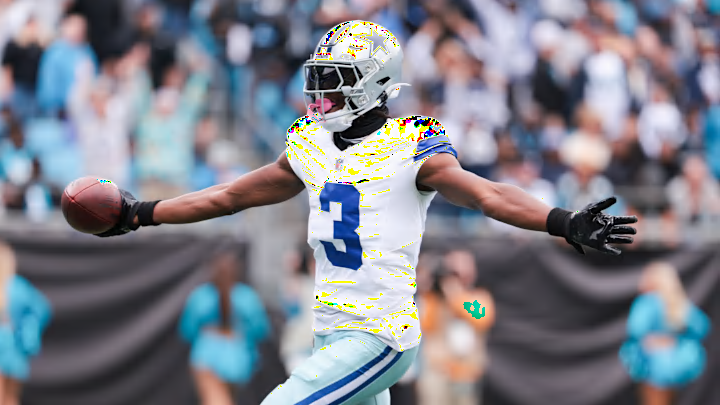
WR George Pickens, Dallas Cowboys

Coming off the best season of his career, Pickens is now looking to get paid — whether that's in Dallas or somewhere else. He's set to become a free agent when the window opens in March, but the Cowboys have already signaled that they intend to apply the franchise tag to prevent that from happening.
Once that happens, talks will no doubt begin on the long-term contract Pickens has earned. With CeeDee Lamb already making top-of-the-market money, though, the Cowboys need to be careful with how much they're paying their dynamic receiving duo.
RB Breece Hall, New York Jets

A rebuilding team like the Jets wouldn't seem to have much interest in paying a running back with precious few years remaining in his prime. But New York opted against trading Hall at the deadline this year, which would seem to be a sign that they want to keep him around: And sure enough, The Athletic's Zack Rosenblatt reports that "the winds have been blowing" in the direction of the Jets using the tag.
Then the question becomes: To what purpose? Is Hall really the best use of resources for a team with this many holes? Or does GM Darren Mougey plan on tagging Hall and then trading him to any number of interested suitors? Getting something for him rather than nothing would seem to be a smart move for an organization that needs all the draft capital it can get right now.
RB Kenneth Walker III, Seattle Seahawks

The picture is much different for the other big running back set to hit free agency this offseason, as ESPN has already reported that the Seahawks don't plan on using the franchise tag on the Super Bowl LX MVP. Walker is a sensational runner who exploded during Seattle's playoff run with Zach Charbonnet injured, but the Seahawks have the luxury of not needing to get into a bidding war for a player who's more a luxury than a need right now.
That doesn't mean that a Walker reunion has already been ruled out; Seattle will no doubt make a competitive offer for him once the market opens in March. But signing up for a $14 million cap hit for 2026 would use up a big chunk of the team's space.
TE Kyle Pitts, Atlanta Falcons

Pitts finally showed some signs of life this season, just in time to become a free agent in March. Will Atlanta let him get there? The team has yet to make a decision one way or the other, although new head coach Kevin Stefanski did rave about both Pitts as a player and the importance of the tight end position overall in his introductory press conference.
If the Falcons don't want to let him go just yet but are also hesitant to commit financially to a player who's been so hard to trust over the course of his career, the tag could be a good compromise.
EDGE Trey Hendrickson, Cincinnati Bengals

The saga of Hendrickson in Cincinnati isn't over quite yet. Both player and team seem ready to move on at this point, but the Bengals could still decide to slap the tack on their star edge rusher in order to try and trade him this offseason. It's better than letting him walk for nothing, and while it does invite the risk of getting stuck with him still on the roster for 2026, it seems pretty safe that some pass rush-needy team will be willing to cough up healthy draft capital for his services.
QB Daniel Jones/WR Alec Pierce, Indianapolis Colts

The Colts will almost certainly use the tag on somebody in the next two weeks. The only question is who: Will it be Jones, who sure looked like a franchise QB before suffering a fractured fibula followed by an Achilles injury? Or will it be Pierce, who offers a dynamic downfield threat that Indy otherwise lacks?
If Jones had finished the season healthy, he'd be the obvious answer; viable starting quarterbacks simply don't come available very often, and you lock them up when you have the chance. But the Achilles situation could cloud his future enough that he becomes affordable to bring back in free agency, allowing Indy to tag Pierce and work out a long-term deal with its WR1.
More NFL offseason news and analysis
 Add us as a preferred source on Google