
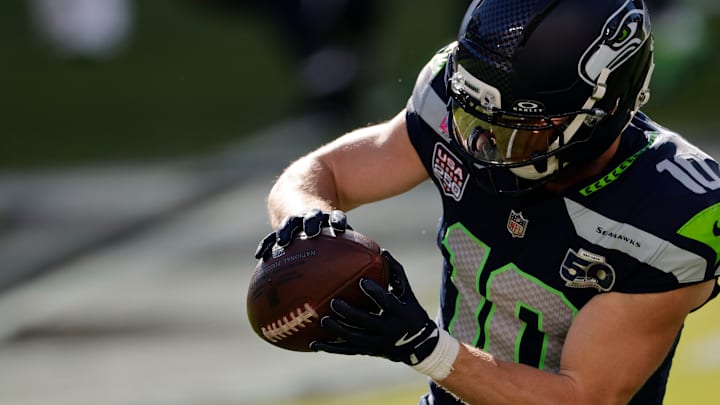
If there's been one constant this NFL season, it's been officiating controversy, with a new reason for one fan base or another to get angry at the zebras seemingly every week. So of course it took less than two minutes of Super Bowl action to get our first questionable call of the big game, courtesy of a catch by Seattle Seahawks wideout Cooper Kupp that ... may not actually have been a catch.
Darnold to Kupp on the sideline for a gain of 23!
— NFL (@NFL) February 8, 2026
Super Bowl LX on NBC
Stream on @NFLPlus + Peacock pic.twitter.com/Az2LAfQomU
The play was ruled a catch on the field, and Seattle's offense hurried up to the line before the New England Patriots could get a challenge in. Upon further review, though, challenging might have been a smart idea: While Kupp got two feet in before heading out of bounds, the ball certainly seemed to move a bit as Pats corner Marcus Jones stuck his arm between Kupp's hands.
It turned out to be a crucial play, too, as the Seahawks wound up getting a field goal out of the drive to take a 3-0 lead. So: Did the refs get this one right? Here's what the NFL rulebook has to say.
How does the NFL define a catch?
It's become something of a running joke at this point: somehow, we still have no idea exactly what a catch is, with the definition varying based on the circumstances (or, for the more cynical among us, who the teams are). Per the NFL rulebook, a pass is complete if a player:
- secures control of the ball in his hands or arms prior to the ball touching the ground; and
- touches the ground inbounds with both feet or with any part of his body other than his hands; and
- after (a) and (b) have been fulfilled, clearly performs any act common to the game (e.g., extend the ball forward, take an additional step, tuck the ball away and turn upfield, or avoid or ward off an opponent), or he maintains control of the ball long enough to do so.
Kupp initially secures the ball in his hands, and he certainly touches the ground inbounds with both feet. But does he actually complete the third requirement, maintaining control of the ball "long enough" to perform any act common to the game?
Did officials rule Cooper Kupp catch correctly during Super Bowl?
No one's asking me, but I'd say no. The ball clearly shifts in Kupp's hands once Jones makes contact, and by the time he secures it again, he doesn't get two feet inbounds. By rule, that should be a catch ... although it's worth noting that the NFL sometimes plays fast and loose with what constitutes "control". The ball can technically move ever so lightly, just as long as it doesn't move enough for the officiating crew to decide that control was lost.
Really, it seems to more or less come down to vibes. And that helps explain why the Patriots opted not to challenge: It's impossible to know exactly what the replay officials will think in this sort of situation, and with a high bar to clear to overturn a call on the field, Mike Vrabel didn't want to risk it and burn a timeout. All of which could be rectified if we simply found a way to define a catch in a satisfactory way, but that's too much for the richest league on Earth.
 Add us as a preferred source on Google