
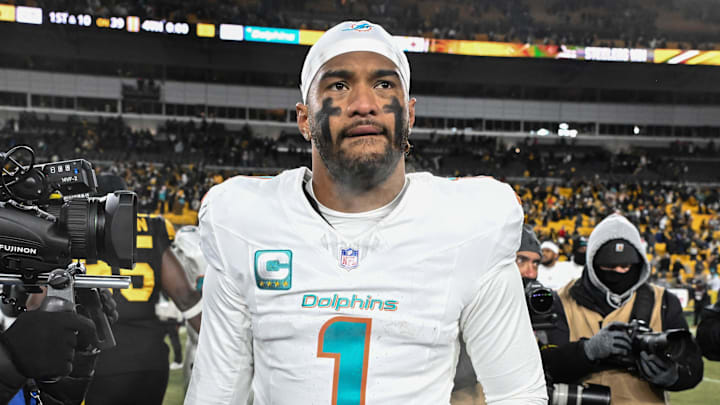
Unless hell freezes over between now and September, quarterback Tua Tagovailoa won't be the Miami Dolphins' starter in 2026. The 27-year-old recorded 2,660 passing yards, 20 touchdowns and a frightening 15 interceptions in 14 appearances last year (37.5 QBR), another losing season that signaled the end of the Mike McDaniel era in South Florida.
With Mike McDaniel now serving as OC for the Chargers and Miami staring down a rebuild, reports indicate Tagovailoa, who is owed a fully guaranteed $54 million, is unlikely to be playing for the team this upcoming season. But just how the Dolphins handle the situation is another question entirely.
If Tagovailoa is cut immediately, Miami would have to eat $99.2 million in cap charges for the 2026 season. If he's given a post-June 1 designation, then the team can spread out that hit across the next two years ($55.4 million in 2026 and $43.8 million in 2027).
Neither option is ideal, to say the least. But while it might be tempting to take the smaller short-term hit, and avoid nearly nine figures of dead cap money sitting on your books at once, that might actually be Miami's best course of action.
Why the Dolphins can solve their Tua Tagovailoa problem by soft tanking
Considering the NFL salary cap is expected to be between $301.2 million and $305.7 million next season, Tagovailoa's one-and-done cap hit of $99.2 million would eat up roughly a third of Miami's cap space, more or less torpedoing their 2026 season before it even begins — it's hard to imagine building a competitive roster around that sort of albatross, especially considering the Dolphins' needs elsewhere.
But really, isn't Miami's 2026 season torpedoed anyway? Isn't that what firing McDaniel and moving on from Tagovailoa meant in the first place — that it was time to start over? Doing so was never going to be quick, or easy. And it will be a lot smoother in the long run if the Dolphins just take all of their medicine at once rather than prolonging the pain.
Let's say Tagovailoa is cut and Miami takes the full cap hit. General manager Jon-Eric Sullivan will struggle to replace him and other former stars like Bradley Chubb and Tyreek Hill in free agency next month. That means head coach Jeff Hafley may have to turn to backup QB Quinn Ewers to start with a skeleton crew of an offense and a Swiss cheese defense.
Good luck finding wins in that scenario. The Dolphins hold the No. 11 pick in in a draft where there are no obvious stud passers beyond Heisman Trophy winner Fernando Mendoza. Miami can take the best available prospect, or simply find a bridge option in free agency and punt on a franchise QB until next year — where talents like Oregon's Dante Moore and Texas' Arch Manning are expected to be available.
Spreading out the cap hit would help free up some spending room this offseason, sure. But no matter how much money Miami spends, they're not going to turn themselves into contenders overnight. And by putting a still-significant cap hit on the books for not just 2026 but 2027 as well, the Dolphins risk getting stuck in purgatory, not good enough to matter but not truly bad enough to start over (and find their next franchise passer). That delays a rebuild or forces the general manager to trade valuable draft capital to move up.
Tagovailoa is acting as a financial and competitive anchor the longer he is associated with the team. No matter how you cut it, the Dolphins have $99.2 million to ink into their ledgers. Ripping the bandage off really looks to be the lesser of two evils here.
 Add us as a preferred source on Google