
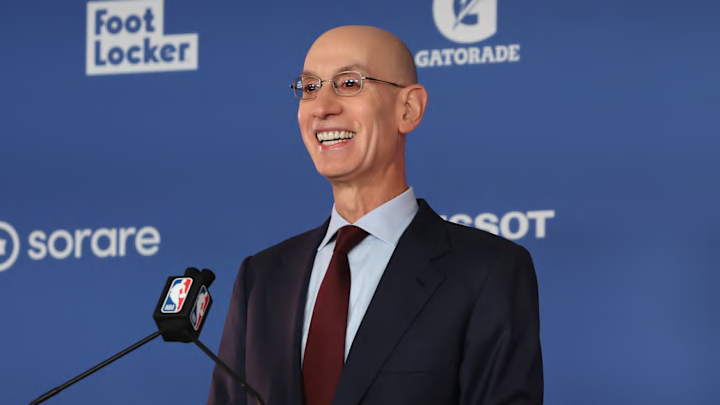
The WNBA and WNBPA have been engaged in tumultuous negotiations over the latest CBA for roughly 10 weeks. The original October 31 deadline was pushed back twice, first to Nov. 30, and then to its current date, Jan. 9, 2026.
Though both parties have gone back and forth on a number of issues, the most disputed has been revenue sharing. Under the current CBA, players only receive 9 percent of all revenue generated by the league, while NBA players get over five times that, at a whopping 50 percent. Players argue that such a small percentage undermines their own value, while the league argues that drastic differences in total revenue between the NBA and WNBA (the NBA valued at 14.3 billion and the WNBA at $300 million) with roughly the same operating costs limit the league’s ability to yield to player demands.
The league’s resistance appears to be rooted in preserving the WNBA’s longevity, yet they do not seem bothered by an arguably more striking calculation: between Unrivaled, Athletes Unlimited, overseas leagues, and the highly anticipated international league, Project B, all 156 WNBA players could feasibly subsist without the WNBA, as these supplementary leagues provide salaries that equal or surpass those of the league.
Players have multiple, viable alternatives to playing in the WNBA
The league’s bargaining position only makes sense when we zoom out.
WNBA ownership is split between three major parties: 42 percent goes to the WNBA — another 42 goes to the NBA, and the remaining 16 percent is owned by a group of not so independent investors. Among the last group are Ted Leonsis, Joe Tsai, and Herb Simon, all of whom stake in the NBA and are the respective owners of the Washington Mystics, New York Liberty, and Indiana Fever.
Yet, not all WNBA owners are so directly tied to their parent league. A handful of teams are independently owned. The Seattle Storm is owned by Force 10 Hoops LLC, a group of all-woman investors. The Connecticut Sun is owned by the federally-recognized Mohegan Tribe. The Atlanta Dream is owned by Larry Gottesdiener, founder and chairman of Northland Investment Corporation, and the Chicago Sky is owned by Michael Sky, president of the Alter Group, a commercial real estate company. All of these owners invested in the WNBA long before its popularity and are in large part responsible for putting women’s basketball on the map. Nonetheless, they are implicated in the league’s bargaining tactics.
As long as the WNBA is owned by the NBA and affiliated investors, the league’s failure will be survived by its owners. CBA negotiations will reflect this reality — interests of investors will prevail over the players’ bottom lines.
With the majority of ownership either directly or indirectly affiliated with the NBA, potential losses in the WNBA do not seem as significant. A delayed or canceled WNBA season is obviously not optimal, but it does not threaten the core product, the NBA. Consequently, these parties can deploy riskier negotiation tactics, such as hard bargaining and conditional concessions, which drag out CBA talks and heighten tensions. Arguably, the league does not intend to alienate and undervalue players. Rather, its structural and financial backing gives a false confidence that its owners can get away with it.
Player loyalty to the league is well-founded, but not iron-tight. Caitlin Clark has vowed to play in the WNBA in a recent statement, but she commented on the increase in viable alternatives to that league: “I think more than anything, it showcases what people think of women's basketball. All of these different opportunities, all of these different leagues, the platform that they want to give women's basketball, where they think women's basketball is gonna continue to grow,” Clark told reporters at USA Basketball.
Already, Project B has captured big names, including Nneka Ogwumike, Alyssa Thomas, Jonquel Jones, and Jewell Loyd, Unrivaled has expanded from six to eight teams, and Athletes Unlimited expects 70 percent of its roster spots to be filled by players from the WNBA.
In light of a lockout, players may consider walking away. The group of independent investors has the opportunity to do the same, joining the countless other leagues that have left to make women’s basketball their principal investment.
More WNBA news and analysis:
 Add us as a preferred source on Google