

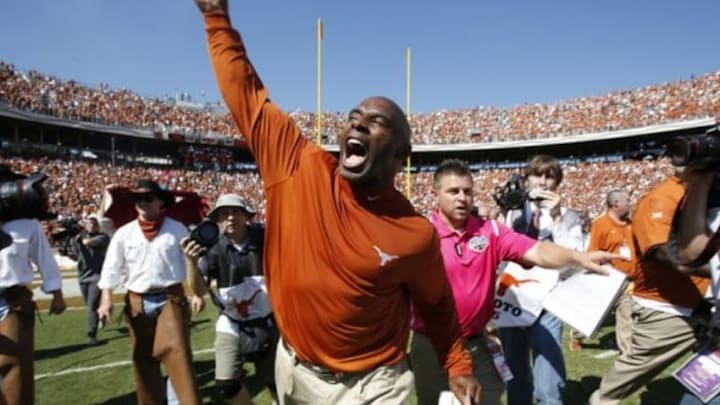
Charlie Strong’s victory over Oklahoma brought to light one of the more prevalent narratives in sports.
Once the final horn had sounded on Saturday and Texas had officially defeated tenth-ranked Oklahoma, Longhorns players doused head coach Charlie Strong with a Gatorade bath and carried him off the field on their shoulders. The celebration felt much greater than a rivalry game victory. In reality, it probably was.
Strong has faced an uphill climb since agreeing to coach for the pressure-cooker program two summers ago. Widely known not to have been the administration’s (nor the fan base’s) ideal choice to replace Mack Brown, Strong smiled politely and forged ahead. He dismissed a bevy of the old regime’s ne’er-do-well players and set about a complete institutional overhaul in order to resurrect one of college football’s proudest programs.
The 2014 season began with tempered optimism and was ultimately a roller coaster bookended with unsightly defeats. Losses to BYU and UCLA (at home and in AT&T Stadium) proved that Strong’s team was a work in progress. Midseason happiness was snuffed following a 23-0 shutout to Kansas State. And despite making a bowl game (The Texas Bowl, of all contests), the Longhorns’ fate in their final two contests – defeats with the combined score of 79-17 – gave way to a grey offseason.
Things only got worse for Strong and his team as the calendar pages flipped to the autumn months of 2015. Texas was pummeled by Notre Dame on the road, then defeated Rice in a tougher-than-it-should’ve-been game in Austin. And then the wheels came off.
Among waves of discontent, Texas dismissed athletic director Steve Patterson – the man who hired Strong – on September 15. Four days later, a missed extra point would gift California a 45-44 victory over Texas inside Darrell K. Royal-Texas Memorial Stadium. The following week, another special teams gaffe would fell Texas, again at home, this time against Oklahoma State. Seven days later, the Longhorns would travel to Fort Worth and get waxed by TCU, 50-7, in a game that was over by halftime.
With his employer ousted and a trio of bad beats Charlie Strong was officially on the hot seat.
So goes the curious world of college athletics (and sports in general). It’s widely acknowledged that the Longhorns program, while not broken, had slipped considerably under Brown. It would take time for any coach to right the ship – three years at the very least.
In this age it’s not so much if you lose, but how you lose. Texas looked not at all competitive against Notre Dame and TCU. Against Oklahoma State and Cal the team proved that it couldn’t finish close games. The Longhorns were inept in every way. They needed a win over Oklahoma for Strong to save his job.
But where does the “save your job” narrative come from? After Texas beat Oklahoma, seemingly every media member in a America came out of the woodwork to congratulate Strong. He’s a nice guy, people like him. Who, then, would push the firing agenda for such a beloved individual?
There’s a trope in the new media landscape to hit Twitter and gauge the public reaction. We are a shoot-first, ask questions later society. Hot takes and impulsive tweets. In the media we can steer the conversation without ever really engaging. We lob softballs about whether a coach should be fired, play off public perception and simultaneously dodge around a topic while pushing it to the forefront of people’s brains.
Strong, for his part, kept a steady course. Before the season he said that he had a good team. After heartbreaks and blowouts he maintained as much. He measures the product of his program by more than wins and losses; as Texas has proven this year, the bounce of a football can be a cruel mistress.
Sports is one of the few arenas in life where a timeline is given, all parameters and challenges are known and yet grades are distributed on an uneven curve. As results trickle in they’re graded at face value or patience to let a situation breathe beyond the day at hand.
In such a climate it’s easy to wonder why anyone would want to be a coach. Then you see Strong, a hero protectorate, carried off the field atop his players’ shoulders and the answer is suddenly clear.