
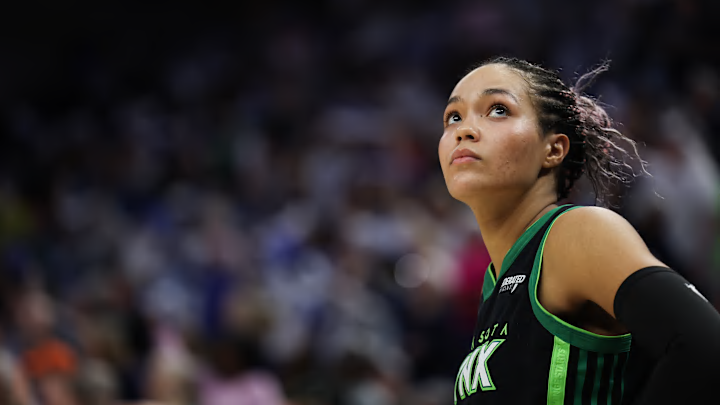
On Thursday, Dec. 18, 2025, the WNBPA voted to strike “when necessary.” A whopping 93 percent of eligible players participated in the vote, and 98 percent voted in favor of strike authorization. The vote does not guarantee a strike; instead, it signals widespread trust and support of the seven WNBPA executive committee members who can initiate a strike at any point before the Friday, January 9, deadline.
If realized, the strike would be a first in WNBA history, and the result would determine more than just player pay: it would define the primary beneficiaries of the league’s growth and set a precedent for women's professional leagues attempting to establish equitable labor relationships during periods of investment and expansion.
Striking also carries inherent risk: a strike would stall the expansion draft, suspend the season’s start, interfere with media deals, and above all risk stunting the momentum in league attendance and viewership once play resumes. According to The Athletic, the 1994-95 MLB strike and ensuing negotiations left such a sour taste in fans’ mouths that attendance the following season dropped 20 percent. If the WNBA were to suffer the same fate, regular season attendance would plummet from this year’s record high of 3 million to around 1.4 million, roughly the same number as the attendance record from 2002.
To strike or not to strike: Key considerations for the WNBPA
As the WNBPA executive committee members consider the stakes, they must consider the factors that will help, or harm, their bargaining power. Below is a list of five key factors that will influence player leverage should they choose to strike. Each factor represents a potential “win”, “loss” or “coin toss” for player bargaining power.
Ownership: Loss
WNBA ownership is split between three primary parties: the NBA (42 percent), WNBA owners (42 percent), and a group of independent investors (16 percent). Though truly independent owners could try to settle to curb losses, they are largely outnumbered by those who have a stake in the NBA. Six of the fourteen franchise owners and three of the independent investors also own NBA teams, meaning they can afford to ride out a work stoppage due to NBA backing. The NBA itself has been subsidizing the WNBA for years and has the financial bandwidth to outlast a player-led stoppage in order to maximize profit down the line.
Offseason leagues: Win
Historically, WNBA players would supplement their deficient WNBA incomes by playing abroad in Europe or Asia. Recently, three new leagues — Unrivaled, Athletes Unlimited, and Project B — present additional options, all offering salaries that equal or surpass that of the WNBA. If the majority of players partake in the aforementioned offseason leagues, they can wholly subsist without pay from the WNBA, forcing ownership to cave to their demands or see a permanent talent exodus.
Public narrative: Win
Players have not minced words when describing their qualms with the league. At an October press conference, WNBPA Vice President Napheesa Collier skewered commissioner Kathy Englebert’s leadership as the “worst in the world.” Since then, multiple players have spoken to news outlets or taken to social media to express frustration with the league’s continued resistance to equitable pay and fair treatment; however, the league has stated that player sentiment does not accurately characterize their bargaining approach. If the league wants to retain credibility as the top women’s basketball organization in the world, its leaders may find themselves yielding to player demands sooner than they intended to maintain their reputation.
Star power and visibility: Coin toss
Though the league’s popularity has been swelling for years, Caitlin Clark’s outsized role is undeniable. If Clark chooses to speak up on behalf of the WNBPA, the player cause will likely garner increased fan engagement, support, and consequently, leverage. Though Clark may carry substantial influence, countless other players — Angel Reese, Paige Bueckers, Aj’a Wilson — have also amassed large followings on social media and to have the ability to expose fans to their plight. After livestreaming for a total of 72 hours over WNBA All-Star weekend, the duo known as Stud Budz, Courtney Williams and Natisha Hiedeman, gained a loyal, often pink-haired fanbase ready to rally behind the player cause.
Union cohesion and solidarity: Coin toss
With 93 percent voting, 98 percent in favor, the vote for strike authorization signals historic solidarity among players across various age groups and experience levels. Leverage will hinge heavily on the players’ ability to maintain this solidarity as the strike protracts. The biggest threat is likely differences in stability among players, with younger players taking on larger financial risks without a cushion to fall back on compared to veteran players. On the other hand, star rookies like Paige Bueckers and Angel Reese, among others, have secured brand deals which comprise the majority of their income, while other newcomers yet to see the spotlight have opportunities to gain income from offseason leagues.
Where things stand right now
When asked about negotiations on Good Morning America earlier this week, Napheesa Collier stated that though no one wants a stoppage, WNBA and WNBPA are at a “bit of a standstill.” In a recent proposal, the league offered to give players 70 percent of net revenue (revenue after costs are covered) after claiming that the player proposal for 30 percent of gross revenue (revenue before costs are covered) would lead to a loss of $700 million across the span of the agreement, risking serious damage to the league’s hard-fought financial well-being. Players dispute this claim.
More WNBA news and analysis:
 Add us as a preferred source on Google