
Key Points
Bullet point summary by AI
- MLB umpires began calling fewer borderline strikes in 2025, even before the ABS Challenge System was implemented.
- The rate of called strikes in the shadow zone dropped sharply from 2022 levels, signaling a major behavioral shift among umpires.
- Pitchers who relied on edge-of-the-zone calls are now facing reduced margins, leading to higher walk rates and more hittable pitches.
The ABS Challenge System was coming in 2026. Everyone around baseball knew that. The impending arrival of a system that was going to prove or more importantly, disprove, an umpire’s call changed the way business was done.
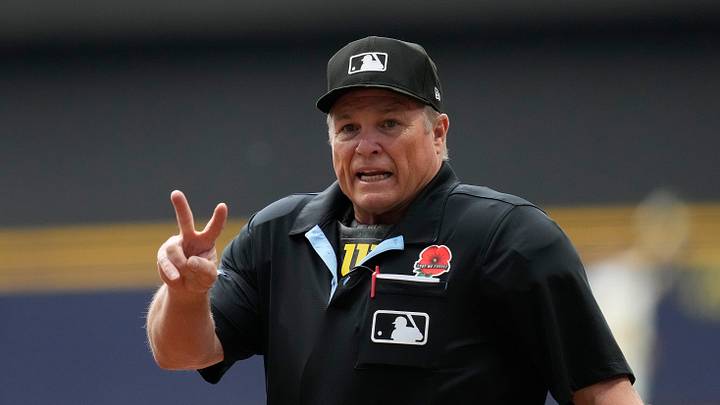
Umpires started calling fewer borderline strikes on their own in 2025.
Nobody came storming out of a dugout. Nobody tapped their helmet. The pitches just stopped getting called. Shadow zone called strikes, the borderline pitches that live on the outer edges of the zone where framing used to matter most, dropped from 2.3 percent of total pitches in 2022 to 1.6 percent in 2025. Through the first third of 2026, the rate is sitting at 1.5 percent. That is not a rounding error. That is a behavioral shift, and it started before ABS was live in a single regular season game.
The system changed how umpires work before it ever had the chance to correct them.
The shadow zone started shrinking before ABS debuted

Part of the outrage that led to the ABS Challenge System was the seemingly egregious strike calls on the outside edge of the plate. The painting had gotten sloppy, but it was still acceptable.
I went deep into the Statcast data on shadow zone called strikes and the trend is hard to ignore. From 2022 through 2024, the rate held relatively steady. Umpires called strikes on shadow pitches at 2.3 percent in 2022, then 2.1 percent in both 2023 and 2024. The zone had its quirks and its human edges, but it was consistent. The shadow zone is the area outside the hard and fast strike zone above home plate, roughly the width of a baseball. Yes, it is not the strike zone, but the little white box we see on TV doesn’t really exist.
Then 2025 happened. The rate dropped to 1.6 percent, the largest single-year decline in the dataset. ABS was announced, the league was preparing for implementation, and umpires were already adjusting. The camera hadn't started overruling anyone yet. The deterrent was enough.
The chase zone tells the same story with sharper numbers. Called strikes on the true chase pitches well outside the zone, went from 0.077 percent of total pitches in 2022 down to 0.032 percent in 2025. In 2026, that rate is tracking at 0.022 percent. Umpires are essentially refusing to call strikes on pitches that have no business being strikes, and the volume of mistakes in that category has collapsed. The Chase Zone is that area outside of the Shadow Zone. Definitely not a strike, but those sweepers and sliders tend to end up there. On a 1-2 or a 2-2 count, batters love to chase those, right into the ground. There were few called strikes in the chase zone, but there were enough to be meaningful for this study.
Umpires changed their behavior before the technology forced them to

The standard argument about ABS focused on corrections. A batter gets rung up on a pitch that misses the corner, he taps his helmet, the system overrules the call. That's accountability in real time.
What the data shows is something different. Umpires are not waiting to get corrected. They are pre-correcting, pulling back from borderline calls they might have previously made because they know the technology is watching. The shadow zone is where that behavior change is most visible because it's where human discretion used to live. A pitch that clips the corner at the knees, a back-foot slider that catches the edge, a cutter that runs off the plate just enough. Those were the pitches catchers framed, umpires rewarded, and hitters complained about. The rate at which umpires are calling those pitches strikes has dropped by more than a third since 2022.
The devil is always in the details, and the interesting part is the timing. The 2025 drop happened during the season ABS was piloted in the minor leagues and announced for major league implementation. Umpires knew it was coming. The behavioral shift preceded the enforcement.
Simple deterrent. The rule changed the behavior before the rule was fully in place.
MLB’s edge-strike pitchers are losing their biggest advantage

A shrinking shadow zone has real consequences. Pitchers who lived on the edges of the zone, who built careers on getting borderline calls on two-strike counts, are working with less margin than they had three years ago. Walk rates climbed early in 2026. The advantage that elite framers gave their pitchers, the ability to steal an inch or two on the outer edge, is worth measurably less than it used to be. Pitchers like Jacob deGrom, who made his fortune on the edges, has been rocked by it.
Hitters are getting more pitches to hit. Perhaps more accurately, they're getting fewer called strikes on pitches that shouldn't have been called in the first place.
The challenge system gets the attention because it's visible. The batter or catcher signal the challenge, the stadium waits, the call stands or gets overturned. That's a television moment. The shadow zone correction happens silently, one pitch at a time, in the space where framing used to be an art form.
The umpires saw the camera coming and adjusted before it ever had to correct them. That might be the most significant behavioral change in baseball in years, and almost none of it shows up in the challenge data.
More MLB news and analysis:
 Add us as a preferred source on Google