
Kyle Schwarber, Pete Alonso, and Dylan Cease headline the notable proven veterans who have already cashed in during the 2025 MLB offseason. All secured contracts with at least $150 million in guaranteed money, with Alonso (five years and $155 million from the Baltimore Orioles) and Cease (seven years, $210 million from the Toronto Blue Jays) finding new homes with teams willing to pay them what they wanted.
Those teams, along with others who have been active in free agency, rightfully hope those contracts result in a World Series title. They should also be hoping that things work out well enough that those contracts don’t rank among the sport’s worst within a few seasons. Even in the holiday season, we're compelled to remind fans and teams of the dangers that come with signing the wrong free agent to the wrong contract. For this list, we ranked players by position and included only those who signed free-agent contracts. Players who signed long-term extensions while still in the organization, whether they were a top prospect or one year away from hitting free agency, are ineligible.
SP: Eduardo Rodríguez, Arizona Diamondbacks
- Contract: Four years, $80 million, as well as a 2028 vesting option that could reach as much as $18 million based on incentives
We're not exactly sure what the Diamondbacks envisioned when they signed Rodríguez following the 2023 season. Although he was fresh off recording 3.2 bWAR and a career-best 3.30 ERA for the Detroit Tigers, that shouldn’t have been enough to give him $80 million in guaranteed money. This move always felt like a team believing they needed to get overly aggressive in hopes of keeping up with the Los Angeles Dodgers.
The problem, as anyone who watched the Blue Jays and Orioles attempt similar strategies in the 2000s, is that such a strategy rarely works. Those Blue Jays and Orioles teams tried to make the occasional splash signing, believing it’d help them take down the Yankees and Red Sox, but they’d instead trade those players after a few seasons, with no playoff berth to show for it.
Rodríguez has a 5.02 ERA and a disappointing 190-79 K-BB ratio in 204 1/3 innings across 39 starts with the Diamondbacks. More importantly, the Dodgers have won the World Series the last two years. Barring a miracle, we can already give this one a failing grade.
RP: Josh Hader, Houston Astros

- Contract: Five years, $95 million
In fairness to Hader, he recorded a 2.05 ERA and 2.3 bWAR in 52 3/3 innings for the Astros last season. This contract isn’t a train wreck just yet, and Hader deserves credit for rebounding following an inconsistent 2024 campaign. In fact, Hader's 2.7 walks per nine was his best since 2019.
However, Hader lands on this list because we're concerned about some of the underlying metrics as he enters his age-32 season. Hader’s 13.0 strikeouts per nine was his worst since 2017, and he’s allowed 1.5 home runs per nine innings the last two years, considerably worse than his 1.1 lifetime average.
Underlying metrics don’t always tell the complete story, as we recently argued with New York Mets closer Devin Williams. It’s just hard for us to feel truly comfortable with Hader moving forward, considering he still has three years and $57 million left on his contract. We’ll see whether he proves us wrong, though we’re going into 2026 with expectations far lower than they should be for a player of Hader’s caliber.
C: Travis d'Arnaud, Los Angeles Angels
- Contract: Two years, $12 million
Most of the free-agent contracts that catchers have signed in recent years aren’t too bad, honestly. In a way, d’Arnaud lands here by default, but his inclusion also feels justified because $6 million per year for a backup catcher seems too high — and even more so for a team like the Angels that is nowhere near contention and hasn’t even had a winning record in a decade.
We understand the value in having a proven backup catcher, but that doesn’t change the fact that d’Arnaud provided the Angels with -0.3 bWAR and a .598 OPS in 231 plate appearances last year. Even if he’s league-average in 2026, does it really matter? There are plenty of reasons why the Angels perennially rank among the league’s most frustrating organizations, and here’s further proof.
1B: Christian Walker, Houston Astros

- Contract: Three years, $60 million
This is yet another example of a team overpaying for an aging player when they likely could have found a way to make a smaller contract work. To be clear, we can understand why the Astros felt they needed to give Walker a three-year, $60 million deal after he averaged 32 home runs, 94 RBIs, and an .813 OPS for the Diamondbacks from 2022 through 2024. His three consecutive Gold Gloves definitely helped his case, too.
The problem, as the Astros quickly realized, is that Walker turned 34 last spring. Not only did Walker’s .OPS drop from .803 to .717, but his 0.2 bWAR was his worst since becoming a full-time player in 2019. Oh, and the Astros have two more years of this unless they can find another team willing to eat some of the money. For everyone’s sake, Houston better hope it wins the World Series next season.
2B: Marcus Semien, New York Mets
- Contract: Seven years, $175 million
Had the Rangers not traded Semien to the Mets, then he wouldn’t have made this list. We’ve said before that championships are the magic elixir, meaning that because the Rangers won the 2023 World Series largely because of Semien’s regular season (7.7 bWAR and .826 OPS) and postseason (ALCS MVP honors) heroics, that alone would have saved him here. Much is forgiven, at least with regard to questionable contracts, when you win a World Series title.
And, yes, that could apply to the Mets down the road for Semien and Juan Soto. For now, though? Semien cracks this list because the Mets traded longtime outfielder Brandon Nimmo to the Rangers for a second baseman who has mustered a below-average .686 OPS since the start of 2024. David Stearns and Steve Cohen have spent the offseason testing Mets fans’ patience, and this move has way too much potential to fail.
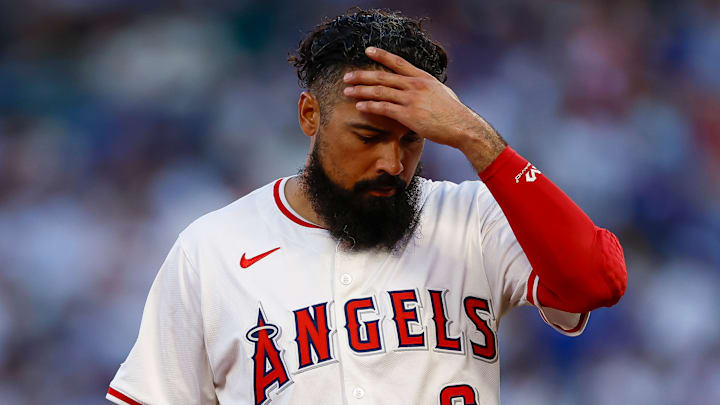
3B: Anthony Rendon, Los Angeles Angels

- Contract: Seven years, $245 million
Our long national Anthony Rendon nightmare may be over soon, as ESPN reported in November that the Angels have discussed buying out the final year of Rendon’s contract. If such a move occurs, the 35-year-old Rendon — who missed the 2025 season with hip surgery — will retire.
Either way, the Rendon contract is among the worst in modern baseball history, and we don’t say that lightly. Rendon has recorded a 1.7 bWAR and a .666 OPS in only 205 games since the start of 2021. Those numbers are fine for a utility infielder or a backup catcher, but a third baseman making over $35 million per year? And we can’t forget the March 2023 incident when Rendon grabbed a fan by the shirt during a game in Oakland and subsequently received a four-game suspension. If you think of any positives from Rendon’s time in Anaheim, please let us know, because we’re drawing a blank.
SS: Xander Bogaerts, San Diego Padres
- Contract: 11 years, $280 million
Why? No, seriously. Why did the Padres believe that giving a shortstop an 11-year, $280 million deal entering his age-30 season was the right move? Even a contract in the neighborhood of, say, six years and $180 million would have raised some eyebrows. But 11 years? The Padres clearly learned nothing from other massive contracts teams have awarded to players on the wrong side of 30.
This swim move from Xander Bogaerts was AWESOME 😱 pic.twitter.com/I46ougGnyZ
— MLB (@MLB) August 27, 2025
If you’re an optimist, you’ll point out that Bogaerts gave the Padres 2.0 bWAR and an above-average .720 OPS in 136 games last season. However, he averaged 4.2 bWAR and an .830 OPS from 2015 through 2023. By the way, Bogaerts has a full no-trade clause and no opt-outs. If the Padres don’t win their first World Series title within the coming years, this could easily wind up on the list of worst contracts in MLB history.
LF: Andrew Benintendi, Chicago White Sox
- Contract: Five years, $75 million
What is it with former Red Sox players getting drastically overpaid elsewhere? Benintendi joins Bogaerts and Rodríguez on our list after averaging 0.2 bWAR and a .699 OPS in his first three seasons with the White Sox. Although we won’t pin too much of their historically awful 41-121 2024 season on him, we will note that he ended that year with -0.8 bWAR in 135 games.
Benintendi has two years and over $32 million left on his deal, and we’re sure that someone will acquire him if desperation strikes. He doesn’t turn 32 until next July, and he hit .240 with 20 home runs, 63 RBIs, and a .738 OPS in 116 games last year; his 1.0 bWAR marked his highest since 2022. Who else is ready to see him discover the Fountain of Youth when he eventually joins the Dodgers in a midseason trade?
CF: Javier Báez, Detroit Tigers

- Contract: Six years, $140 million
Although Báez is typically the Tigers’ everyday shortstop, he played 53 of his 126 games in center field last year. That’s enough for us to feel comfortable listing him as our center fielder. What an honor!
If there’s anything that the Tigers did right here, it was only giving Báez six years. Imagine if they had decided he was worth eight or nine years? Although Báez earned All-Star honors last season, he finished with a .680 OPS and struck out 109 times against only 10 walks. That’s not a typo. You’d expect a 2.3% walk rate from pitchers when they needed to hit, but a three-time All-Star midway through a six-year, $140 million contract. Nope! That’s a hard pass from us, and something tells us that, consciously or subconsciously, this is the kind of move that could convince the Tigers not to extend ace Tarik Skubal.
RF: Nick Castellanos, Philadelphia Phillies
- Contract: Five years, $100 million
In fairness to Castellanos, he’s at least stayed healthy throughout this contract, never playing fewer than 136 games. He has hit .260 with 82 home runs, 326 RBIs, and a .732 OPS in nearly 2,500 plate appearances since joining the Phillies. Those are adequate numbers for a player making $10 million a year, but teams rightfully expect far more from someone making $20 million.
Seeing as the Phillies are reportedly signing former Texas Rangers All-Star slugger Adolis García to play right field next year, we expect the Phillies to subsequently trade Castellanos within the coming months. We’ll see whether he can end his contract on a strong note, or if we’ll instead see another average season; Castellanos has totaled 1.3 bWAR in his four years with the Phillies.
DH: Kris Bryant, Colorado Rockies
- Contract: Seven years, $182 million
If not for Rendon, Bryant might have the worst contract in all of baseball. Various back injuries have limited Bryant to 170 games and -1.6 bWAR in four seasons with the Rockies, and he’s increasingly faced questions regarding his potential retirement. Doctors diagnosed Bryant with lumbar degenerative disc disease earlier this year, and he only appeared in 11 games.
We don’t fault the Rockies for paying Bryant what and when they did, and it’s not his fault that he’s battling significant back problems. This is nothing more than an instance of poor health interrupting a talented career and dooming a contract to fail before it had any chance of succeeding. Unfortunately for Bryant, it’ll be far easier to remember his back issues and his Rockies contract than his Rookie of the Year, MVP Award, and role on the 2016 Chicago Cubs team that broke a 108-year title drought.