
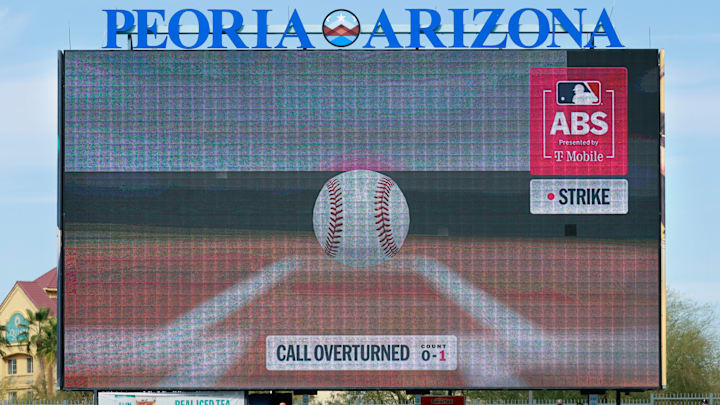
Players in new uniforms are far from the only change we've seen so far at Spring Training. The game itself is also looking a bit different, thanks to the implementation of the ABS challenge system: replay review that, after years of being tested at lower levels, is finally set to come to the Majors for the 2026 regular season.
Before the calls start counting for real on Opening Day, all 30 teams have been trying to get a feel for how this might work. We've now got almost a full week of Spring Training games in the books, which means almost a full week of insight into how teams and players might approach this new challenge system. So what does that data say?
How the new ABS challenge system works

It's worth reiterating that not all that much is changing; there will still be a human umpire behind home plate calling balls and strikes. The difference is that ABS technology will allow the pitching or hitting team to challenge their calls, similar to the challenge systems we see in the NFL and NBA.
Who can challenge a call?
Only three people can challenge a given pitch: the hitter, the pitcher or the catcher. Not the manager, not the base coach, not a teammate. If the hitter things a called strike was actually a ball, or if the pitcher or catcher thinks a called ball was actually a strike, they can challenge — provided that decision comes within a second or two of the initial call.
To do so, they simply tap their helmet or hat. From there, the home-plate umpire will stop play and everyone waits for the review process to play out.
How does a challenge work?
The challenge will be shown on the main Jumbotron, where a screen will appear showing a computer-generated strike zone. That strike zone is always 17 inches wide (the width of home plate), and its height is based on the height of each specific batter: The top of the zone is set at 53.5% of a player's measured height without cleats, while the bottom is set at 27% of the player's measured height. And keep in mind that those measurements are not based on a player's height while he's in a batting stance. So no matter how low you crouch down, the top and bottom of your strike zone won't change.
Once a review has been initiated, Hawkeye technology will display whether the previous pitch fell inside or outside of that strike zone, and the call on the field will be upheld or overturned.
How many challenges does each team get?
Each team gets two challenges per game. If the call made on the field stands, the team that requested a challenge will lose one of them. If the call made on the field is overturned, the team that requested a challenge will still have two challenges remaining. A team can challenge as many times as it likes, so long as the challenges are successful. Once you lose two challenges, though, you're out for the remainder of the game. (Unless the game goes into extra innings, that is, at which point a team that has run out of challenges will be given an extra one.)
Spring Training challenges: How are umpires faring so far?

Overall, it seems like players are pretty much just as fallible as umpires are — if not more so. According to Statcast's ABS database, 53% of challenges so far (242 out of 457 total attempts) have been overturned, meaning that players are wrong almost just as often as they're right about the strike zone. Pitchers and catchers are apparently far more trustworthy here than hitters: The former is running a 56% success rate, while the latter is slightly below water at 49%.
It's also fascinating to see how approaches to the challenge system vary by team. There's a pretty massive difference between the top and bottom of the leaderboard: The New York Yankees have called for the most reviews at 14, while the Miami Marlins have only done it once. Is that organizational policy, or have some teams decided not to sweat it until the games actually count? And will the extra practice help some teams be more effective than others?
Ragging on umpires has become a hallowed tradition among baseball fans; we're as guilty of it as anyone. But it must be said that, so far, this whole exercise has revealed that umpiring has come a long way. Anyone who's gone back and watched highlights from the 1990s or even early 2000s probably already knew that, but it bears reiterating: It's not often that you get a true howler of a call anymore. You can see for yourself when you look at the daily strike zone plot: Most of the overturns are borderline pitches.
Is it good that we can get those right more often now? Sure, especially when it inevitably helps to decide a high-leverage game (and rest assured it will). Will it also be tremendous human drama? Absolutely.
What roboumps will mean for the 2026 MLB season
Both MLB players and umpires are, as a rule, pretty prideful people. They've made it to the absolute pinnacle top of their professions, doing something that most of us can't even fathom. (If you're inclined to sneer at that description of big-league umpiring, please keep in mind tracking a 90-mph slider through an invisible box is almost as hard as hitting one.) That means they're not comfortable with failure, and they really don't like being proven wrong.
Which should lead to some combustible situations. It's clear from reactions around camps so far this spring that players, while largely appreciative of the option to challenge a call, aren't fully trusting of the technology behind it yet. Some, like Chris Sale, have just decided not to deal with it entirely. And while egos the likes of Joe West and Angel Hernandez are becoming increasingly rare as a new generation of umpires takes over, well, they can still get a little thin-skinned sometimes.
We are for sure going to get at least a handful of meltdowns during the regular season, on either side. And while the time it takes for this process to play out will take some getting used to (it sure feels longer than it was billed to be before its implementation), it will probably be a net positive as it ensures that more calls get made correctly. That sounds like a win-win to me, and the guess here is it will go the way of the pitch clock — something previously unfathomable that everyone adjusts to pretty quickly.
 Add us as a preferred source on Google