
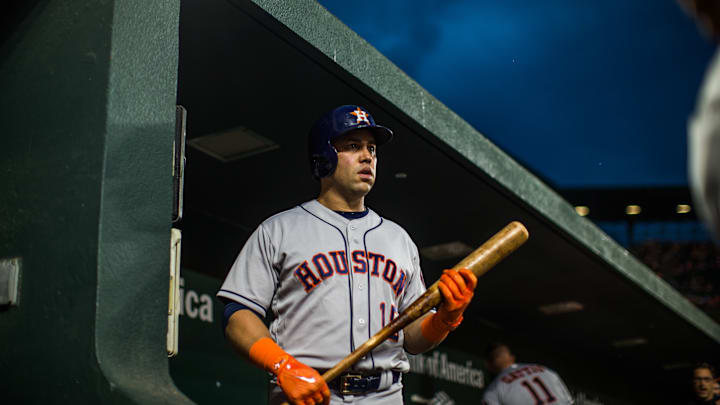
The BBWAA revealed the results of this year's Baseball Hall of Fame balloting on Tuesday night, with outfielders Carlos Beltran and Andruw Jones joining Jeff Kent in the 2026 class this summer. Beltran led the way, earning 84.2 percent of the vote in his fourth year on the ballot — a healthy number.
On the field, there's little doubt that Beltran deserves a spot in Cooperstown. A nine-time All-Star and former Rookie of the Year, he was among the best (if not the best) all-around center fielders in the sport for at least a decade, and his underlying metrics — his 70 career bWAR is almost exactly at the Hall of Fame average at his position of 71.3 — back that up. But of course, the on-field case is just the beginning here, and while voters ultimately embraced Beltran's candidacy, the path he took to the Hall could affect other big names moving forward.
What role did Carlos Beltran play in Astros sign-stealing scandal?

Beltran's leading role in the Houston Astros' sign-stealing scandal of 2017-18 cost him a chance to manage the New York Mets a few years ago, and it continues to hound him today. On Tuesday night, BBWAA voters sent a message that Houston's cheating, and the part Beltran played in it, wasn't significant enough to keep him out of the sport's most exclusive fraternity. But it's worth asking: What kind of precedent might that set moving forward? And might some other controversial candidates previously denied a spot in the Hall take Beltran's induction as a sign of better things to come?
It happened nearly a decade ago at this point (yes, we're all extremely old), so it's understandable if you might need a refresher.
Houston Astros sign-stealing scandal, explained
Teams around the league had long suspected the Astros of some sort of sign-stealing scheme, but it wasn't until the end of the 2019 season that those suspicions were finally confirmed. Mike Fiers, a former Astros pitcher, told The Athletic that November that, during their run to the World Series in 2017, Houston used a video camera in center field to capture signs from the opposing catcher during home games. Those signs were viewed by players and staffers using a live feed from behind the dugout, and relayed to the hitter at home plate by making some kind of noise — most famously, banging on a trash can.
Most of MLB's investigation and subsequent punishment focused on Astros leadership. GM Jeff Luhnow and manager AJ Hinch were both suspended for the 2020 season and later fired. Houston's bench coach at the time, Alex Cora, was suspended through the 2020 postseason before being hired as Red Sox manager. The only player specified by name in the league's report was Beltran, who was accused of being a ringleader of what the team referred to as "the system".
That accusation was backed up by multiple former Astros players and employees, who even noted that at one point Houston catcher Brian McCann asked Beltran to stop. "He disregarded it and steamrolled everybody," an anonymous player told The Athletic in 2020. "Where do you go if you're a young, impressionable player with the Astros and this guy says, 'We're doing this'? What do you do?"
It's still a bit unclear exactly what role Beltran played, how widespread the sceme was and, ultimately, what effect it had on the Astros' on-field success. But at this point it seems safe to say that, if it wasn't Beltran's idea, it was certainly something he believed in, and it wouldn't have become the common practice it was without his impetus.
Which controversial Hall of Fame candidates could benefit from Beltran's induction?
The Steroid Era greats

This is the big question. Names like Barry Bonds and Roger Clemens — not just no-doubt Hall of Famers but arguably the greatest of all time at their respective positions — have already fallen off the ballot without earning induction as a direct result of their links to performance-enhancing drugs, as have other deserving candidates like Rafael Palmeiro, Gary Sheffield, Sammy Sosa and Mark McGwire. Manny Ramirez is going to fall short in his 10th and final year of BBWAA eligibility, while Alex Rodriguez seems destined to meet the same fate as he wraps up his fifth year on the ballot well short of the 75 percent mark.
Reasonable fans can differ as to whether those results are fair or not. But it does seem worth asking just how much their candidacies differ from someone like Beltran. Like Bonds, Beltran also knowingly violated an MLB rule (while on-field sign stealing is tolerated, the use of technology as an aid very much is not) that potentially impacted his performance. And unlike Bonds, what Beltran allegedly took part in affected not just his own at-bats but those of an entire team — a team that went on to win the World Series, no less.
Of course, the easy counter there is that Beltran is only accused of breaking rules in the final season of his career, when he was a part-time DH. As far as we know, he accumulated the overwhelming majority of his numbers above board. But still: Who gets to draw that line, and where should it get drawn? Is some rule-breaking acceptable as long as BBWAA voters deem it not to have impacted a player's production enough? And is potentially helping to decide a World Series insignificant in comparison to an individual career?
There are meaningful differences that can help account for why Beltran has been greeted more warmly by voters than the stars of the Steroid Era. But as Bonds and Co. pop up as candidates for the Eras Committee in the coming years, expect the comparison to gain traction.
The gamblers

Rob Manfred's controversial decision to lift permanent bans upon a player's death has reopened the cases of stars like Pete Rose and Shoeless Joe Jackson — Hall of Famers on the field, but ones who have been left out of Cooperstown because they committed the cardinal sin of betting on baseball. So far, the Hall itself hasn't offered much of any evidence to suggest it's going to reconsider its stance on Rose or the Black Sox, but who knows what the future holds?
In any event, this case feels categorically different than Beltran's. Beltran broke a rule, yes, and his actions are serious and deserve to be treated as such. But gambling is a third rail for a reason, the one thing you absolutely cannot do if you want to continue being associated with a major sports league. Once the integrity of a given game is called into question, there's no way to put that genie back in the bottle; no, there's no hard evidence that Rose ever bet against his teams, but how can anyone really be sure?
There are some parallels here, in that Houston's sign-stealing also called into question whether what we were watching on the field was happening on the level. But that crisis is much more easily managed than the assumption that someone involved in a given game is taking money to throw it. Fans of Rose, Jackson, Eddie Cicotte and others shouldn't get their hopes up.
More Hall of Fame news and analysis
 Add us as a preferred source on Google