
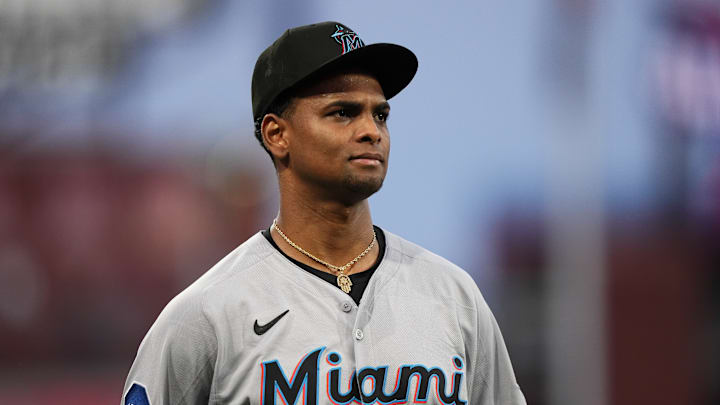
The Cubs are set to acquire Edward Cabrera from the Miami Marlins. The return, assuming medicals are finalized, will include corner outfield prospect Owen Caissie, who has spent far too long on the block for a player of his caliber.
What the Cubs, Yankees, or any acquiring team would've received in Cabrera is a frontline starting pitcher with ace potential. Yes, if Cabrera can stay healthy – and we'll have more on that later – he's a flamethrower in a league predicated on starting pitching. However, a team like the Cubs has a lot more to lose if Cabrera were to miss time. They are smart to do their due diligence.
Edward Cabrera injury history: Should the Cubs (and interested contenders) be concerned?

Again, there is no denying what Cabrera is capable of when he is healthy. However, as recently as 2025, the right-hander suffered an elbow strain that scared the Marlins straight. Cabrera exited a July 11 start with right elbow discomfort (his throwing arm), but avoided the injured list thanks to the All-Star Break. At the time, the Marlins were still in striking distance of an NL Wild Card spot and were flirting with the idea of trading Cabrera at the deadline should the bottom fall out of their season.
Then, in early September, Cabrera spent several weeks on the injured list with a right elbow sprain. He came back for two starts but ultimately cut his season short. If this story sounds eerily similar to baseball fans, it's because it should. Sandy Alcantara gave the same runaround in 2023, and ended up needing Tommy John surgery not that long after.
This is not to say Cabrera will suffer the same fate, but his injury issues aren't limited to his right elbow. Cabrera suffered should injuries in both 2023 and 2024.
The Cubs have actually been here before

While this deal for Cabrera did go through, the Cubs tried to trade for another Marlins pitcher just last winter. Chicago had a deal in place for Jesus Luzardo, but ultimately backed out due to medical reasons, per The Athletic.
"Concerns over Luzardo’s back and elbow made the Cubs reluctant to pay the agreed-upon acquisition cost. Details of the package the Marlins would have received are not known," Ken Rosenthal wrote, while also noting that the pitching depth Chicago tried to acquire has proven...necessary.
Rather, it was the Phillies who took a chance on Luzardo, and it paid off in a big way. In 2025, Luzardo had a 3.92 ERA and 3.9 bWAR near the front of Philadelphia's rotation. Next season, they'll need him to improve upon even those numbers, as they're likely to lose Ranger Suarez in free agency.
As for the Cubs, they could ill-afford to lose out on another coveted starting pitcher this offseason. It comes with a cost.
How the Edward Cabrera trade followed a bad precedent

The Baltimore Orioles started a brutal trend this offseason by trading four coveted prospects for then-Tampa Bay Rays starting pitcher Shane Baz. Baz, while perfectly capable as a bottom-of-the-rotation starting pitcher, is not worth four top-30 prospects for any team, especially not the Orioles, who possess a strong farm system.
That trade increased the asking price of just about every team who had a starting pitcher worth trading. This includes Cabrera who, while flawed in the medical department, remains an All-Star caliber pitcher. For all we know, Cabrera could survive the next couple of seasons in Chicago (or anywhere) without another significant ailment. But there's no denying this trade comes with some risk for the Cubs. The fact they're still reportedly dealing Caissie and more to the Marlins reveals just how inflated this market really is.
And I can assure you that will not end with Cabrera. Trades are important team-building exercises for any front office. The fluidity of that market helps rebuilding teams stock their farm systems, and contending teams improve their big-league product. Without that movement – or if the return is tilted to one side – it freezes the market.
The Cabrera trade, should it go through, could make this offseason even worse. Trades for Tarik Skubal, Freddy Peralta and more aces are waiting to be made, but for now, sides cannot come close to said deals because the value is disproportionate.
More MLB offseason news and analysis:
 Add us as a preferred source on Google