
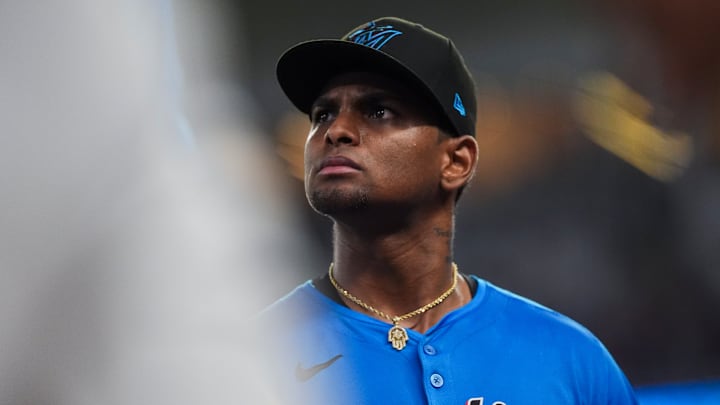
After months of fiddling on the margins, the Chicago Cubs are finally circling a big splash, with reports surfacing on Wednesday that the team was deep into negotiations to acquire pitcher Edward Cabrera from the Miami Marlins. The deal has yet to be finalized as of this writing, seemingly due to a hold-up regarding Cabrera's medicals; he suffered an elbow sprain in 2025 and has a track record of both arm and shoulder issues.
Despite that injury history, though, there's been significant interest in Cabrera around the league in recent days. And it's not hard to see why: Just 27 years old and under club control through 2028, he was rightly viewed as a premier asset. Cabrera made 26 starts for the Marlins in 2025, posting a 3.53 ERA and 1.23 WHIP. He recorded 150 strikeouts in 137.2 innings. While the Dominican native can touch the upper-90s with his fastball, Cabrera leans far more on his off-speed offerings — primarily a zippy mid-90s “changeup” and a loopy curveball, which keep hitters in guess mode.
Cubs fans who lived through the Jesus Luzardo fiasco know that a trade isn't done until the ink is dry. Still, as Chicago closes in on a major acquisition, it's worth taking a look at how the addition of Cabrera could impact their NL hopes this season.
Projected Cubs rotation if Edward Cabrera trade goes through
Order | Name |
|---|---|
1 | LHP Matthew Boyd |
2 | RHP Cade Horton |
3 | LHP Shōta Imanaga |
4 | RHP Edward Cabrera |
5 | RHP Jameson Taillon |
Chicago would have much more depth at an area of need. Colin Rea finished last season with a 3.95 ERA and 1.9 fWAR; he can transition into a long relief, swingman-type role. The Cubs should also get ace Justin Steele back from Tommy John surgery midseason, adding even more firepower at the top of the rotation. Factor in potential call-ups for players like Jaxon Wiggins (No. 4 prospect) or Brandon Birdsell (No. 8 prospect), and Chicago is sitting pretty.
Would Cabrera be the bonafide ace Cubs fans dreamed of, a la Tarik Skubal or even MacKenzie Gore? Not really, but the youth, control and optionality would make this trade a major victory for Hoyer and the front office.
Now … let’s rank the NL Central rotations.
5. St. Louis Cardinals

Order | Name |
|---|---|
1 | LHP Matthew Liberatore |
2 | RHP Dustin May |
3 | RHP Michael McGreevy |
4 | RHP Andre Pallante |
5 | RHP Hunter Dobbins |
The Sonny Grade trade was the first step in a deliberate teardown and rebuild for the St. Louis Cardinals under new GM Chaim Bloom. It is what it is. St. Louis is playing the long game, which means a season full of losses won’t really impact their vision for the future. This rotation has some untapped potential — Liberatore, McGreevy and newcomer Dobbins could all take a leap — but the Cards are a clear-cut fifth place out of five in this circumstance.
Liberatore remains the de facto “ace” of the St. Louis pitching staff. The 26-year-old spent his first full season as a starter in 2025, logging a 4.21 ERA and 1.31 WHIP in 151.2 innings. Liberatore is not heavy on strikeouts, but he gets excellent mileage out of his offspeed pitches and commands the zone well.
McGreevy probably carries the highest ceiling of this bunch, boasting seven pitches and an exceptionally low walk rate. There are bound to be comparisons to, say, Seth Lugo. What McGreevy lacks in velocity and overwhelming power, he compensates for with control and variety. Dobbins, part of the Willson Contreras return package, gets plenty of ground balls and soft contact, as does Pallante.
In short: This Cardinals staff will let the defense carry the day, rather than overwhelming hitters. Dustin May, their one free agent addition, lost a lot of velocity last season coming off of elbow surgery. The hope is that he can regain a bit of zip after a full offseason under a new coaching regimen, unlocking his once-effective, high-90s sinker.
4. Chicago Cubs

Order | Name |
|---|---|
1 | LHP Matthew Boyd |
2 | RHP Cade Horton |
3 | LHP Shōta Imanaga |
4 | RHP Edward Cabrera |
5 | RHP Jameson Taillon |
Depth should give the Cubs a leg up in MLB’s 162-game regular season grind, but Cabrera alone would not solve all of Chicago’s issues. The return of Steele sometime midseason will do a little more good, but it’s generally harder to trust the Cubs’ best arms when compared other aces around the division (more on them shortly).
Matthew Boyd was an All-Star in 2025, but that felt fluky — a feeling that became justified when he fell apart in October. Shōta Imanaga took a sizable step back in his second MLB season, while Jameson Taillon is simply on the wrong end of his prime. The 34-year-old was excellent down the stretch of last season, with sharp command and a deep arsenal of pitches (his changeup is a standout). Still, it’s hard to trust him to start 30 games and be consistently above-average the whole way through.
Cade Horton will be Chicago’s biggest swing factor on the rotation front. He excelled as a rookie (2.67 ERA and 1.08 WHIP in 118 innings), but the underlying metrics (3.91 expected ERA, 20.4 percent K rate) are a bit less impressive. He is, on balance, probably the best arm in this Cubs rotation right now, but whether or not Horton can make the leap to true stardom will determine if this is the correct ranking or a grave underestimation.
Cabrera, as mentioned before, is a rock-solid third or fourth arm in a quality rotation. He didn’t get the shine he deserved in South Beach, but the Cubs bring on a whole different level of attention and expectation. Though not particularly dominant on the mound in terms of production just yet, Cabrera’s changeup-curveball combination — paired with a decent enough fastball — gives him a healthy balance of strikeouts and weak contact. He can struggle with command, but the stuff is very much there. Don’t be shocked if he climbs the ranks a bit, as he’s still young enough to grow.
3. Pittsburgh Pirates

Order | Name |
|---|---|
1 | RHP Paul Skenes |
2 | RHP Mitch Keller |
3 | RHP Bubba Chandler |
4 | RHP Braxton Ashcraft |
5 | RHP Carmen Mlodzinski |
There is, admittedly, plenty of uncertainty with this Pittsburgh Pirates rotation. At the end of the day, however, Paul Skenes alone gives your rotation a high floor. He’s the best pitcher in the National League, arguably in all of MLB, and he’s only beginning to tap into his full powers. If Pittsburgh’s offense takes the leap so many expect it to, the Pirates practically have a scheduled win every fifth game.
Mitch Keller isn’t the sexiest name out there, but he’s a classic innings-eater — durable, with a varied arsenal that he commands well and uses to generate enough soft contact to get by. On the opposite end of the spectrum is top prospect Bubba Chandler, who is all upside. One of the brightest up-and-coming arms in baseball, Pittsburgh will hope that Chandler blossoms into a genuine second ace.
Both Braxton Ashcraft and Carmen Mlodzinski were effective in limited exposure last season, while the impending return of Jared Jones from IL should take things up a notch. Pittsburgh also has a deep well of Minor League pitching, with top-five prospect Hunter Barco knocking on the door of a full-time rotation spot.
So, while the Pirates may lack established options behind Skenes, the pipeline depth and upside of this young group does give Pittsburgh a slight edge over Chicago. The is a world in which the Pirates rank comfortably in the No. 1 spot by season’s end; purchase your stock now.
2. Cincinnati Reds

Order | Name |
|---|---|
1 | RHP Hunter Greene |
2 | LHP Andrew Abbott |
3 | RHP Brady Singer |
4 | LHP Nick Lodolo |
5 | RHP Chase Burns |
The Cincinnati Reds have much to figure out offensively, but their unexpected Wild Card berth in 2025 was the product of an lights-out rotation. Hunter Greene leads the way as the best non-Skenes pitcher in the division. With triple-digit heat and a wipeout slider, Greene only needs two pitches (with an occasional changeup mixed in) to obliterate opponents. He posted a 2.76 ERA and 0.94 WHIP in 107.2 innings last season; his 31.4 percent K rate fell in the 93rd percentile. At 26, Greene gives Cincy its headliner for the foreseeable future.
What gives the Reds enough ammo to potentially sneak back into the postseason mix, however, is the depth behind Greene. Chase Burns, their top prospect, made eight starts last season, with mixed results. But the upside is pronounced: He’s another triple-digit fireballer who, with better command, can quickly climb the ranks.
Andrew Abbott finished eighth in NL Cy Young voting last season, with a 2.87 ERA and 1.15 WHIP. He’s a different flavor of ace compared to Greene (and potentially Burns), working in the low-to-mid 90s with his fastball, but he's able to locate it with precision and generate loads of soft contact via his plus offspeed pitches.
Brady Singer and Nick Lodolo should continue to shoulder their load in the middle of the rotation, giving Cincinnati a nice balance of right- and left-handed weapons. The potential ascents of Rhett Lowder (No. 5 prospect) and Chase Petty (No. 7 prospect) offer the Reds a nice pool of depth to pull from, both in the short and long term.
1. Milwaukee Brewers

Order | Name |
|---|---|
1 | RHP Freddy Peralta |
2 | RHP Jacob Misiorowski |
3 | RHP Brandon Woodruff |
4 | RHP Quinn Priester |
5 | RHP Logan Henderson |
The Milwaukee Brewers exceeded all expectations to claim the No. 1 seed in the National League last season. The offense proved insufficient against the superteam Dodgers, but Milwaukee’s balance and plate discipline offensively is elevated by a steadfast pitching staff.
It remains to be seen what Milwaukee will do with frontline ace Freddy Peralta, who’s entering his final year under contract. If the Brewers swap out Peralta for controllable prospects, that obviously changes these rankings. That said, few organizations are better at developing in-house talent and maximizing disparate parts. Do not bet against the Brewers under any circumstances.
Peralta finished fifth in NL Cy Young voting and earned his second All-Star nod. He’s even better than you think he is. Jacob Misiorowski became the fastest player to reach an All-Star game in MLB history last season. It seems the league jumped the gun a bit — he floundered down the stretch, expected for a rookie with command issues — but Misiorowski consistently throws above 100 MPH and his stuff is pure electricity. He’s due for an ace-level leap sooner than later.
Logan Henderson, Milkwaukee’s No. 5 prospect, posted a 1.78 ERA in five starts. He feels like their next homegrown star. Brandon Woodruff picked up his qualifying offer after a strong return from injury and promises to perform; he made 12 starts last season, with a strikeout rate in the 94th percentile and a walk rate in the 91st percentile. Quinn Priester, meanwhile, is the unsung hero. A former top prospect who bounced around from Boston to Pittsburgh beforehand, Priester solidified his approach and became a legitimate mid-rotation arm for the Brewers last season. There’s no reason to think he’ll slow down.
Chad Patrick (3.53 ERA in 23 starts) and DL Hall (3.49 ERA in 20 appearances, three starts) offer depth and optionality.
 Add us as a preferred source on Google