
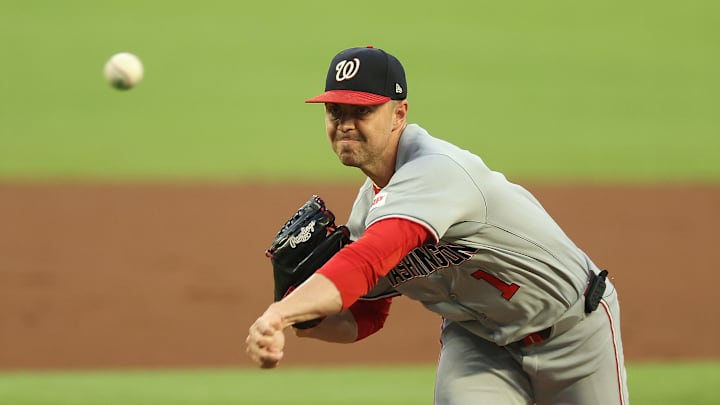
The Washington Nationals are beginning anew under 35-year-old GM Paul Toboni, a former Red Sox executive hired to shepherd the Nats out of these dark times. There are multiple potentially foundational young stars in the Nationals organization, but after a 66-win campaign, it's hard not to feel like the window is gradually closing.
MacKenzie Gore's name was floated around the trade deadline in July, but the Nats' asking price exceeded the incoming offers. It was an uneven season overall for the 26-year-old southpaw, but in terms of clear and present upside, Gore outpaces the majority of pitchers in his age bracket. ESPN's Jeff Passan sets the odds of a Gore trade this winter at 30 percent.
Why would the Nationals trade MacKenzie Gore?
Gore is under contract through 2027 at cheap arbitration rates, so there's no immediate pressure for the Nationals to trade him. But this is the classic quandary of small-market clubs. Gore is a Scott Boras client and is therefore unlikely to sign an extension. The more team control left on his contract, the more Washington can recoup in a hypothetical trade.
If the Nats don't see a future with Gore, and if there are plans to effectively restart the clock on their rebuild, it only makes sense to explore Gore's market. That's not to say the Nationals need to take pennies on the dollar, but if the right team comes on strong with an offer of multiple high-level, Washington needs to listen.
10. Athletics

A two-year window might scare off the Athletics, who are unlikely to compete for Gore's services on the open market in 2027. That said, the A's have quietly built up the most exciting young offensive core in MLB. Nick Kurtz put up MVP numbers after his call-up. Jacob Wilson made the All-Star team as a rookie. Shea Langeliers and Tyler Soderstrom can both hit 30-plus homers in a good year. The A's are closer than folks realize, but the rotation needs a major facelift. Gore is cheap for the two years under contract, and he'd give the A's the ace they so desperately lack. This is a concept at least worth entertaining.
9. Detroit Tigers
The Detroit Tigers are in a pickle with Tarik Skubal. If Detroit opts to trade him, replacing Skubal with a younger ace under club control for a couple years is a reasonable course of action. If Skubal sticks around, Gore would make for an incredible No. 2 in the rotation — and he'd surely learn a lot under Skubal's mentorship. Plus, Comerica Park is a pitching haven. It could be just what Gore needs to build confidence and finally reach that next level. Now, is Detroit comfortable with reliving the Skubal saga again a year from now when Gore becomes an expiring contract? Maybe not, but the Tigers need to push some chips in regardless. Detroit won't be as hopeless when it comes time to extend Gore, for what it's worth.
8. Philadelphia Phillies

The Philadelphia Phillies probably a) re-sign Ranger Suárez or b) let Suárez walk and insert top prospect Andrew Painter into the rotation. That said, Dave Dombrowski engineered the Jesús Luzardo trade a year ago and in the year prior, he offered Yoshinobu Yamamoto north of $325 million. He tends to gravitate toward elite arms, and the opportunity to add Gore under two years of club control — with his 27.7 percent strikeout rate and a track record of durability — is at least worth a stab. Especially since Zack Wheeler is still recovering from shoulder surgery.
7. Houston Astros
The Houston Astros could view Gore as a lefty-for-lefty Framber Valdez replacement. He's an extremely different pitcher, of course, but the combined strikeout material between Gore and Hunter Brown would give the Astros a gnarly one-two punch atop the rotation. Houston has fallen by the wayside a bit since Dusty Baker's retirement, but there's too much talent on the roster for GM Dana Brown to sit idly. The Astros are a couple moves that connect away from contending again. Gore is worth the upside swing, and Houston has the financial liquidity to one day re-sign him if all goes well.
6. San Diego Padres

The San Diego Padres made the "best offer" for Gore at the trade deadline, per NY Post's Jon Heyman. Gore began his career with the Padres, but was sent to D.C. in the now-infamous Juan Soto trade. The Padres need pitching depth as badly as any contender in MLB. Dylan Cease has already signed elsewhere; Michael King will probably follow him out the door. Beyond Nick Pivetta, San Diego has very few proven commodities in the starting rotation. It's clear that A.J. Preller is interested in Gore, but there's a problem: San Diego has the worst farm system in baseball. The Padres made several go-for-broke trades at the deadline, including swapping MLB's No. 3 overall prospect Leo De Vries for Mason Miller. The Padres might not have the ammo to outbid other contenders.
5. New York Yankees
The New York Yankees will begin the 2026 campaign with Gerrit Cole, Clarke Schmidt and Carlos Rodón on the IL. It feels like Max Fried and Cam Schlittler can anchor a rotation in the short term, but the Yankees need depth — and durability. Gore checks all the necessary boxes, providing New York with another fire-balling southpaw who can miss bats and eat 150-plus innings in his sleep. This trade also gets Gore out of the NL, a plus for the Nats. And more importantly, the Yankees have the strong financial backing necessary to re-sign Gore when the time comes. That could empower them to push past other smaller-market bidders, who probably have a cutoff point in negotiations.
4. New York Mets

The Nationals are probably resistant to trading Gore within the division, especially to a team with the New York Mets' spending power. But it's a business, and the Nationals are thinking far down to road. Few contenders need a frontline ace more than the Mets. Gore's cheap (short-term) contract can only help, as the Mets would surely prefer to focus their financial resources on the likes of Cody Bellinger or Pete Alonso this winter. A top three of Gore, Nolan McLean and Kodai Senga, with Clarke Schmidt, Sean Manaea, Jonah Tong and others supplying depth, leaves the Mets in a good position.
3. Chicago Cubs
Shōta Imanaga's qualifying offer decision gives the Chicago Cubs some short-term relief, but Justin Steele and Matthew Boyd are not winning headliners in October. The Cubs need a proper star on the mound, especially with the offense expected to recede post-Kyle Tucker. Gore might not be the most stable option, but the upside clears just about every other reportedly available ace, with the exception of Tarik Skubal or Freddy Peralta — neither of whom is under club control past 2026, and neither of whom will end up on the North Side. Gore might exceed Chicago's typical spending limit once he hits free agency in two years, but two years of a burgeoning ace is worth it for the Cubs.
2. Boston Red Sox

The Boston Red Sox made their first major swing of the offseason, acquiring Sonny Gray from St. Louis. He's an instant Boston fan favorite with his Yankees bad blood, but is Gray a true No. 2 starter behind Garrett Crochet? Ideally not at this stage of his career. Boston still has the ammo to go out and get another weapon. Gore's cheap, controllable contract makes him an especially appealing option. Boston could wield two of the nastiest left-handed pitchers in MLB come October. Crochet and Gore are strikeout machines; Gray suddenly looks much better as the No. 3. This is a huge win for Boston, and for Gore, who gets a chance to contend at the highest level.
1. Baltimore Orioles
Of all the potential outcomes, Gore screams "Baltimore Orioles trade target" the most of all. Baltimore has the assets, firstly. A stacked farm system, full of intriguing bats. Gore's contract is also favorable for the O's. Baltimore can ride out 2026, see if Gore elevates them to a more competitive stature, and then reassess at the start of next season. If the O's aren't back in the postseason hunt, GM Mike Elias can recoup assets in another trade. If it goes well — if the Orioles get healthy and Gore proves to be the solidifying ace Baltimore lacks — then Baltimore can squeeze at least two years out of him before the open market determines his fate. There's a bit more length and flexibility to this arrangement than the Corbin Burnes rental, and few teams need frontline pitching more than Baltimore.
 Add us as a preferred source on Google