
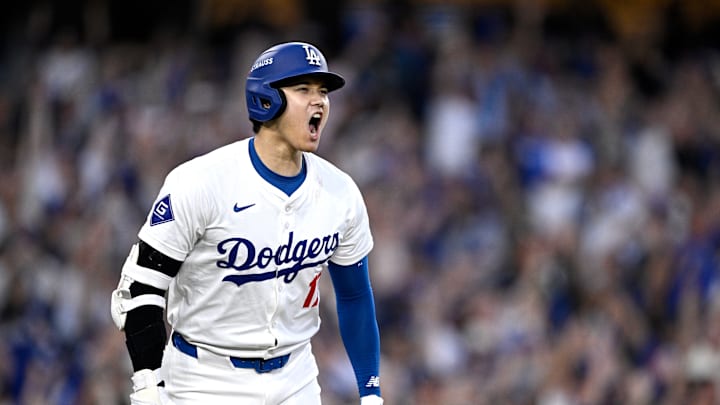
The Los Angeles Dodgers can outspend your favorite baseball team. Mark Walter and Los Angeles' ownership group have repeatedly put money behind the on-field product, and the front office isn't afraid to get creative to add the best available players. This includes international stars like Shohei Ohtani and Yoshinobu Yamamoto and domestic ones like Blake Snell, Edwin Diaz, Mookie Betts and more.
If the Dodgers are breaking baseball, they're doing so in a way that is so flamboyant but also flies under the radar. Yes, the end product is a higher payroll and luxury tax penalties, but how the Dodgers got there includes over a decade of international scouting, being ahead of the curve in domestic scouting and player development and investing in the right people.
How the Dodgers got here, and why they're so reliant on contract deferrals

When the Dodgers signed Diaz just a few weeks ago, it served as a milestone. No, Los Angeles didn't just fix their back-end bullpen problem – though that was a nice side-effect of this illness – they also surpassed $1 billion in deferred contracts. Think of it this way: The Dodgers aren't just set to spend over $350 million and pass the luxury tax in 2026 – they've achieved those marks at a discount.
Player | Deferred money |
|---|---|
Shohei Ohtani | $680 million |
Mookie Betts | $120 million |
Blake Snell | $66 million |
Freddie Freeman | $57 million |
Will Smith | $50 million |
Tommy Edman | $25 million |
Tanner Scott | $21 million |
Edwin Diaz | $19 million |
Teoscar Hernandez | $32 million |
As you can see, most of the deferred payments will be made to Ohtani. The Dodgers also have plenty of time to make said payments, which is a critical detail since Los Angeles is all-in right now. When the Dodgers win a World Series, that means more merchandise, ticket sales and advertising opportunities.
Dodgers already made up their $1 billion in deferred contracts

Only three professional sports teams have reached the $ billion revenue plateau in a single season – the Dallas Cowboys, and La Liga's Real Madrid and Barcelona. That's it. In 2024 and surely 2025, the Los Angeles Dodgers added their name to that list thanks to a blockbuster TV contract, merchandise and ticket sales and the arguably the greatest player in baseball history. Ohtani is an international superstar, and most of his contract is deferred. This provides a rare window of opportunity for the Dodgers.
While they'll have to pay Ohtani back later, for now they receive all the benefits of arguably the best deal in sports. The Dodgers have TV and radio deals in California and overseas, and they aren't going anywhere, as Sportico's Kurt Badenhausen explains.
"The Dodgers’ road to $1 billion was built on a combination of new blood in the owner’s box and front office, a blockbuster local TV contract, and a generational player on and off the field that arrived with the 2024 season to turbocharge ticket revenue and sponsorships," Badenhausen wrote.
Team | Earnings per home game |
|---|---|
Dodgers | $4.29 million |
Yankees | $4.11 million |
Cubs | $3.25 million |
Red Sox | $2.93 million |
Astros | $2.69 million |
Padres | $2.42 million |
Phillies | $2.24 million |
Braves | $2.05 million |
Rangers | $1.96 million |
The Dodgers signed a 25-year, $8.35 billion deal with Spectrum prior to the 2013 season. It's one of the richest contracts in the sport. Los Angeles also rakes in about $4.29 million per home game, of which there are 81 at Dodger Stadium. The average ticket price for a Dodgers game is $87, which ranks fourth behind only the Yankees, Red Sox and Cubs.
Debunking the narrative around Ohtani and the Dodgers

Much of the information shared above shows how the Dodgers have a financial advantage over every other MLB team. However, it's important to keep in mind that they play in California, and thus deal with many of the financial disadvantages that come with it, such as higher taxes and prices for the land they play on.
Also, MLB has a system in place to even the playing field, even if it isn't necessarily working to the best of its ability. If the Dodgers are worth $1 billion, they contribute nearly $150 million via the league's revenue sharing system. They also are forced to pay luxury tax fines, which cost a pretty penny even if Walter isn't all that concerned with them. And it's also worth noting that, while the team doesn't have to make deferred payments until years down the line, they do still need to have that money in escrow right now; this isn't quite the get-out-of-jail-free card it's been made out to be.
Expect owners to push for a salary cap in the next round of CBA negotiations, which are set to take place after the 2026 season. The Dodgers will be a focal point of that conversation, with small-market owners claiming they are at a spending disadvantage. In reality, more MLB franchises should try to be more like L.A. The Dodgers use much of their revenue to improve the on-field product, and were built from the ground up after Walter's ownership group bought the team from Frank McCourt back in 2013.
All of this happened under the league's nose, but if anyone were paying attention, the Dodgers wouldn't have the huge edge they have now in scouting, the international market, and on the big-league roster.
More MLB offseason news and analysis:
 Add us as a preferred source on Google