
Key Points
Bullet point summary by AI
- MLB fans know spring training stats can be misleading, but this year’s examples prove just how little they mean for the regular season.
- Jordan Walker’s dismal spring numbers were overshadowed by a stellar start to his MLB season, while others like Matt McLain went the opposite way.
- Austin Riley and several others' seasons haven't reflected what they showed in spring training.
MLB fans have mixed feelings about spring training every year. On one hand, it's awesome that baseball is back, and it's always fun watching your team play, even in games that don't count. On the other hand, these games don't count, which means that the statistics that come from them are hard to take seriously. Context matters. In some cases, players are simply experimenting with things like swing mechanics or new pitches, and things that don't work well often aren't taken into the regular season.
Every year, we see players have strong springs only to disappoint when the games actually count, and vice versa. It comes as no surprise to see another lengthy list of players who are proof that spring training stats, while fun to overreact to, are completely meaningless.
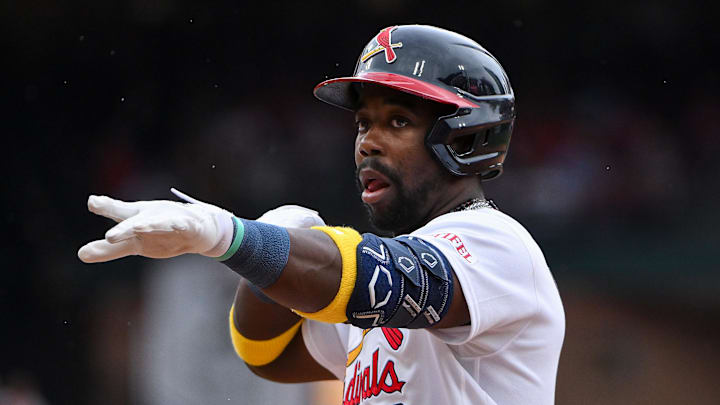
Jordan Walker, St. Louis Cardinals

The starkest example of this is Jordan Walker. Entering arguably the most important spring training of his career, Walker looked like a player who was destined to lose his job with the St. Louis Cardinals. He slashed .205/.255/.273 with just one home run and three RBI. Most alarmingly, he struck out 16 times in 44 at-bats, struggling to make any sort of consistent contact.
Well, while Walker is still striking out a decent amount, none of that has mattered thus far. He's slashing .328/.386/.734 with an MLB-leading eight home runs and 15 RBI. After posting -0.8 fWAR through his first three MLB seasons, Walker leads the majors with 1.3 fWAR through his first 17 games of this season.
If the season ended today, he'd probably be the NL MVP winner. While this performance is obviously unlikely to sustain, it looks like Walker has turned a corner. Nobody would've thought this after watching him in spring training.
Matt McLain, Cincinnati Reds

Conversely, it looked like Matt McLain had revived his career. McLain followed up a tremendous rookie campaign in 2023 by missing all of 2024 due to injury and struggling mightily all year in 2025 to the point where he was hitting ninth by the end of the season. McLain's huge spring had Cincinnati Reds fans believing he was all the way back, but that has not carried into the regular season.
McLain finished spring training tied for the MLB lead with seven home runs and leading all qualified players with a 1.540 OPS. In the regular season, though, McLain has yet to go deep a single time, and his .596 OPS ranks 142nd out of 186 qualified position players. In fact, his .596 OPS is roughly 50 points shy of his .643 mark from last season.
Perhaps McLain will get it going at some point — we know he has the talent to do so — but it's incredibly discouraging to see him start the way he has after such a strong spring training.
Edward Cabrera, Chicago Cubs

Spring training stats can be meaningless for pitchers, too, with Edward Cabrera as a clear example. After trading a haul, which included their top prospect, Owen Caissie, to acquire him over the offseason, Cabrera looked nothing like the difference-maker he was brought in to be, posting a 7.47 ERA across five starts. He allowed 14 runs (13 earned) on 20 hits in 15.2 innings of work.
To say he's proven that was a fluke in the regular season would be an understatement. Cabrera has been one of the best pitchers in the National League thus far, allowing three runs in 16.2 innings of work (1.62 ERA). The fact that he's issued nine walks in minimal innings is a pretty big red flag, but the results speak for themselves — he didn't even allow a run until his third start.
Cabrera's steadiness has come in handy for a Chicago Cubs team that's already lost Cade Horton and Matthew Boyd due to injuries, and has the fan base excited for what's to come with the talented right-hander.
Michael Wacha, Kansas City Royals

Michael Wacha has been consistently awesome for several years now, so seeing him allow 12 runs in 15.2 innings (6.89 ERA) in five appearances was a bit shocking. Some Kansas City Royals fans wondered whether the 34-year-old with over 1,600 innings under his belt was simply running out of gas. Clearly, that is not the case.
Wacha has been even better than Cabrera, allowing just one run on 10 hits in 21 innings of work across three starts. After walking 10 batters in 15.2 spring innings, Wacha has issued only five free passes in his 21 regular-season innings. His command is night and day from where it was in February, and the same can be said about his results.
Spring training stats are meaningless for many, and this can especially be said for veterans who just know how to pitch like Wacha.
Mike Burrows, Houston Astros

There was a lot of excitement around Mike Burrows entering spring training after the Houston Astros acquired him in an offseason trade, and the right-hander met the hype in February and March, allowing just three runs in 18 innings of work (1.50 ERA) across five starts. He did not allow a single home run and struck out nearly a batter an inning.
Well, this success has not translated into the regular season at all. Burrows has a 6.55 ERA in four starts, allowing 16 runs on 33 hits in just 22 innings of work. As if that isn't bad enough, after not allowing a single home run in spring training, Burrows has already given up five home runs in the regular season.
The Astros are in dire need of starting pitching, so having Burrows struggle as he has is incredibly frustrating, especially after he looked like such a promising arm in spring training. Astros fans can only hope that he can find his groove sooner rather than later.
Austin Riley, Atlanta Braves

Coming off three straight injury-plagued and underwhelming years, Austin Riley reported to spring training eager to prove he should still be considered a superstar. He sure looked like one in the spring, slashing .357/.451/.786 with five home runs and 13 RBI in 42 at-bats. This momentum has not carried into the regular season, though.
After hitting five home runs in the spring, Riley is still seeking his first of the regular season. He's slashing .212/.307/.258 overall, and had more home runs in spring training than he has extra-base hits (3) in the regular season, despite 24 more regular-season at-bats.
Riley has always been a streaky hitter capable of hitting home runs in bunches once he hits one. Atlanta Braves fans can only hope a major breakout is coming sooner rather than later.
More MLB news and analysis:
 Add us as a preferred source on Google