
Key Points
Bullet point summary by AI
- The Yankees' Giancarlo Stanton shows power but health remains key for the team's 2026 hopes.
- Control issues for a high-profile pitcher could signal bigger problems beyond spring ERA.
- Performance narratives from exhibition play often fade once regular-season pressure begins.
For decades, we as baseball fans have understandably wondered how much of spring training truly matters. In fairness, that applies to all sports; we should never forget that the 2008 Detroit Lions went 4-0 in the preseason before becoming the first NFL team to lose all 16 games. Teams that struggle in exhibition play reach the postseason without too much trouble, and the opposite is always true, too.
This spring, question marks about Giancarlo Stanton's health and Roki Sasaki's control have dominated headlines – and they're far from alone. But which narratives actually matter in the lead-up to Opening Day?
Who is healthy, and can we trust them to stay healthy?
MLB spring training example: Giancarlo Stanton
This one should be obvious, right? You can’t really contribute to your team’s success if you’re on the injured list. But this goes far beyond who will start the active roster in uniform, who will stay behind while recovering from surgery or a minor ailment, and whose 2026 season is over before it truly begins.
GIANCARLO IS LOCKED IN! His second homer of the night is an oppo shot and his third bomb in the last two days! pic.twitter.com/JqlxGQbZR9
— Talkin' Yanks (@TalkinYanks) March 12, 2026
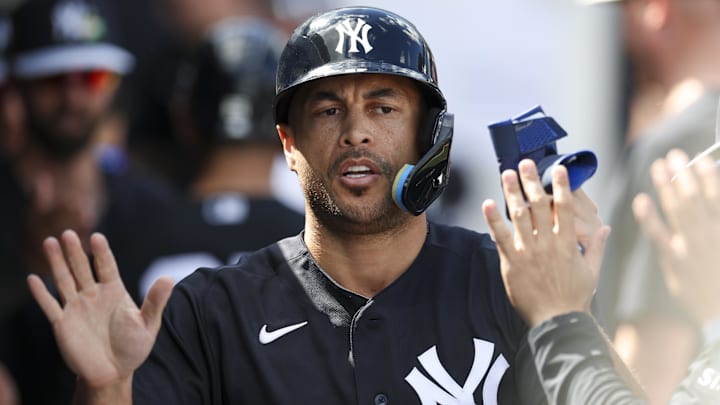
New York Yankees designated hitter Giancarlo Stanton is the perfect example. The 36-year-old Stanton is 4-for-11 with three home runs and four RBIs through his first 11 plate appearances this spring. Despite battling lingering tennis elbow in both arms, Stanton’s power stroke is right in line with last year’s 8.5% home run rate, tied for the best ratio of his career.
But a strong start for Stanton only means so much if he can’t stay healthy. He didn’t make his debut last season until June 16, and he’s only played at least 120 games once since the start of 2019. Yankees fans might be excited about Stanton now, though that optimism will evaporate if he suddenly isn’t ready for Opening Day.
Which teams (and players) can leave the past behind

MLB spring training example: Rafael Devers
Injuries are certainly part of the equation here, though that’s not the only factor. Let’s stick with the Yankees for a moment. Yes, they reached the postseason for the ninth time in 11 seasons, but they lost to the rival Toronto Blue Jays in the ALDS. Captain Aaron Judge, who left the Yankees to participate in the World Baseball Classic, subtly expressed his frustration with the team’s roster as it’s currently constructed. We’ll see whether Judge, Stanton, and the Yankees can forget about their past playoff failures and finally end a title drought that is nearing 20 years.
Teams and players have other hurdles they’ll need to overcome besides how last season ended. For players coming off injury-plagued campaigns, are they ready to regain their old form? How will managers on the hot seat handle the pressure?
Someone like San Francisco Giants slugger Rafael Devers, who joined the Giants in a stunning midseason trade with the Boston Red Sox last June, has much to prove. Devers resisted moving from third base with the Red Sox, eventually accepted a transition to DH, and was unexpectedly traded. Can he put his odd, and oftentimes frustrating, 2025 season aside to regain his All-Star form?
Strikeout and walk rates, both for pitchers and hitters
MLB spring training example: Roki Sasaki
As we’ll discuss shortly, I’m not someone who cares too much about spring training batting averages or a pitcher’s ERA. What I am interested in is how a hitter is faring at the plate overall, and if any pitchers are running into control issues.
Roki Sasaki in his Spring 2026 debut for the Dodgers:
— Dodgers Nation (@DodgersNation) February 25, 2026
3 K
3 H
2 BB
36 Pitches
1.1 Innings Pitched pic.twitter.com/0wFouLxlkL
The story of Dodgers pitcher Roki Sasaki’s rookie season was his lack of control. He walked 22 hitters and hit another three batters in 36 1/3 regular-season innings, and his 0.84 ERA in the postseason was overshadowed by his 6-5 K-BB ratio. Through his first 3.1 spring training innings, Sasaki had already issued five walks and allowed seven runs.
Sure, Sasaki’s 18.90 ERA is noteworthy, but a bad pitch or two can easily inflate a pitcher’s spring numbers. Keep in mind that a pitcher who allows three runs over six innings has a 4.50 ERA for the game itself, even if those three runs came on a first-inning homer. The problem arises when we’re still seeing Sasaki struggle to hit the strike zone.
Most of the traditional stats

MLB spring training example: Nick Solak
Like I said, I don’t see the point in caring too much about what someone hits or what their spring training ERA is. If a pitcher throws 10 innings and allows six runs because of one bad start, then does the 6.00 ERA really matter?
No disrespect intended to San Diego Padres left fielder Nick Solak, but he’s a career .250 hitter with a .694 OPS over nearly 1,000 plate appearances in parts of six big-league seasons. Why should I bother getting excited about him starting the spring with a .355 average through 31 at-bats?
I’m not trying to be negative, here. If you want to be optimistic or outright cynical about how your favorite team’s players fare in exhibition play, go for it.
Verdict: Doesn't matter
Advanced metrics … to an extent
MLB spring training example: Noah Miller
No, this isn’t an anti-analytics stance. Although some of the advanced metrics are flawed, there’s no denying that they’ve become immensely valuable and a key part of how we view modern baseball. That’s partly why someone like Seattle Mariners legend Félix Hernández could realistically make it to the Hall of Fame despite having well below 200 wins and a 3.42 ERA. We care more about his peak (five seasons with at least 5.0 bWAR) than we do his six seasons with double-digit losses.
Noah Miller 💣
— SportsNet LA (@SportsNetLA) March 5, 2026
🚀 Exit Velocity: 105.4 mph
📐 Launch Angle: 32°
📏 Projected Distance: 432 ft pic.twitter.com/VkvdDG4Gxg
Yes, there is value in someone’s launch angle, but the context has to be relevant, too. Are they coming off an injury? Did they revamp their swing? How many plate appearances did they take this spring? Context should always matter when discussing any stat, whether it appears on the back of the baseball card or not.
Verdict: Doesn't matter
Anyone who talks a big game
MLB spring training example: We're all guilty
We’ve seen it before in plenty of sports, where a player comes out during the preseason and all but guarantees a championship. I once had a Florida Atlantic football player tell me during a preseason interview that the team had become the “Alabama of Florida.” The Owls finished that year 5-7 and missed a bowl game. Alabama went 14-1 and made the national championship game.
So, if at any point you hear a player talk about how great they themselves or the team overall is, I suggest rolling your eyes and moving on. Let them go viral on social media, and let other people be the ones to mock them or buy into the hype. We have more pressing things on our plate, like wondering where the top remaining unsigned free agents will sign.
Verdict: Doesn't matter
More MLB news and analysis:
 Add us as a preferred source on Google