
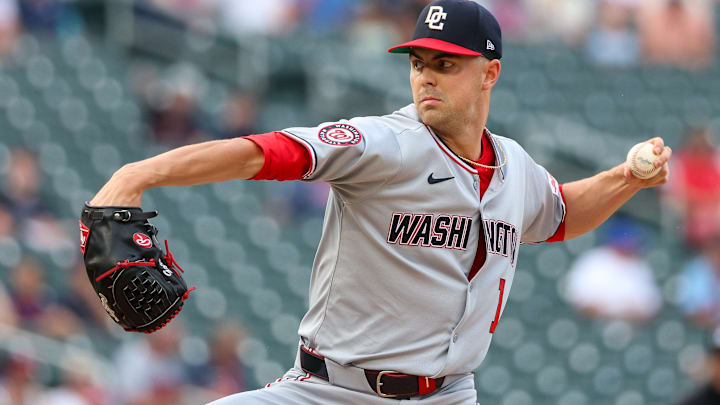
The Milwaukee Brewers traded Freddy Peralta meant that barring a shocking Tarik Skubal trade, MacKenzie Gore was probably the best starting pitcher available on the trade block. Well, this is no longer the case, as Jon Heyman of the NY Post reported that the Washington Nationals traded Gore to the Texas Rangers. FanSided's Robert Murray came through with the full return.
The Texas Rangers are acquiring MacKenzie Gore from the Washington Nationals for Gavin Fien, Alejandro Rosario, Abimelec Ortiz, Devin Fitz-Gerald and Yeremy Cabrera, according to sources familiar with the deal.
— Robert Murray (@ByRobertMurray) January 22, 2026
Getting Gore, a young All-Star-caliber starter with two years of control, is a great thing for a Rangers team trying to compete. It also cost them five prospects, several of which are exciting.
MacKenzie Gore trade grades: Did Rangers overpay for their new starter?

Gore gives the Rangers a trio in their rotation as good as anyone's, as he slots in behind Jacob deGrom and Nathan Eovaldi. Injury concerns are real, but when healthy, the Rangers can beat anyone on any given day with that top three, and young guys like Jack Leiter and Kumar Rocker can make this rotation even better if things go right.
Still, it's hard to ignore the fact that Texas parted with five prospects in order to acquire Gore. Giving up five prospects doesn't always mean they overpaid though. Let's dive in.
Rangers trade grade: B

The Rangers are in win-now mode, and trading five prospects proves just that. There's no disputing that Gore makes them much better. The Rangers lacked depth in their rotation, and Gore gives them a rotation that, again, has as much upside as any in the American League.
Rangers Rotation Order | Name |
|---|---|
1 | Jacob deGrom |
2 | Nathan Eovaldi |
3 | MacKenzie Gore |
4 | Jack Leiter |
5 | Kumar Rocker |
Sure, his 4.17 ERA might not inspire much confidence, but Gore was an All-Star this past season and he ended his season with a rock-solid 27.2 percent strikeout rate. He finished poorly, which isn't great for a Rangers team that hopes to have meaningful games to play down the stretch, but it's also worth noting that Gore had a 3.74 FIP. Going from a Nationals team that was 29th in Outs Above Average to a Rangers team that ranked sixth in that category should help him, even without Marcus Semien.
It'll be interesting to see where Texas will end up. There's reason to believe Gore is in for a big year, but how well they do in 2026 depends a lot on deGrom and Eovaldi. If they're healthy, don't be surprised to see this team go on a run. If not, their rotation, like in Washington, would leave a lot to be desired.
At the end of the day, the rotation needed an upgrade, and the cash-strapped Rangers didn't have many other options. Getting a pitcher with as much upside as Gore without parting with prospects like Sebastian Walcott and Caden Scarborough is a win, even if they did wind up giving up a lot.
Nationals trade grade: B+

Nationals fans are probably upset that the team moved on from Gore, but should they be? Yes, he was a huge piece of the Juan Soto trade, but he also has just two more years of club control left. Does anyone think that, as constructed, the Nationals are going to be even somewhat competitive in the next two years? The answer to that question should be no, so selling pretty high on a player who was unlikely to be on the next contender in Washington anyway should be viewed as a win, as painful as it is.
The only complaint Nationals fans should have in this trade is that they didn't receive a true blue-chip prospect for Gore. It would've been nice to have gotten Walcott or Scarborough, but the Nationals did receive five promising pieces.
Gavin Fien, the Rangers' first-round pick of the 2025 MLB Draft, is the headliner and is a great get for new Nationals president of baseball operations Paul Toboni. At just 18 years old, Fien has a long way to go before being deemed MLB-ready, but he was one of the most exciting high school prospects in this past year's draft and again, the Nationals are not in a rush to win right now. Plus, how can you not get excited about this crop of infielders?
Nationals Player | Position | Age | Level |
|---|---|---|---|
C.J. Abrams | SS | 25 | MLB |
Brady House | 3B | 22 | MLB |
Luis Garcia Jr. | 2B | 25 | MLB |
Seaver King | SS | 22 | AA (WSH No. 9 Prospect) |
Luke Dickerson | SS | 20 | A (WSH No. 6 Prospect) |
Eli Willits | SS | 18 | A (WSH No. 1 Prospect) |
Gavin Fien | SS | 18 | A (TEX No. 2 Prospect) |
Alejandro Rosario's stock has dipped a bit now that he's missed substantial time due to an elbow injury, but he can hit triple-digits with his fastball, has a tremendous splitter, and should be back on the mound in 2027. He was once a top 50-ish prospect, and it wouldn't be shocking to see him get back to that level when healthy.
The prospect closest to the majors is Abimelec Ortiz, a power-hitting first baseman who has also gathered some experience in the corner outfield. Ortiz figures to begin the year in Triple-A and has some strikeout and defensive concerns, but could be the Nationals' first baseman of the future if things click.
As for Devin Fitz-Gerald and Yeremy Cabrera, they're both 20-year-olds in Single-A who are far away from contributing, but they could easily develop into core position players for Washington.
Trading Gore now made sense, and while it would've been nice if the Nationals got a surefire top-100 prospect, they got several exciting prospects with interesting skill traits. This deal makes a lot of sense for both sides.
More MLB news and analysis:
 Add us as a preferred source on Google