
Key Points
Bullet point summary by AI
- The 2026 World Baseball Classic showcased elite talent and national pride, but also served as a high-stakes proving ground for several MLB stars.
- Five players significantly boosted their market value through standout performances, altering contract projections and team strategies.
- Ronald Acuña Jr. and Junior Caminero were just two players who should demand extensions this season.
The 2026 World Baseball Classic was exactly what it promised to be. Elite talent, national pride, games that actually meant something in March. But underneath the flags and walk-off moments, something else was happening.
Contracts were being written in real time. Arbitration ceilings were getting raised. Questions were getting erased. Five players – including Junior Caminero and Ronald Acuña Jr. – left this tournament in a fundamentally different financial position than when they arrived and the data backs it up.
Junior Caminero, Tampa Bay Rays

The Rays are paying Junior Caminero $820,000 for a 21-year-old who just posted a 1.259 OPS in six games against the best international talent the sport has to offer. One strikeout in 22 plate appearances. Three home runs. Seven RBI. He is a player telling the world exactly what he is.
Tampa's entire model is built on controlling talent before the market sets the price. Buy out the arb years, lock in the extension, protect the payroll. The problem is that model requires the player to not do what Caminero just did. His first arbitration hearing was already coming. Now it arrives with this performance in the record. The number an arbitration panel puts on a 21-year-old who hits .350 with 3 HR and a 1.259 OPS on an international stage is not the same number they put on a prospect with a quiet spring training. He just made the Rays' next conversation with his agent significantly more expensive.
The age context matters as much as the stat line. He is 21, doing what we all saw, on a world stage. Every projection model that feeds into arbitration valuations just got updated. The Rays know what they have; Caminero just made sure everyone else does too, and that changes the negotiating room.
Jarren Duran, Boston Red Sox
Boston's outfield situation has been one of the more discussed roster problems in the American League. Roman Anthony arrived with a long-term deal and immediate star power. Ceddanne Rafaela locked in his extension and patrols center field like he was born there. Wilyer Abreu is a legitimate piece. The conversation all winter was about which one of them was most tradable, and Duran's name kept coming up.
Then he went to Mexico and hit 1.412 OPS in four games. Three home runs. Two steals. Fifteen total bases in 15 at-bats. The Red Sox wanted clarity on the outfield picture before the season started. They got it, just not the kind that makes a trade easier to execute.
The financial mechanics here are worth understanding. Duran is a Super Two player, which means four arbitration years instead of three. He's in his second arb year at $7.7M right now. His 2027 and 2028 figures get calculated off his 2026 salary and his ongoing performance. He just added a 1.412 OPS WBC run to his portfolio heading into that calculation. Whatever number his agent puts on the table next winter just got bigger. And if Boston wants to move him, any trade partner knows they're acquiring two more years of hearings priced off this.
The Red Sox also had Wilyer Abreu and Roman Anthony play the full tournament for Venezuela and USA respectively, both posting solid but unspectacular numbers while Duran was putting up the best line of any Boston outfielder in the field. That is not a coincidence that the front office can ignore. Duran made the decision of who stays and who goes significantly more difficult.
Fernando Tatis Jr., San Diego Padres

Tatis didn't need a new contract; he needed to look like the player San Diego paid $340 million for. The suspension. The injuries. The quiet seasons that left people wondering if the deal was a mistake before it even had a chance to play out. That cloud has followed him for two years.
He led the entire 2026 World Baseball Classic in RBI with eleven. He hit .400 with a .538 on-base percentage across six games against international-caliber pitching. That OBP number tells the story the box score doesn't fully capture. The pitchers on the world stage stopped attacking him. They worked around him. Tatis earned respect where it was not given out. He proved what a $340 million player looks like.
The contract runs through 2034 at $24.3M AAV. In the current market, where Juan Soto is at $51M and Vlad Guerrero just signed for $35.7M, that number looks more reasonable by the day. Tatis is 26. If this tournament is who he is now, the Padres didn't overpay. They might have underpaid.
The value he increased isn't tied to a negotiation coming up. It's reputational. It's market perception. It's the narrative that follows a player into every conversation about his team's contention window. Tatis just changed his. The question around him entering 2026 was doubt. The question leaving the WBC is anticipation.
Masataka Yoshida, Boston Red Sox
Yoshida's Boston tenure has been harder to read than it should be. The talent is obvious. The production has been real. But the narrative around him never quite settled — inconsistency, questions about durability, the adjustment to American pitching that never fully went away in public perception. He enters the final guaranteed year of his $90M deal with genuine uncertainty about what the second contract looks like.
Then he gets to the WBC with Japan, plays alongside Shohei Ohtani, and posts a 1.257 OPS in five games. Two home runs. Six RBI. .375 average. .813 slugging. The comfort of playing for his home country in front of his home country's fans is real, and no one is pretending those factors don't exist. But scouts don't write footnotes. The numbers go in the file as numbers, and those numbers are excellent.
He's 32. The years on a second deal won't be what they were on the first. That is just arithmetic. But the AAV conversation just got reopened in a meaningful way. A 32-year-old lefty bat who can hit .375 and slug .813 in high-leverage international competition is a player teams pay for. His agent now has a tournament line to point at.
Ronald Acuña Jr., Atlanta Braves

The ACL tear cost him most of 2025. That is the entire context for why Acuña's WBC mattered more than any stat line can convey. He is under contract through 2028 at one of the most team-friendly deals in professional baseball given what he is when healthy. The Braves' contention window runs directly through him. Everything they're building toward requires him to be the player he was before the injury.
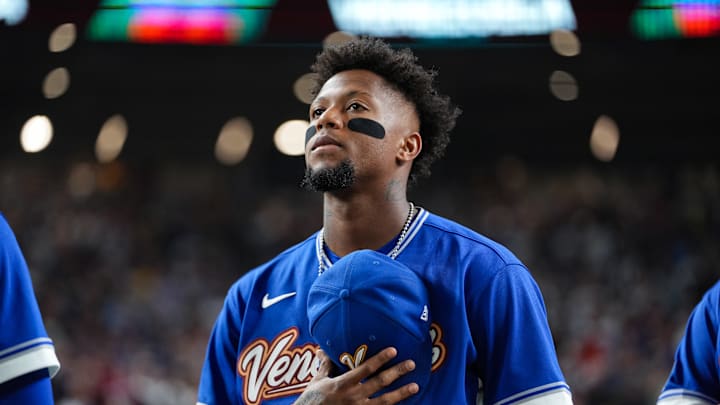
He showed up in March. He played all seven of Venezuela's games, hit two home runs, stole two bases, drew walks at a rate that produced a .424 on-base percentage, and looked, by every observable measure, completely himself. He did not play cautiously. He was not compensating. He was himself.
The value he increased here is not the kind that shows up in a contract negotiation. His deal doesn't come up until 2028 and Atlanta is not going to be the team that lets him walk. The certainty he brings to the club is what matters most to the Braves right now. The question going into 2026 was whether they had their guy back. Seven games, two home runs, two steals, and a .424 OBP later, that question has been answered.
Acuña is the most underpaid star in baseball. That fact was true before the WBC. It is more obvious now. The Braves locked him up before anyone knew what he was going to become, and what he became is a generational talent playing at a team-friendly price while recovering from major knee surgery and still posting a .962 OPS on an international stage. The contract is what it is. The player just reminded everyone why it's a bargain.
The WBC has always been about more than baseball
That is the easy take. National pride. March meaning. The kind of games that actually make your hands sweat before the season starts. All of that is real. The 2026 World Baseball Classic was also a stage, and these five players used it the way elite competitors use every stage, to make a statement that outlasts the box score. The WBC puts real pressure on the situation. These five stars showed up when the stakes were highest.
 Add us as a preferred source on Google