
Key Points
Bullet point summary by AI
- Rafael Devers’ declining contact rates raise long-term concerns for Giants.
- Minimal defensive value leaves his bat carrying entire contract risk.
- At 8 years, $200M-plus, it's already trending toward the worst contract in MLB.
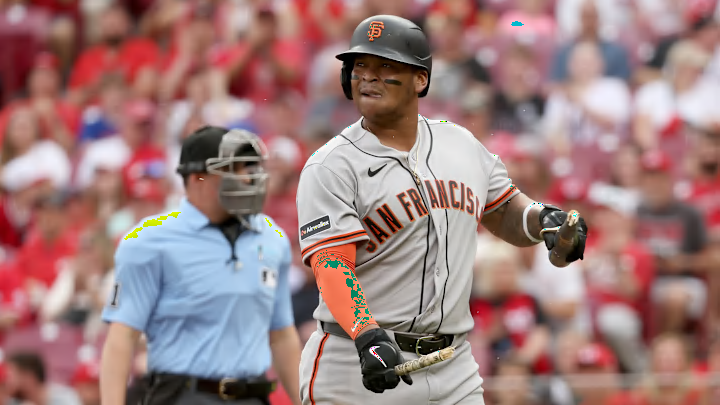
I realize that you're probably rolling your eyes right now. It's April 16, after all — surely we shouldn't be in the business of making grand proclamations after less than one month of baseball? Surely Rafael Devers won't continue to post an OPS around .600 for the San Francisco Giants, just one year after he slashed .252/.372/.479 with 35 homers?
Which is true enough, generally speaking. But after another 0-for-4 on against the Reds on Thursday afternoon, I'm here to tell you that, if you're just assuming that Devers' production will revert to his career norms, there's a good chance you're sorely mistaken. And if he's already declining at the plate now, things are about to get ugly over the eight years and more than $200 million remaining on the massive extension he signed before things went south with the Boston Red Sox — as ugly as we've seen from any contract in recent memory.
Rafael Devers' struggles are much more than just a slow start
If you want to argue a turnaround is imminent, be my guest. Certainly he won't be this bad all year: He still hits the ball hard when he makes contact, and his fluky-low HR/FB rate suggests the power numbers will begin to tick up soon. But's not like Devers has been unlucky so far this season; he's been straight bad by just about every metric, and most of his expected stats are in the same neighborhood as his actual ones.
And the most alarming part is that the underlying skill indicators are full of red flags. A tell-tale number for a hitter is their zone contact rate — how often they make contact on pitches in the strike zone. After all, those are the best pitches to do damage on; if you can't even get the bat on the ball when a pitcher is challenging you, that doesn't bode well for your ability to hit consistently. The MLB average is around 82 percent, while Devers so far this year is down below 74 percent.
This isn't a one-year thing, either. He's always had whiff problems, both in and out of zone, and they've gotten worse in recent years.
Year | Zone contact rate |
|---|---|
2026 | 73.9% |
2025 | 71.3% |
2024 | 71.9% |
2023 | 76.2% |
2022 | 77.8% |
He's gone from below average during his peak in Boston to downright awful, and again, if you're unable to do damage when a pitcher throws you strikes, that's a hard way to make a living.
Granted, Devers was even worse in this area last year, and his top-line numbers wound up just fine — despite a move to a brutal hitter's park in San Francisco. But we're trying to be predictive here, and Devers isn't getting younger; he's always been a mediocre bad speed guy, and as he hits 30 — the age at which bat speed really starts to deteriorate — his whiff problem is only going to get worse. And eventually, it's going to reach a point of no return, where he simply doesn't make enough contact to keep his profile afloat.
Maybe that won't happen all at once. Maybe Devers will heat up soon enough and post his typical slash line again in 2026. The trend line here is unmistakable, though, and it tells the story of a player in steady decline — his K rate has gone from 18.6 in 2022 to 19.2 to 24.5 to 26.3 to 28 this year. Even if he still finds a way to run into 25-30 homers each season, they're going to come with more and more strikeouts and a lower and lower on-base percentage which will kneecap his offensive value.
And that's a problem, because — as Devers has made abundantly clear of late — offensive value is the only thing propping him up as a player anymore.
Rafael Devers has no margin for error given his contract

It's safe to say at this point that Devers' days playing third base on anything like a regular basis are over. He's in the 27th percentile in sprint speed, and his metrics look rough even at first base this season. Even at age 29, he's not adding much of any value to the Giants with his glove or on the basepaths. That means he needs to hit like a star to come anywhere close to recouping value on his current contract — and one that runs through 2033, Devers' age-36 season.
Maybe he continues to defy the contact odds and puts together one or two more plus offensive seasons. That still leaves so, so much time for things to go bad; what do you think a 32-year-old or 33-year-old Devers is going to look like, with his athleticism even further deteriorated and San Francisco still compelled to pencil him into the middle of the lineup every day? It might not be long until the Giants are paying nearly $30 million a year for an average (at best!) bat who doesn't do anything else, a player who will struggle to even get to two or three WAR in a given season.
Why the Rafael Devers deal is already the worst value in MLB

Given just how much money, and for just how long, San Francisco is committed, that already makes him the worst contract in the sport. Don't believe me? Let's break it down.
A good way to think about this is to ask yourself a simple question: Would the Giants be able to swap Devers' contract with [insert bad long-term deal here] in a straight-up trade — i.e., would another team view Devers' deal as the better value of the two? I'm not sure you can find a contract for which the answer would be yes.
Devers currently has the 21st-highest AAV in baseball.
Player | AAV | Contract runs through |
|---|---|---|
Shohei Ohtani | $70 million | 2033 |
Kyle Tucker | $60 million | 2029 |
Juan Soto | $51 million | 2039 |
Zack Wheeler | $42 million | 2027 |
Bo Bichette | $42 million | 2028 |
Aaron Judge | $40 million | 2031 |
Framber Valdez | $38.3 million | 2028 |
Jacob deGrom | $37 million | 2027 |
Blake Snell | $36.4 million | 2030 |
Gerrit Cole | $36 million | 2028 |
Vladimir Guerrero Jr. | $35.7 million | 2039 |
Mike Trout | $35.5 million | 2030 |
Alex Bregman | $35 million | 2030 |
Anthony Rendon | $35 million | 2026 |
Francisco Lindor | $34.1 million | 2031 |
Carlos Correa | $33.3 million | 2032 |
Cody Bellinger | $32.5 million | 2030 |
Nolan Arenado | $32.5 million | 2027 |
Corey Seager | $32.5 million | 2031 |
Manny Machado | $31.8 million | 2033 |
Rafael Devers | $31.3 million | 2033 |
Which of those deals would you choose Devers' over? Ohtani, Soto and Judge can be thrown out immediately. Tucker, Wheeler, Bichette, Valdez, deGrom, Cole, Rendon and Arenado are all off the books soon (and plenty of them can still very much play). The same is even true of Kris Bryant, who only has two more years remaining on his deal with the Rockies and will almost certainly retire before then anyway.
The other long-term deals start to get a bit ugly, but Snell and Seager remain dynamite when healthy while Lindor and Bregman still provide value defensively if nothing else — and all four of those deals are significantly shorter than the Devers contract. The only two candidates here are Trout and Correa, and Trout is showing this season that he's still got plenty left in the tank even if the last couple years (at least) will be ugly. If you want to nominate Correa, that's fair enough, but the money is almost the same, his deal is one year shorter and at least he still gives you something as a reliable defender at multiple infield spots. Do you really feel that confident in Devers outperforming him from an overall value perspective over the next eight years?
And after that, the candidates just about dry up. I'd rather pay both Trea Turner ($27.2 million per through 2033) and Bryce Harper ($25.3 million through 2031). Christian Yelich only runs through 2029, Pete Alonso through 2030. A couple of San Diego contracts come close: Both Xander Bogaerts and Manny Machado will be getting paid through their age-40 seasons, and while both remain solid players, the decline has already very much begun. If you want to argue that you'd rather pay Devers for the next eight years than either of those two because at least Devers will be younger, be my guest. But he also offers nothing else of value outside of his bat.
And really, the fact that this is even a conversation is a damning indictment of Buster Posey and Co., who were so desperate to finally add a middle-of-the-order bat after so many swings and misses in free agency that they jumped at the first big name they were offered — without wondering why Boston was making him so available in the first place.
 Add us as a preferred source on Google