
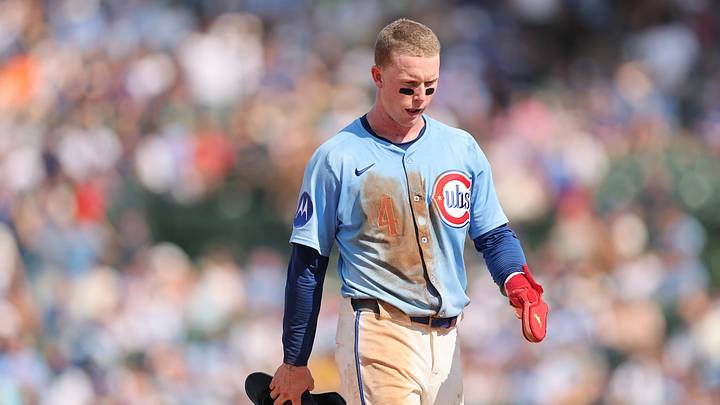
Pete Crow-Armstrong has had a rough week. He was fined $5,000 for a fan interaction on Sunday with a Sox fan at Rate Field. On Wednesday, he misplayed a single that turned into a Little League home run for the Brewers. Both viral moments fueled Cubs discourse on social media, but they distract from the bigger on-field question surrounding PCA right now: Is his game actually slipping, or are the optics louder than the data? The answer depends entirely on which side of the ball you are looking at.
We checked the data behind PCA's recent struggles, and the answer is more nuanced than either the panic crowd or the dismissal crowd wants to admit.
What the defensive metrics actually say about Pete Crow-Armstrong
Three errors in 50 games. That matches his entire 2025 total of two in 156 games. Visible misplays. A missed catch that went viral. It looks bad from the stands, and it looked worse on social media. Here is what the advanced metrics say about the same stretch:
Through 50 games in 2026, PCA leads all of baseball with a +10 OAA, +11 FRV, and +12 DRS. His range component is +9. His arm value is +2. No center fielder in baseball is saving more runs. No outfielder is converting more difficult chances. As his teammate Michael Conforto said after the missed catch Sunday, "If Pete can't catch that ball, there isn't a center fielder alive who could."
The Statcast catch probability data backs that up. He is attempting plays in 2026 that most outfielders do not even try. Some of those plays result in misses that look like errors. None of that shows up in the OAA or FRV columns because the model accounts for difficulty. What shows up is the best defensive center field season in baseball through May.
The errors are real. The defensive collapse is not. Those are two different things.
Why PCA’s offensive profile looks familiar to Cubs fans

This is where it gets more honest and less comfortable. Through his first 401 plate appearances in 2025, PCA slashed .265/.302/.544 with a 131 wRC+, 25 home runs, and a .356 wOBA. The first half of 2025 looked like an MVP candidate in the making. Then the All-Star break happened.
In 246 post-ASG plate appearances, he hit .216/.262/.372 with a 72 wRC+ and just six home runs. His ISO dropped from .279 to .156. His barrel rate fell from 14.2 percent to 10.8 percent. His pull rate jumped from 49.3 percent to 59.0 percent.
His current 2026 numbers look like the second version. A wRC+ tracking in the low 70s, barrel rate suppressed, and a pull rate that suggests he is selling out for power and losing the other half of the field. That pull rate spike is the most telling mechanical signal in the data. When hitters start yanking everything to the pull side at that rate, it typically means pitchers made an adjustment, and the hitter is responding emotionally rather than analytically.
As we noted earlier this season when his early struggles first surfaced, the bat speed has remained intact. The swing decisions are the problem, not the physical tools.
Why Cubs fans shouldn't panic about Pete Crow-Armstrong
The reason to stay calm is simple. He already lived through this exact pattern and came out the other side.
He opened 2026 as the same player who dominated the first half of 2025. His defense has not regressed in any meaningful metric. His athleticism and range are intact. His exit velocity and hard-hit rate are not the profile of a hitter whose physical tools are eroding. And critically, he is 24 years old on a $115 million extension that the Cubs clearly believe in, as the reasoning behind that deal made clear.
What the post-ASG stretch in 2025 proved is that PCA is susceptible to mechanical drift under volume and pressure. Pitchers make adjustments. Young hitters respond to those adjustments emotionally before they respond analytically. The pull rate spike is that emotional response showing up in the data. The fan confrontation on Sunday might be the same thing showing up in a different way.
The difference now is that he and the Cubs coaching staff have seen this before. The question is not whether PCA can fix it. He already proved he can. The question is how long it takes.
The two stats Cubs fans should monitor moving forward
Pull rate: His pre-ASG 2025 mark was 49.3 percent. His post-ASG mark spiked to 59.0 percent. Right now, he is in that elevated range. If it starts moving back toward 49-50 percent, he is finding the middle of the field again, and the power will follow. If it stays above 55 percent, pitchers have found a hole they are not giving back.
Barrel rate: Pre-ASG 2025 was 14.2 percent. Post-ASG dropped to 10.8 percent. A move back toward 13-14 percent means the swing decisions are improving before the results catch up.
On the defensive side, the errors will keep happening occasionally because PCA plays center field at a difficulty level most outfielders never attempt. That is not a bug. It is a feature of being the best defensive center fielder in baseball.
The bat needs watching. The defense does not.
Data: FanGraphs 2025 pre and post All-Star splits. Baseball Reference fielding data. Baseball Prospectus DRP. Statcast via Baseball Savant. OAA, FRV, DRS via FanGraphs.
 Add us as a preferred source on Google