
Key Points
Bullet point summary by AI
- The New York Mets are struggling to score runs after significant offseason roster changes, sitting at .500 after six games.
- Key offseason additions are underperforming, with several veterans and prospects failing to produce expected power.
- The team's lack of extra-base hits and home runs highlights a critical weakness that could hinder their playoff hopes this season.
Safe to say that any good will the New York Mets may have bought themselves with that 11-7 win on Opening Day is long gone now. Sure, knocking Paul Skenes out in the first inning was fun, a needed show of strength from a team that underwent a historic amount of change over the offseason. Now, though, this new-look lineup looks completely lost, having scored exactly one run over two straight losses to the St. Louis Cardinals that have knocked the team back down to .500 on the season.
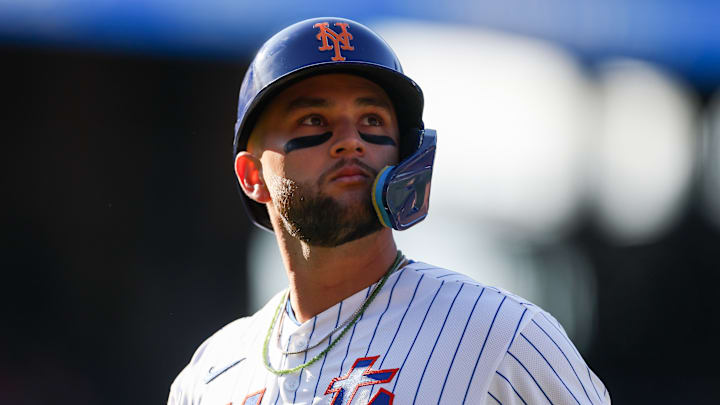
A Juan Soto solo homer accounts for the entirety of the scoring in that span, and he is indeed still a force. But beyond the $765 million man, hardly anyone is hitting right now — least of all the guys David Stearns built his winter around, from Bo Bichette (.249 OPS) to Jorge Polanco (.691) to Marcus Semien (.390) to top prospect Carson Benge (.554). New York seemed confident in letting the likes of Pete Alonso and Brandon Nimmo go. But the 2026 edition isn't an improvement on the one that missed the playoffs last season; if anything, it looks even worse.
Mets fans are never too far away from an existential crisis even in the best of times, so you can imagine how they're taking this at the moment. And I have to admit, it's hard to chalk this up to a fluke of small sample size.
Mets' offensive struggles highlight a real, and potentially fatal, flaw

It's not just that the Mets aren't hitting; every offense goes through slumps over the course of a 162-game season, and we shouldn't overreact just because New York's has come right out of the gate. It's how the Mets aren't hitting that should have fans nervous.
Contact hasn't been the problem; New York came into Wednesday with just 49 strikeouts through six games, tied for the 10th-lowest total in baseball, and they only whiffed six times in an 11-inning loss. But hardly any of that contact is significant: Their .335 slugging percentage ranks just 23rd, and their four homers entering the day were tied with the Royals and Guardians for 24th.
This is a team with a power problem, which makes sense if you take one look at the lineup. The two biggest offensive acquisitions Stearns made over the offseason were Bichette, whose value was never tied to his ability to hit the ball over the fence, and Luis Robert Jr., whose ground-ball rate has spiked to career-high levels so far with the Mets. Alonso, one of the great power hitters of his generation, was replaced by Polanco, who hit 26 homers last season but has been difficult to trust due to both injuries and inconsistency in recent years. Semien is a 35-year-old whose power outage (from 29 in 2023 to 23 in 2024 to 15 last year) mirrors his steep physical decline. Benge is a rookie who was hit over power to begin with.
Soto is one heck of a foundation, and Francisco Lindor will eventually pick it up and get to his usual 30 homers. Beyond that, though, it's hard to know exactly where the power is going to come from. Can Mark Vientos turn his career around? Can Francisco Alvarez stay on the field long enough to make good on his potential? Because if the answer to those questions is "no" — which seems like the most likely outcome at this point — New York is in real trouble.
Should David Stearns already be regretting some of his offseason decisions?

I was high on the Mets' offseason at the time, and I remain so now — provided, of course, that you take a long enough view. Swapping Nimmo's contract for Semien's was a no-brainer; Nimmo's defensive decline made him an untenable fit next to Soto, and you clear out the payroll space two years sooner. Opting not to pay Alonso $31 million a year until he's 35 will also prove prudent. But while I think Stearns would make those decisions all over again if he had to, it's also worth noting that they could hurt a bit in the immediate term. Nimmo is a better player than Semien, after all, and Alonso has at least one or two more 35-homer seasons in him before the decline hits.
If you want to criticize Stearns for failing to land Kyle Tucker, well, that's fair enough. But in his defense he did try, only for the Los Angeles Dodgers to hand the star right fielder almost $60 million a year. And beyond that, where were the upgrades going to come from? Cody Bellinger would've been a terrible fit at Citi Field. I'd still rather have Bichette than Bregman moving forward. Trade targets like Ketel Marte would've been exorbitantly expensive, likely blowing a hole in the Mets' enviable pitching depth.
The simple fact of the matter is that Stearns inherited a team that was in worse shape than most would care to admit. I don't begrudge any Mets fan for feeling an emotional attachment to franchise stalwarts like Alonso and Nimmo, but it's also worth remembering that the old core had just about run its course — without winning much of anything. This wasn't a "just add water" situation; this was a wonky roster that's going to take time to straighten out, and there's a good chance that means some frustration in the near term. The good news is that the process here sure seems sound, and there's still plenty of Soto's prime left to go.
 Add us as a preferred source on Google