
Key Points
Bullet point summary by AI
- Early Statcast data is separating real MLB breakout performers from temporary hot starts through xwOBA and barrel rate.
- Some established stars like Trea Turner and Marcus Semien show declining contact quality that flags second-half regressions.
The first two months of an MLB season produce two kinds of performers: players whose numbers reflect something real, and players whose numbers reflect something temporary. The box score does not tell you which is which, but early Statcast data is already separating the players building toward something real from the ones running out of runway.Metrics like xwOBA, barrel rate, exit velocity and strikeout rate tell a cleaner story about where a hitter actually is and where they are headed.
These MLB starts look shaky beneath the surface
Trea Turner, Philadelphia Phillies

Trea Turner is hitting, and the Phillies are counting on him. But the Statcast profile says something different.
His barrel rate is 4.1 percent and his xwOBA sits at .280. For a 33-year-old whose offensive value depends almost entirely on contact quality and speed, those are thin margins. The exit velocity of 90.1 and hard hit rate of 39.9 percent are both trending in the wrong direction for a player at this stage. His wRC+ of 75 is below replacement-level production for a short stop, and the underlying numbers give no indication that a correction is coming. It is the same dynamic we tracked with Tatsuya Imai earlier this season: surface results that look fine until the underlying numbers catch up.
Marcus Semien, New York Mets

The Mets signed Semien to anchor their infield, and the numbers through May suggest they may be paying for what he was rather than what he is.
At 36, his barrel rate of 7.6 percent and xwOBA of .310 are functional but fragile. His ISO has dropped to .100 and his exit velocity of 85.9 is soft for a middle-of-the-order bat. The K rate of 19.8 percent looks fine in isolation, but combine it with a 7.1 percent walk rate and limited power and there is very little margin when the bat goes cold. Semien has been durable and professional throughout his career. The profile of a 36-year-old with declining contact quality and shrinking power is one the data consistently flags as a second-half problem.
Matt Chapman, San Francisco Giants

Chapman signed with San Francisco, and the Giants are still waiting for the offensive profile to show up. His wRC+ sits at 77. Barrel rate 5.6 percent. ISO at .090. xwOBA of .250. The exit velocity of 86.9 and hard hit rate of 31 percent are both soft for a corner infielder being paid to provide power. At 33, Chapman has always been a streaky hitter whose defense carried his overall value, but the bat needs to be at least functional for that equation to work. Right now it is not. A 194-plate-appearance sample is large enough that the underlying numbers are telling a real story.
These breakout bats look completely real
James Wood, Washington Nationals

Start with the exit velocity: 96.5. Barrel rate: 26.6 percent. Hard hit rate: 62.4 percent. Walk rate: 17.6 percent.
Wood is 24 years old and already producing contact quality that most hitters never reach. His wRC+ of 149 is backed by an xwOBA of .430, which means the production is not running ahead of the process. It is the other way around.
The K rate at 31.2 percent is the one number that gives analysts pause. It has not hurt him yet because the power and patience profile absorbs it. Whether it stays that way as pitchers adjust is the only real question in an otherwise clean breakout profile. We flagged him as a buy earlier this season, and the data has only gotten stronger since.
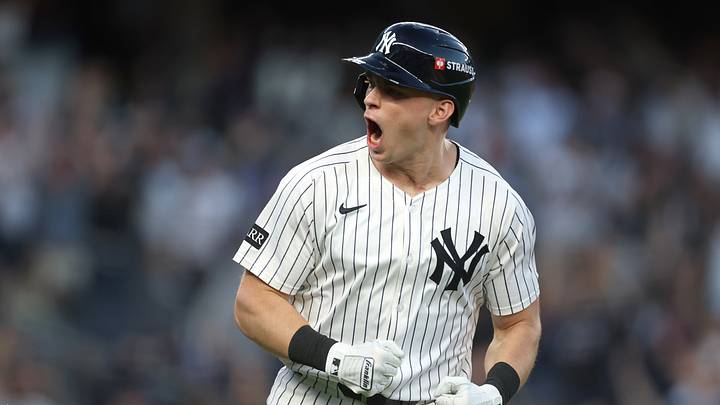
Ben Rice, New York Yankees

Rice is 27 and having the best stretch of his career. The underlying numbers say it is not a fluke.
His wRC+ is 194. His barrel rate is 21 percent. His xwOBA is .430. His hard hit rate is 55.2 percent. The power is real, and the contact quality backs it up. At 27, he is in the window where hitters typically consolidate their approach and the gains tend to hold. That combination does not regress as often as people expect, and the Statcast profile here gives no indication a correction is coming.
Nick Kurtz, Athletics

Kurtz does not have Wood's exit velocity or Rice's current production. What he has is a 21.4 percent walk rate at age 23, a number that tends to predict sustained offensive value better than almost any other early-career marker.
His wRC+ of 156 is built on a real approach. Barrel rate of 17.2 and hard hit rate of 59.6 show the power is developing on schedule. At 23 he has significant runway, and the plate discipline suggests he will be able to make adjustments as pitchers try to exploit him.
The profile is quieter than the other two names on this list. The trajectory is just as real.
 Add us as a preferred source on Google