
Key Points
Bullet point summary by AI
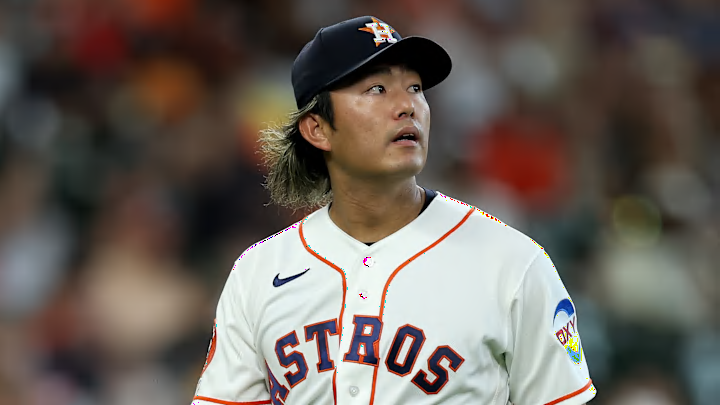
- The Houston Astros invested $54 million in a Tatsuya Imai, a pitcher the Dodgers evaluated but passed on this offseason.
- Reports show the newcomer struggled with fastball command in his first MLB start, walking more batters than he struck out.
- This reveals a critical difference in how Los Angeles constructed a deep, reliable rotation to start the season.
The Houston Astros spent $54 million on a problem the Dodgers already solved. One start in, the math is getting harder to ignore.
The Astros needed a rotation anchor after losing Framber Valdez to Detroit. They found their guy and beat the market, signing Tatsuya Imai. It was three years, $54 million for the three-time Japanese All-Star who posted a 2.34 ERA and 187 strikeouts with the Saitama Seibu Lions in 2024.
Except the Dodgers looked at that same market and passed.
Yoshinobu Yamamoto is on a $325 million deal and he just threw six innings against the Diamondbacks on Opening Day without surrendering a walk. Tyler Glasnow is locked in through 2028. The Dodgers' rotation was already full, sure, but they evaluated Imai and made their bet somewhere else. After Sunday's debut, that bet looks very good.
Imai's first start was a command disaster, not a stuff problem

The line was ugly. 2.2 innings, four runs, four walks, four strikeouts, 13.50 ERA. Everyone has seen that part.
What the box score doesn't show is how it got there. Imai threw 74 pitches in less than three innings and found the strike zone on only 48.6 percent of them. He walked two batters in the first, had a clean second, then completely lost the zone in the third. Zach Neto walked, Mike Trout singled, Nolan Schanuel walked to load the bases, and Jorge Soler doubled to the corner to clear them. A four-run lead became a one-run game in a matter of minutes.
The fastball was the culprit. He sat 95-96 mph with it but couldn't locate it anywhere near the zone with consistency. His slider and curveball were sharper, which matters for understanding what this debut actually was. This wasn't a stuff problem. His arsenal is legitimate. It was a fastball command problem, and in the big leagues that single issue is enough to get you knocked out before the third inning ends.
Joe Espada said he was surprised by the wildness. "I wasn't expecting the scattering of the zone. He's shown the ability to throw strikes." That's the whole tension right there. Imai can locate. He did it for eight years in Japan. He did it in spring training. Sunday was something else.
Imai acknowledged it himself. "I was kind of nervous, which may have been a bad thing," he said through a translator. "It was just a different atmosphere for me."
The underlying numbers make the concern harder to dismiss than debut nerves. His FIP was 4.64, his xFIP was 5.21, and his SIERA landed at 6.20. Think of FIP as what a pitcher's ERA probably should have been, stripping out defense and focusing only on the outcomes he actually controlled: strikeouts, walks, and home runs. SIERA goes one step further and accounts for how those outcomes interact, making it the most reliable predictor of what a pitcher's ERA will look like going forward. League average for both sits around 4.00. When a pitcher walks as many as he strikes out, those numbers don't grade on a curve for debut jitters.
The Dodgers are doing this with depth, not stars

Meanwhile in Los Angeles, nothing was broken.
Yamamoto went six innings on Opening Day against Arizona, issued zero walks, and struck out six. His SIERA came in at 2.72. He mixed five pitch types and faced 21 batters without a single free pass, throwing 95 pitches with 63 strikes on a national broadcast in front of a banner-raising crowd. That's what command looks like.
Glasnow followed two days later in the series finale. Six innings, two runs, four hits, six strikeouts, 90 pitches. His FIP was 1.64. His WHIP was 0.833. The Dodgers swept Arizona, outscoring the Diamondbacks 16-6 across three games, and their rotation was the foundation of all of it.
Even the middle game, where Sheehan gave up runs early and the bullpen had to piece things together, ended in a 5-4 Dodgers win. Edwin Diaz closed it out, trotting to the mound to a live trumpeter playing his entrance music, converting his second save of the week. The infrastructure held even when the starter struggled.
Both Yamamoto and Glasnow allowed runs. Neither had a pristine line. But they both gave the Dodgers six innings, which is the whole ballgame when it comes to protecting a bullpen across a three-game series. The Astros got 2.2 innings from Imai on Sunday and asked their relief corps to cover the rest in a 9-7 game they somehow still won.
The hard-hit rate gap tells part of the story too. Glasnow held Arizona to a 31.3% hard-hit rate. Yamamoto was at 33.3%. Imai's was 42.9%, even in fewer than three innings. When you're behind in counts because you can't find the zone, everything gets harder to manage.
What this actually means for the Astros

One start doesn't define a pitcher. That's worth saying clearly before conclusions calcify.
Imai's stuff is real. The strikeout rate, even in a rough outing, was 13.5 per nine innings. The slider gets swing and miss. His splitter, which teammate Taylor Trammell called the most unhittable pitch he'd ever seen during spring training, barely appeared Sunday at just 9.5% usage. There's a version of this where the nerves settle, the fastball command comes back, and Imai is exactly what the Astros paid for.
But the adjustment curve is steep and the organizational cost is immediate. Houston is running a six-man rotation to keep Imai on the once-a-week schedule he's accustomed to from Japan. That's a bullpen arm removed from the equation every fifth or sixth day. The unit gets shorter, games get harder to hold, and the margin for error shrinks. If the command volatility sticks around for even a few more starts, that cost starts compounding fast.
The Astros open 2026 without Framber Valdez and counting on a pitcher who just demonstrated that his most significant pre-signing concern is not theoretical. Command volatility at this level, attached to this kind of contract, is exactly what separates a smart international acquisition from an expensive lesson.
The Dodgers looked at the same pitcher, evaluated the same risk, and built their rotation around Glasnow and Yamamoto instead. One week into the season, that decision looks exactly right.
More MLB news and analysis:
 Add us as a preferred source on Google