
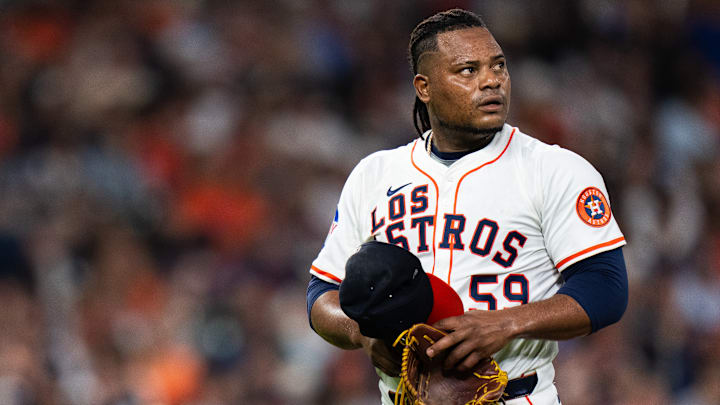
Just when the vibes around the Detroit Tigers' offseason were at their lowest, a winter full of fiddling on the margins culminating in one final indignity on the road to losing Tarik Skubal, Scott Harris flipped the script. Hours after the conclusion of the team's arbitration hearing with Skubal, word broke that the Tigers had poached star lefty Framber Valdez on a three-year deal worth a cool $115 million. (According to The Athletic's Ken Rosenthal, the contract also includes an opt-out after year two.)
That's just shy of $40 million per year, for those keeping track at home, the highest AAV ever given to a left-handed pitcher. Which should qualify as a serious statement of intent: Valdez was the best remaining free agent on the market, a workhorse No. 2 who does nothing but eat up quality innings, and it was finally the Tigers who did what was necessary to get a deal done.
But of course, in Detroit these days, nothing is ever that simple. Is this enough to get fans off of Harris' back and have Tigers fans believing again? Should the rest of the league press pause on all those mock Skubal trades for now? More than just about any other deal this side of Kyle Tucker, the Valdez contract has ripple effects that will be felt around baseball — maybe for years to come.
With or without Tarik Skubal, Detroit needed Framber Valdez
No matter what does or does not happen with Skubal this year, the Tigers needed to add pitching. Skubal, Jack Flaherty and Casey Mize were just about the only arms that Detroit could reasonably count on for a full workload in 2026, and even Flaherty and Mize have their share of question marks.
If there's one thing Valdez is, it's steady. Not only has he pitched to a 3.21 ERA over the last four years, but he's cleared the 175-inning mark in each of those seasons. He's not going to miss as many bats as you'd expect from a top starter, but he's among the best in the league at minimizing hard contact and keeping balls on the ground. Combine that with a sturdy defense, and you get a whole lot of outs while working deep into ballgames.
That's exactly the sort of high floor that this Tigers rotation needed if they want to contend in 2026.
Projected Tigers rotation with Framber Valdez
Role | Pitcher |
|---|---|
SP1 | Tarik Skubal |
SP2 | Framber Valdez |
SP3 | Jack Flaherty |
SP4 | Casey Mize |
SP5 | Reese Olson |
SP6 | Troy Melton |
You can immediately see the impact that Valdez has. It's not just his own production, but the way he allows each of Detroit's non-Skubal starters to slide down a rung — and into roles for which they're better suited. Flaherty and Mize become fine mid-rotation options, rather than having to carry the load immediately behind Skubal. And guys like Olson (who's flashed real promise, if he can ever stay healthy) and Melton (who bounced between the bullpen and rotation) go from guys on whom the team is depending to more depth roles.
That makes a huge difference over the course of a long season; it's hard to overstate the strain that all those extra innings put on a staff, much less one as thin as Detroit's was. And when we get around to the postseason, the Tigers will finally have somebody they feel excited to hand the ball to for Game 2. There's a ton of on-field reasons to feel good here, even if the off-field concerns loom even larger.
Tigers preparing to win arbitration case against Tarik Skubal

It's hard not to read into the timing here. The Tigers signed Valdez mere hours after the conclusion of their arbitration hearing with Tarik Skubal, a dispute that will decide how much the reigning two-time Cy Young winner will make in salary for the 2026 season. Detroit filed at $19 million, a number just shy of the record arbitration salary for a pitcher in MLB history (David Price at $19.75 million). Skubal and agent Scott Boras, meanwhile filed at ... $32 million, a number that would be the highest arbitration salary on record, edging out Juan Soto's $31 million in 2024.
We won't know which number the arbiter chooses until Thursday, according to the latest reports. But it sure seems like the Tigers are confident they're going to be the winners. After all, it's awfully unlikely that this front office, and this ownership group, will be paying not just one but two starting pitchers north of $30 million this season.
Which, on the one hand, makes sense. Skubal's filing is so far beyond the precedent at his position, and any arbiter might blanche at going so far beyond the established standard. Of course, precedent or not, it also underlines just how broken baseball's economic model is — and why owners will have such a hard time demanding a salary cap in CBA negotiations this year.
Skubal is about to start his seventh MLB season, and he'll turn 30 in November. And yet, despite that, and despite being possibly the best at his position on planet Earth right now, he's yet to have the opportunity to earn market value for his services. No other league operates in this way, and while the arbitration system is meant to ameliorate the extreme leverage teams hold over their homegrown talent, clearly that system is still tilted in one particular direction. As it is, it seems likely that Skubal will have to spend one more year making far less than he's worth.
Framber Valdez contract means Tarik Skubal won't be back — but he won't get traded, either

Everything the Tigers do at this point is viewed through the lens of what it means for Skubal's future, and certainly signing Valdez is no different. Paying him nearly $40 million a year not just in 2026 but in 2027 as well would sure seem to signal that Detroit has more or less abandoned any hope of extending Skubal before the season begins — much less competing for him in free agency next winter. Nothing about the way Scott Harris and Co. have operated of late suggest that they have the stomach to sink what will probably amount to $80-90 million into two starters for multiple years, even with relatively little future money on the books right now.
So if the Tigers are resigned to losing Skubal eventually, they might as well try and get something via trade while they can, right? Well, not so fast. For starters, a Skubal trade is far harder in practice than it is in theory; good luck finding a team that can make this worth Detroit's while and still have enough leftover to contend, all with the knowledge that they might lose the lefty in free agency after only one season. Plus, moving Skubal would necessarily mean a step back in the short term, and that seems at odds with signing Valdez to this particular contract.
The most likely scenario here is the one we've predicted all along: That the Tigers know they can't afford Skubal (or, more accurately, just don't want to), but they're determined to see it through to the end and make one more run at a World Series in 2026.
What else does Detroit need to make one last run with Skubal in 2026?
The good news is that Detroit's starting rotation looks far healthier now than it did 24 hours ago. And when you combine that with the shrewd work Harris did in rebuilding this bullpen earlier in the offseason (from re-signing Kyle Finnegan to adding Kenley Jansen and Drew Anderson), this seems on paper like a solid pitching staff capable of supporting a playoff push.
Unfortunately, they still feel at least one bat short. Even if you want to bank on Spencer Torkelson and Parker Meadows taking steps forward — and you could talk me into either one, really — there are some serious question marks on the left side of the infield between Javier Baez and Zach McKinstry. Top prospect Kevin McGonigle might hit the ground running, but that's a lot to ask a rookie, and there's a lot of swing and miss even among the more proven hitters in this group.
All of which was why the Tigers were interested in Alex Bregman for two consecutive offseasons. Someone like Bregman or Bo Bichette would've been an ideal fit and taken Detroit up a notch or two in the AL. Alas, they missed on both, and now they're left with a very solid team that should reclaim the AL Central — but whose ceiling doesn't seem to match the league's elite, much less a team like the Los Angeles Dodgers.
 Add us as a preferred source on Google