
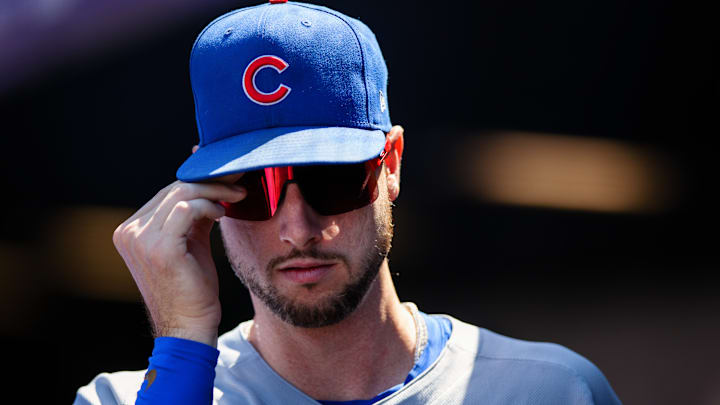
Well that happened. Just when baseball fans were about to lose their minds from boredom, the MLB offseason went from 0 to 100. When Kyle Tucker shocked everyone by taking a historic four-year, $240 million deal with the Los Angeles Dodgers, it kicked off a remarkable chain of events: First Bo Bichette to the New York Mets on a similarly short-term, opt out-heavy deal, and then JT Realmuto to the quickly panicking Philadelphia Phillies.
When the dust settled, three of the biggest dominos remaining in free agency were off the board, and the landscape of the league had shifted considerably. Who played this whole thing perfectly? Who's left scrambling with precious little offseason remaining before spring training? Let's break it down.
Winners
Kyle Tucker
Can you start anywhere else? Tucker not only broke the AAV record, he smashed it, outpacing Juan Soto by some $6 million in terms of present-day value. He gets to spend the 2026 season with the two-time defending World Series champions, and if he can just stay healthy and produce in the best possible team context, he can hit the market again next winter — when he'll still be just 30 years old, and should have no problem securing a six- or seven-year deal that could well carry him through the remainder of his career.
And if he gets hurt again, or a lockout throws the league into uncertainty? He can simply opt in, secure another record bag for 2027 and play the short-term game. Either way, it's hard to see a world in which Tucker doesn't make out very well over the remainder of his prime free agency years, all while winning a lot of games.
Los Angeles Dodgers

Look, this is not a defense of the Dodgers. While I'm skeptical that a salary cap is the answer to what's broken about MLB's economic model, it's undeniably true that a lot of teams simply can't spend in the way that Los Angeles does, and that's a problem — one that Rob Manfred and the MLBPA need to address sooner rather than later.
Still, Andrew Friedman can only follow the rules that have been laid out for him, and he can only use the resources that are at his disposal. The Dodgers are acting exactly as they should under the circumstances, and in both Tucker and Edwin Diaz, they've strengthened argualby their two biggest weaknesses ahead of their threepeat bid. Good luck to everyone else.
Bo Bichette

It seemed like Bichette was set to accept a seven-year, $200 million deal with the Philadelphia Phillies, a perfectly fine outcome for his free agency. And then the New York Mets whiffed on Tucker, and gave Bichette the opportunity to cash in on their desperation. Bichette is in total control here: He'll make a whopping $42 million in 2026, tied for the fourth-highest AAV in the league, and because he won't turn 28 until March, he still has plenty of time to cash in on a long-term deal — especially if he excels in the transition to third base that was bound to come anyway.
Even more than Tucker, Bichette's age made him a great fit for a short-term deal at a higher AAV, and this feels like the best-case scenario.
Cody Bellinger

Just a week or so ago, it felt like Bellinger was going to lose a leaguewide game of chicken. The New York Yankees were the only team that seemed truly interested in a long-term contract, and they were getting so fed up with his sky-high asking price (something like seven years and north of $200 million) that they more or less told he and his agent, Scott Boras, to take a hike.
Now, though, Bellinger's holding all the cards. He's the last impact free agent left standing on the position player side, and after Tucker made a loaded Dodgers roster even more so, there are plenty of teams that should be desperate to secure his services — from the Yankees to the Mets to the Phillies to the San Francisco Giants and more. That's the sort of bidding war megadeals are made of, and even if he doesn't get the years he wants, the precedent established by Tucker and Bichette should at least help him boost his AAV.
Scott Boras

And speaking of: Let this be a lesson for anyone who tries to shovel dirt on Boras' grave, or who wonders aloud why players continue to flock to the sport's preeminent superagent. The five-year, $175 million contract Boras secured for Alex Bregman looks great in hindsight, a perfect mix of high yearly salary and long-term security, and his stubbornness with Bellinger appears to be paying off beautifully. The man knows what he's doing.
JT Realmuto

Maybe the Phillies had a three-year, $45 million deal for Realmuto on the table for weeks, and were just waiting for other dominoes in free agency to fall. But man, the timing did not look good: Just an hour or so after missing on Bichette, and less than a day after watching Tucker go to the team that just bounced them from the NLDS last October, Philly paid real money for the age 35-37 seasons of a catcher who's no longer particularly exceptional for his position. Realmuto is still plenty useful, but he's lost much of the skill set that made him such a unique star in his prime, and $15 million a year won't help an already-clogged payroll. And really, who were they bidding against for Realmuto's services?
Rob Manfred

Manfred simply can't lose. After this latest flurry of activity, he gets to have his cake and eat it too. After publicly flirting with the idea of a free agency deadline in order to kick MLB's offseason into gear, the commissioner finally got the sort of activity that thrust his sport to the forefront of the news cycle in the middle of January. And while fans everywhere are rolling their eyes at the Dodgers, last year is proof that nothing boosts ratings quite like a good villain.
As if that weren't good news enough, the increased likelihood of a Dodgers threepeat will give Manfred even more leverage as he and the owners he works for try to demand sweeping economic changes at the negotiating table when the current CBA expires next winter.
Losers
Philadelphia Phillies

It's hard to imagine a worse 24 hours or so for a team with ostensible World Series aspirations. Paying big money for Bichette was a move rooted in desperation, to be sure, but it would still represent a real talent upgrade and some much-needed balance to an offense that needed a boost beyond simply re-signing Kyle Schwarber. Now, though, the Phillies are staring down the barrel of running back more or less the same roster that simply wasn't good enough last season — only a year older, and minus Ranger Suarez. Maybe Dombrowski will throw a bag at Bellinger, but that would seem to bring considerable long-term risk without getting his team meaningfully closer to actually beating the Dodgers.
New York Mets

As far as pivots go, Bichette is a fine one, even though his opt out-laden deal hands him all the leverage while costing the Mets meaningful qualifying-offer penalties. And there's still plenty of offseason with which to work for David Stearns, who can still sign Framber Valdez or trade for Freddy Peralta or Luis Robert or Jarren Duran. But zooming out, the goal of catching the Dodgers appears to be even further away than it was two days ago, and the odds are pretty good that Bichette will walk next winter. I'm still bullish on the long-term vision — Stearns' track record speaks for itself, even if I wish he'd get a bit more uncomfortable — but falling short on Tucker hurt.
Toronto Blue Jays

Just when it seemed like the Blue Jays had finally flipped their years-long script, they watch both Tucker and Bichette head elsewhere. Barring something very unexpected, Toronto is going to head into 2026 with a meaningfully worse lineup than it had in 2025, to the extent that it might well undo all the good work the team had done to revamp its pitching staff this offseason. I'd still have the Jays as AL favorites if the season started tomorrow, but this was a huge missed opportunity to not only improve the on-field product but continue to the reputational overhaul.
New York Yankees

You can add Tucker to the increasingly long list of big-name free agents that the Yankees inexplicably never seemed to show interest in, one that already included the likes of Bryce Harper, Manny Machado and Corey Seager. Not only is it fair to wonder why New york wasn't interested in handing Tucker that sort of short-term contract, but now their staring contest with Bellinger threatens to backfire as the teams that missed out pivot in that direction out of necessity. Brian Cashman can still salvage this by signing Bellinger and swinging a trade for someone like Freddy Peralta, but he better hope he played his cards right.
Framber Valdez

Any dreams that Valdez had of a long-term megadeal likely died between Thursday night and Friday afternoon. Granted, the starting pitcher market has run hotter than the one for position players all offseason, and Ranger Suarez — a lesser pitcher — got a healthy five-year, $130 million deal from the Boston Red Sox. But if Tucker and Bichette are taking short-term contracts, it's hard to imagine that Valdez is getting anything like six or seven years.
Plus, if the Mets want to avoid the second QO penalty after signing Bichette, who else is going to spend big money on him? How much money to the Baltimore Orioles have left after shelling out for Pete Alonso? Will the San Francisco Giants jump into the deep end? At 32, Valdez is a bit too old to be playing the year-to-year game, but he might have to anyway.
The rest of baseball
I don't want to engage in too much doom and gloom here. If given the choice between the Dodgers and the field right now, I'd take the latter; it's really, really hard to win a World Series, as we saw when L.A. got pushed to the brink in both 2024 and 2025. Things will go wrong. Guys will get hurt, or underperform.
Still ... this has to be a hard pill to swallow for other fan bases of would-be contenders, especially in the NL. And it also has to be a blow to fans of everyone else, who have watched the Dodgers run their tax payroll north of $400 million for the second consecutive year. Again, owners still bear a ton of the blame — but the reality for fans is the same, and for far too many of them, that reality stinks.
 Add us as a preferred source on Google