
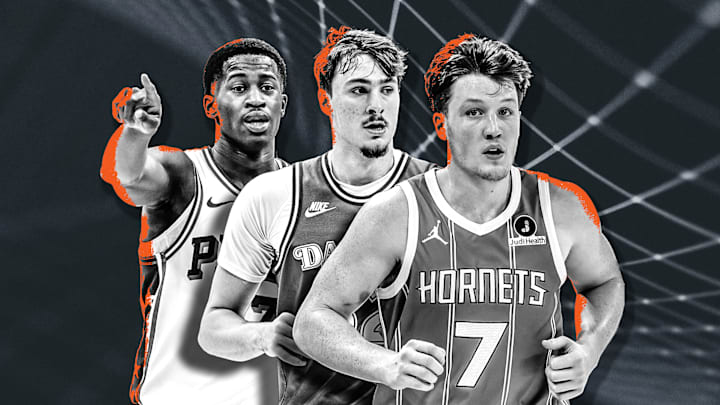
The 2025 NBA Draft class was met with substantial hype, which has thus far been rewarded. It's feels like several future All-Stars just hit the professional stage. Cooper Flagg and Kon Knueppel are doing Duke proud, while VJ Edgecombe, Derik Queen and Cedric Coward, among others, are all exceeding expectations right out of the gate.
This is a deep and talented class. A lot of teams probably feel good about the decisions they made. For those who might sense a missed opportunity, however, let's run it back. A lot of rookies have now played more NBA games than college games at this point. Here's how things might change with the benefit of hindsight.
1. Dallas Mavericks: Cooper Flagg

Original Pick: 1
FanSided's Draft Guide Ranking: 1
Why the Mavs make this pick: Cooper Flagg was hailed as a generational talent on draft night and he has done nothing to dissuade that notion since arriving in Dallas. Things got off to a moderately bumpy start when the Mavs made the 6-foot-9, 18-year-old forward their opening day point guard, but Flagg quickly made the necessary adjustments and mastered the rigors of conducting an NBA offense. He looks to be in complete command nowadays, and he's still the youngest player in the league — which, L-O-L. Flagg is malleable, efficient, and more than capable of taking over games. Over his final six games before the All-Star break, Flagg averaged 32.0 points, 7.7 rebounds and 4.0 assists on .526/.455/.844 splits.
What we got right: Flagg went through a similarly steep learning curve at Duke, when he began his freshman season at just 17 years old. Jon Scheyer smartly threw him directly into the fire, not unlike Jason Kidd in Dallas a year later. Once Flagg got up to speed, he was far and away the best player in college hoops. Flagg does a lot of everything, all at an extremely high level. He's so well-rounded. Dallas knew what their lottery luck meant as soon as the pingpong balls dropped. Too bad Nico Harrison won't be around to see the fruits of his, uh, "genius."
2. San Antonio Spurs: Kon Knueppel

Original Pick: 4
FanSided's Draft Guide Ranking: 5
Why the Spurs make this pick: Kon Knueppel spent his freshman season at Duke in Cooper Flagg's shadow, willingly embracing his secondary role. He was extremely successful. Knueppel buried a high volume of spot-up 3s, beat closeouts, and connected dots with cerebral passing — everything that has made him such a success in Charlotte. It's fair to wonder how much higher is ceiling reaches, but Knueppel was never a one-trick pony. He has the strength and craft to attack the soft center of a defense, even without much straight-line burst. His defense, though not sensational, is solid. He knows what he's doing at all times. No rookie was more prepared to hit the ground running. The Spurs need spacing to complement Victor Wembanyama, De'Aaron Fox and Stephon Castle. There is no more obvious, synergistic fit than Knueppel in San Antonio.
What we got wrong: Not much, really. Knueppel was in the same tier as VJ Edgecombe, Collin Murray-Boyles and Derik Queen, others who've cemented their claim in this range. While Knueppel was always a better upside play than folks realized — always far more than a specialist — it feels the collective 'we' misunderstood just how good he would be out of the gate. Knueppel is charging toward a historic shooting season as a rookie. Like he did at Duke, Knueppel can effortlessly blend into the background or take the controls and operate as Charlotte's primary weapon. The Hornets' trajectory has completely shifted since last June. The vibes are good, the future is bright, and Knueppel is the major reason why.
3. Philadelphia 76ers: VJ Edgecombe

Original Pick: 3
FanSided Draft Guide Ranking: 6
Why the Sixers make this pick: VJ Edgecombe exploded out of the gate, dropping 34 points on Boston in his NBA debut. That was, predictably, an outlier, as Edgecombe is still developing as a finisher and live-dribble creator. But he has done nothing to dissuade the Sixers from taking him here — if he'd even fall this far in a re-draft. Edgecombe is such a strong intangibles guy; the work ethic and personality has proven infectious in a Sixers locker room that desperately needed a Robin to Tyrese Maxey's Batman. Edgecombe does so much for Philly, from clutch shot-making to suffocating point-of-attack defense, clever screens and cuts, and sharp connective passing.
What we got wrong: Edgecombe was always a 99th percentile athlete with a relentless motor and underrated feel. The knock on him pre-draft was that he was a bit undersized for an off-ball guard who couldn't really finish at the rim or covert consistently on pull-up jumpers. Edgecombe has made major strides in both respects already. His touch is better than expected. He's shooting 3s at a higher volume than he did at Baylor, too, which helps buoy his offense when the layup package occasionally falters. Edgecombe is such a clear culture-builder, even on a team with established, future Hall of Fame vets. That he's already dominating the end of games and helping Philly win games makes this an easy re-pick.
4. Charlotte Hornets: Dylan Harper

Original Pick: 2
FanSided Draft Guide Ranking: 2
Why the Hornets make this pick: Charlotte would undoubtedly love to keep a good thing going with Kon Knueppel, but absent such an opportunity, there's no real doubt here. Even without a viable jump shot, Dylan Harper has consistently driven positive impact for the Spurs, even in a less-than-ideal setup. He's sharing a crowded backcourt with two other slashing guards; San Antonio's spacing is a real challenge at times. Still, Harper pressures the rim at will, dives deep into his bag of tricks as a finisher, and looks the part of a jumbo lead guard when the Spurs ask him to. He's the perfect backcourt foil to LaMelo Ball's deep shooting range and infectious ball movement.
What we got wrong: Let me preface this: there's a strong argument in favor of San Antonio still taking Harper second. It's important to not overreact to two-thirds of a single NBA season, and Harper's upside still rivals any prospect not named Cooper Flagg. That said, the Spurs' backcourt situation has proven difficult to navigate. San Antonio is already extremely competitive and its rotation desperately lacks consistent shooters. Fox and Castle both take precedent over Harper's developmental reps right now. Knueppel, for example, would be playing 30-plus minutes a night for a title contender. Harper is stuck in a bench role, potentially for a while, with his weaknesses exacberated — not mitigated. He's shooting 23 percent on non-corner 3s. The are positive touch indicators, such as a 75 percent free throw clip, but Harper is probably better positioned to reach his ceiling more quickly on a team like Charlotte.
5. Utah Jazz: Collin Murray-Boyles

Original Pick: 9
FanSided Draft Guide Ranking: 3
Why the Jazz make this pick: Collin Murray-Boyles was always going to outperform his draft slot. The early numbers don't jump off the screen — 7.9 points, 5.0 rebounds, 2.1 assists on .553/.348/.639 splits — but CMB is starting games at center for a competitive Raptors squad. He's a hellacious, all-encompassing defender. He's also much further ahead on the offensive curve than expected. He's slowly evolving to shoot 3s. The finishing, short roll passing and interior mismatch-hunting has all translated. He is a versatile weapon, with an extreme capacity for the small things that drive winning. Utah has since acquired Jaren Jackson Jr. and really loaded up on the frontcourt, but for a team that has struggled defensively all season, CMB would've been an immediate boon.
What we got right: CMB was No. 3 on FanSided's board, much higher than consensus. A lot of folks pointed to his lack of shooting as a 6-foot-7 "big" and found it difficult to envision a clear role at the next level. And that's fair. CMB was, in many ways, a classic "if he can shoot" guy. So far, CMB is shooting, albeit on light volume. It's a welcome first step toward something greater. Even without the jumper, though, CMB was too dominant in other respects — as a defender, rebounder, and interior scorer — to not buy stock. At least from my vantage point. He was among the most dominant two-way forces in college basketball as a sophomore, but he was stuck on a bad team. Now he's on a good team. Lo and behold, Murray-Boyles is helping them win a lot of games.
6. Washington Wizards: Derik Queen

Original Pick: 13
FanSided Draft Guide Ranking: 7
Why the Wizards make this pick: Washington is another team that underwent substantial changes at the deadline, acquiring Anthony Davis and Trae Young in a bid to start contending next season. Those were reasonable trades given the basically nonexistent cost, but it would complicate Derik Queen's standing in DC. Does Washington even make such a trade with Queen on the roster? Those are unknowable factors, but Queen has shown more star-type juice than any rookie outside the top four. Defensive questions remain, but he'd align quite nicely with Alex Sarr in the Wizards frontcourt. Sarr can protect the rim from the weak side and switch 1-5. Queen is an offensive battering ram with uncommon finesse, touch and feel — a legitimate playmaking hub. Perhaps Queen and Sarr could evolve into something akin to the bargain-bin version of Boogie Cousins and AD in New Orleans, ironically.
What we got right: Queen was such a joyful watch in college. He competes hard and his positive energy radiated off the screen, both in postgame interviews and on the court. The pre-draft concerns largely centered on his defensive role and inconsistent shooting, both of which persist today. But Queen was an outlier, awesome-level playmaker at the five spot, with the strength and dexterity to put opposing bigs in a blender, with the vision and soft touch to drop dimes out of a variety of actions. His pirouetting footwork, bonkers finishing package and oft-appearing clutch gene all made it very easy to believe in Queen's upside, even with the red flags.
7. New Orleans Pelicans: Jeremiah Fears

Original Pick: 7
FanSided Draft Guide Ranking: 8
Why the Pelicans make this pick: Joe Dumars put together one of the more baffling offseasons in recent memory after taking over the Pelicans front office, but to his credit, their first-round picks — in a vacuum, without accounting for that god-awful trade with Atlanta — look quite good. Queen, obviously, has All-Star potential. So does Jeremiah Fears, if a few things break right. Given the hit-or-miss nature of Fears at Oklahoma, it was a bit surprising to see him make such an immediate impact in the NBA. He still has deep flaws to work through, but Fears is such an electric ball-handler. He gets where he wants on the floor, he's launching with confidence at all three levels, and the court vision and defensive activity both pop (even if he's a liability at the point of attack). The main concern when New Orleans made this pick was the presence of Dejounte Murray and Jordan Poole, but Fears has quickly made it clear that neither of them will factor into the Pels' long-term plans.
What we got right: Fears just moved differently at Oklahoma, which remains true today. Is he a "winning" player right now? Not quite. The defense is a mixed bag, heavy on negatives. While he's a creative passer, Fears is still learning the process NBA defenses at game speed. His decision-making can get a bit reckless. Those are standard rookie point guard trials. Fears isn't the most efficient scorer yet. But watching him play — the dynamic first step, twitchy handles, effortless touch, star-level flashes — it's hard not to believe New Orleans has a real foundational piece on its hands, so long as the Pels can remain patient.
8. Brooklyn Nets: Tre Johnson

Original Pick: 6
FanSided Draft Guide Ranking: 14
Why the Nets make this pick: Tre Johnson was billed as a singular shot-making talent, which has been the case so far. Johnson is hitting 38.6 percent of his 3s on 5.5 attempts in 25 minutes per game. His range extends well past the NBA line; his quick, compact release is textbook. Johnson can spot up, he can get to his step-back, he can run through a maze of screens and fire with a hand in his face, his feet unset. There is a certain caliber of shooter that just transforms an offense. It feels like Johnson is on that track right now. Brooklyn basically took 3.5 point guards with five first-round picks. The Nets need to strike a more harmonious balance. Pair Johnson's shot-making with Michael Porter Jr., and opposing defenses will have their hands full.
What we got wrong: Johnson was an extremely uneven defender at Texas, to put it lightly, and he didn't get around to much playmaking. The Longhorns let him cook and he did indeed cook, but it was hard to envision Johnson as more than a one-note contributor out of the gate. He's still a mixed bag on defense, and no, he's not lighting up the assist column every night. But there is simply too much value in a shooter of Johnson's caliber, something I'll admit to underrating. Plus, it's not like he doesn't have the feel and twitch to develop more on-ball value over time. With his 6-foot-10 wingspan, defensive progress is not out of the question either.
9. Toronto Raptors: Cedric Coward

Original Pick: 11
FanSided Draft Guide Ranking: 18
Why the Raptors make this pick: Cedric Coward was a unique lottery pick. He began his collegiate career in D-III, before spending a couple years at Eastern Washington and six games at Washington State as a senior. Despite negligible experience against high-major competition, Coward looked immediately at home in Memphis. He's a consistent volume shooter with real chops as a slasher and connective passer. On defense, Coward gets great mileage out of his 7-foot-2 wingspan. This would be a classic Raptors pick: a toolsy, versatile wing. But he can also space the floor and do multiple things on offense, which Toronto needs more of.
What we got wrong: The lack of high-level experience for Coward was, obviously, scary. He did everything necessary in his six games at Wazzu to convince us of his NBA upside. He increased his 3-point volume without a decline in efficiency. He averaged 1.7 blocks, with a healthy 1.68 assist-to-turnover ratio. All the signs were there. And yet, we just didn't see enough of it against high-major competition to really, truly feel good about Coward as an upperclassman leveling up to face NBA athletes on a daily basis. Not enough to grade him as a lottery pick, at least. Credit where it's due: plenty of smart draft folks were high on Coward all the way. We bumped him up late, but still thought No. 11 was a bit rich. And yet, here we are.
10. Phoenix Suns: Ace Bailey

Original Pick: 5
FanSided Draft Guide Ranking: 11
Why the Suns make this pick: The ideal landing spot for Ace Bailey was always a team with structure — a team with the necessary playmaking apparatus to shift responsbility away from Bailey and allow him to focus on simple shots and simple decisions. Rutgers basically gave Bailey free reign last season next to Dylan Harper. It worked in the sense that he produced, but the nature of his production was a bit difficult to fully embrace. Still, Bailey has looked increasingly comfortable in Utah, aided by the ascent of Keyonte George and, to a lesser extent, Isaiah Collier. But him in Phoenix, next to Devin Booker, and there's ample opportunity for a 6-foot-8 wing with Bailey's shot-making prowess to flourish. The Suns need to be taking high-upside swings given their lack of future draft capital.
What we got right: Bailey still has a lot to figure out. He is a preternaturally gifted scorer, no doubt. He can get to his shot from anywhere, with a gorgeous high release point and endless reserves of confidence. That said, Bailey feels more like a complementary scorer than a future star on his best nights. That is not a bad thing, but it does require a refocusing of the narrative. He still isn't super comfortable creating against one-on-one pressure; he's not particularly advanced as a decision-maker with the ball. That could all come in time, but for now, it's fair to fade Bailey's top-five pick status a little bit. There are positive signs, though, and this could end up as a great hypothetical value pick for Phoenix. Bailey is second among rookies in dunks — green flag!
11. Memphis Grizzlies: Noa Essengue

Original Pick: 12
FanSided Draft Guide Ranking: 4
Why the Grizzlies make this pick: Memphis began the season with faint hopes of contending, but following the Jaren Jackson Jr. trade, it's clear the Grizzlies are thinking long term now. Noa Essengue hurt his shoulder and will miss virtually his entire rookie season (he appeared in six minutes across two appearances for Chicago). That's a tough blow, but Essengue is the second-youngest player in the NBA. He was never going to put up numbers as a rookie. Treat this as a redshirt season. He's still the same lanky, 6-foot-11 forward with intriguing movement skills and flashes of extreme potential on defense. Memphis knows how to develop internally.
What we got wrong: Look, Essengue was an awesome prospect — extremely underrated in my book. I am still bumping him up a spot from his actual draft position after six minutes and a dislocated shoulder. All that said, Essengue is raw. No surprises there. The Bulls are not the most patient team, despite their sustained mediocrity. He was also buried behind, at the time, a deep-ish frontcourt. That said, he was putting up numbers in the G League pre-injury, and he was an impact player in a real pro league overseas before the draft. So... keep the faith.
12. Chicago Bulls: Ryan Kalkbrenner

Original Pick: 34
FanSided Draft Guide Ranking: 25
Why the Bulls make this pick: Even before the Nikola Vučević trade, it was clear the Bulls needed a bit of size in the frontcourt and a proper successor. Ryan Kalkbrenner has flown under the radar in small-town Charlotte, but he's converting 80 percent of his shot attempts at the rim, with a 3.2 percent block rate and a remarkably low 2.5 percent foul rate. His discipline and timing as a rim protector is already damn near elite. He's just a damn good, nuts-and-bolts interior anchor. Perhaps he should go even higher. There is more "upside" with others in this range, but Kalkbrenner was a day-one starting caliber center from the second round. What a pick for Charlotte. He'd really help this tiny Bulls team.
What we got wrong: Kalkbrenner was an easy bet to outperform his draft slot, but he's outperforming even our lofty expectations. Nothing about this is especially shocking — he's an older prospect, with a loaded college résumé. It's worth seeing how much further he can progress. Even if this what he is, Kalkbrenner figures to impact winning for many years to come. He's the most polished rim protector in this draft class and an absurdly efficient rim-runner and lob threat working out of the pick-and-roll. He sets screens, makes sharp connective passes, and just looks like a decade-long vet most nights.
13. New Orleans Pelicans: Khaman Maluach

Original Pick: 10
FanSided Draft Guide Ranking: 9
Why the Pelicans make this pick: In reality, there's a good chance New Orleans opts not to sacrifice their unprotected 2026 first-round pick to move up from No. 23 to No. 13 with Derik Queen off the board. That said, Khaman Maluach makes for a logical pivot in this exercise, even if it does nothing to assuage concerns over the ultimate cost of that trade. Maluach has found minutes hard to come by in Phoenix, which is expected at this stage. He's still 7-foot-2 with a 7-foot-7 wingspan, offering fluid movement skills, advanced at-rim finishing, and limitless defensive potential once he puts the pieces together.
What we got wrong: While rookie bigs almost always need a minute to get up to speed, there was (perhaps foolishly) hope that Maluach could settle in a bit quicker. He did so much in the shadows at Duke. He was a great rim protector, yes, but Maluach was also setting screens, flashing his jump shot, and finishing with outlier-good efficiency in the paint. He's only been playing competitive basketball for a few years, though, so he naturally needs a longer runway. New Orleans really messed up with this trade, but all things considered, Maluach can proceed with the necessary patience in NOLA.
14. San Antonio Spurs: Noah Penda

Original Pick: 32
FanSided Draft Guide Ranking: 17
Why the Spurs make this pick: Noah Penda hasn't seen consistent minutes yet in Orlando, but he consistently pops on film. Penda is averaging a modest 4.8 points and 3.7 rebounds on .435/.385/.641 splits in 13.2 minutes. And yet, he's an exceptional positional rebounder and shot blocker — in the 99th percentile on offensive boards, per Cleaning the Glass, and 91st percentile in block rate. Penda has the strength to guard up a position in the frontcourt and the perimeter coordination to handle switches. He's a suffocating, extremely competitive defender. So long as he can hit 3s and make the simple passes on offense, he'd be a perfect long-term four next to Wemby in San Antonio.
What we got right: It's unclear why Penda wasn't more appreciated pre-draft. He's so strong, so smart, and so hard-wired to battle for every inch on the defensive end. Penda has such obvious role player DNA. His feel for the game is underrated; it should show up more frequently once he's, you know, on the floor. He needs to prove the shooting is real on higher volume, but the floor is high. He's just waiting for his opportunity to break out in consistent minutes, whether it's in Orlando or elsewhere down the line.
15. Oklahoma City Thunder: Thomas Sorber

Original Pick: 15
FanSided Draft Guide Ranking: 10
Why the Thunder make this pick: Thomas Sorber is done for the season with a torn ACL. He will debut as a rookie in 2026-27. That makes it hard to render any real judgement on this pick. While some are understandably concerned about lost developmental reps, there are several examples of redshirt rookies who hit the ground running in the pros. Sorber is a smart player. He feels like a strong candidate to fit into the latter category. OKC picked him as a potential successor to Isaiah Hartenstein in the frontcourt. His talent for short roll processing really fits with the Thunder's identity. Of all the NBA teams, OKC can most afford patience.
What we got wrong: Nothing yet, really. Sorber falls a bit relative to our ranking due to injury, but this was always the right tier for him. OKC felt like a dream fit, and it still is. He probably won't play much as even a second-year rookie, but once Hartenstein clears out and the minutes open up, Sorber should forge a long and fruitful partnership next to Chet Holmgren in the Thunder frontcourt, if all works out.
16. Portland Trail Blazers: Jase Richardson

Original Pick: 25
FanSided Draft Guide Ranking: 14
Why the Blazers make this pick: Damian Lillard's return next season could complicate the fit for another smaller guard like Jase Richardson, but Portland's backcourt is not as crowded as it seems. Neither Lillard nor Jrue Holiday are long-term staples, while Scoot Henderson's future is very much undecided. Richardson, on paper, is a perfect long-term running mate for Deni Avdija. He was the model of efficiency at Michigan State — an effortless, chameleonic off-ball scorer who consistently found weak points in the defense and took advantage. He hasn't found much breathing room on this Magic roster, but Richardson figures to hit the ground running once he gets a proper runway.
What we got right: Richardson is averaging 11.9 minutes per game, but he consistently shows up in those brief spurts. He's a bankable 3-point shooter, a real weapon out of DHOs, and a better passer (2:0 AST-TO) than he gets credit for. There are very few freshmen guards who operated as efficiently as Richardson did in college. While Orlando is slow-playing his development a bit, it feels like a breakthrough ought to happen sooner than later. Richardson is an antidote to what ails the Magic: a shapeshifting guard who can set up the offense, score off of spot-ups and screen actions, and defend his position reasonably well for a small guard, buoyed by the length of the roster around him.
17. Minnesota Timberwolves: Will Richard

Original Pick: 56
FanSided Draft Guide Ranking: 80
Why the Wolves make this pick: Will Richard has quietly put together one of the more complete rookie seasons in Golden State. He was an immediate impact player off the bench — the rare rookie in whom Steve Kerr expressed complete faith. He's in the 89th percentile for steal rate (2.4%) among wings; an active defender and a plus positional rebounder, despite his more guard-sized frame. Richard can spot up, screen, cut and do the little things to help a team on both ends. Minnesota always needs more backcourt depth.
What we got wrong: Yeah man, look. Sometimes you miss the forest for the trees, or whatever. Richard was an essential contributor to Florida's national title run. He was a 6-foot-3 guard with limited handles, but his 6-foot-11 wingspan and impressive defensive metrics were right there on the surface. Oops. He fits a somewhat classic 3-and-D mold. Any "guard stuff" is icing on a well-baked cake.
18. Utah Jazz: Nolan Traoré

Original Pick: 19
FanSided Draft Guide Ranking: 19
Why the Jazz make this pick: Admittedly, it's a little challenging to draft within the current context of Utah's roster. Nolan Traoré overlaps in potentially uncomfortable ways with Isaiah Collier, which could set up a difficult decision down the road. Or, in theory, Traoré just ends up going to Memphis in the Jaren Jackson trade. Regardless of perceived fit or how much playing time he receives out of the gate, this is solid value. Traoré has made a real defensive impact in Brooklyn and his mix of speed and playmaking instincts present tantalizing upside, even if scoring efficiency is a challenge for now.
What we got right: Brooklyn did Traoré zero favors with the players drafted around him, but he's a natural fit for what the Nets want to do — spread the floor with multiple ball-handlers who can penetrate and extend advantages. Traoré is probably the Nets' best guard when it comes to actually getting downhill and setting the offense in motion. His scoring was always going to be a work in progress, but he's a clear NBA athlete and the feel shines through regularly.
19. Brooklyn Nets: Egor Dëmin

Original Pick: 8
FanSided Draft Guide Ranking: 37
Why the Nets make this pick: The Nets clearly like Egor Dëmin — more than most. The Russian point forward was a polarizing prospect, with staunch defenders and stark detractors in equal measure. After struggling from 3-point range at BYU, he has become an efficient spot-up threat for the Nets. He's still a brilliant passer, too, which is always useful in a 6-foot-8 wing. That said, he's a mess on defense and he's remarkably impotent inside the arc, unable to turn the corner consistently or generate self-created looks at the rim. He's still one-dimensional in a way that could limit his upside. He can't leverage the full impact of his playmaking if he can't penetrate or manipulate the defense on a regular basis.
What we got wrong: Dëmin always looked like a better shooter than he actually was pre-NBA, so we should've put more stock into his volume and mechanics. His size, shooting, and passing are enough to still invest as a potential long-term starter on the wing. That said, he really needs to add muscle and work on his ball-handling, because there's increasingly less value in guys who can only do one or two things well — especially when neither of those things involve defending.
20. Miami Heat: Kasparas Jakucionis

Original Pick: 20
FanSided Draft Guide Ranking: 12
Why the Heat make this pick: No team is better at elevating strengths and mitigating flaws than Miami. Erik Spoelstra has unique methods for getting the most from what is essentially a ragtag group of mismatched former first-round picks. Kasparas Jakučionis has settled into a fairly significant role for the Heat. He's hitting 45 percent of his 3s with a 2.5:0.9 assist-to-turnover ratio, which is hard to complain about. His feel, skill and size at the point guard position was always a plus. There's no reason for Miami to turn away now.
What we got wrong: The reason Jakučionis fell — further than we expected — was almost certainly his limitations as an athlete. It's hard to run point in the NBA if you can't pressure the rim, and Jakučionis has had a difficult time penetrating, creating separation and finishing on the interior against NBA defenders. He buoys his value with efficient spot-up shooting and a scalable skill set, but with poor defensive metrics and an abysmal 33.3 percent success rate on 2-point attempts, it's hard to bump him any higher.
21. Washington Wizards: Will Riley

Original Pick: 21
FanSided Draft Guide Ranking: 35
Why the Wizards make this pick: This was a classic Washington pick. The Wizards love long, skilled wings who can do a little bit of everything. Riley was a fun prospect to evaluate at Illinois. He presented clear flaws, with a thin frame, limited burst, and some unforgivable lapses on defense. But he was also 6-foot-9 with dribble-pass-shoot utility, a nifty pull-up jumper, and a knack for slithering to the hoop and drawing contact. He has fulfilled his end of the bargain for the Wizards so far, popping off for some explosive scoring nights as the tank pushes on full-steam ahead.
What we got wrong: Riley's 3-point shot was a concern, but it's falling at a league-average rate for Washington, with positive touch indicators all around. If he can continue to ramp up his 3-point volume (and hopefully add muscle), it will open up driving lanes and set up passes. Every NBA team is searching for tall, skilled wings who can beat the defense multiple ways. Riley exhibits a type of versatility and burgeoning IQ that's hard not to believe in, or at least invest in.
22. Brooklyn Nets: Asa Newell

Original Pick: 23
FanSided Draft Guide Ranking: 22
Why the Nets make this pick: Brooklyn's frontcourt is in a transitional phase right now. Nic Claxton won't stick around forever. Noah Clowney has some fun flashes, but his flaws are difficult to ignore. Asa Newell just feels like a guy who is going to stick around a while. He's hitting 39.7 percent of his 3s as a rookie, he was a prodigious rebounder at UGA, and he's an effective screen-and-roll partner for Brooklyn's guards. Newell is a dirty work extraordinaire, with upside if he can tap into his tools more frequently as a face-up scorer, or as a playmaker on the defensive end.
What we got right: Newell has mostly kept right in line with expectations, despite limited exposure in Atlanta. He's a bit of a tweener, sure, and he could stand to leave a more forceful imprint on the game defensively, but he's a skilled play-finisher on offense. He competes hard on the glass, on both ends, and he possesses excellent spatial awareness when it comes to pick-and-rolls, relocations and cuts.
23. Atlanta Hawks: Carter Bryant

Original Pick: 14
FanSided Draft Guide Ranking: 20
Why the Hawks make this pick: Atlanta has fully moved on from Trae Young, but absent a clear solution at point guard, addressing their wing depth — with De'Andre Hunter already excised and Zaccharie Risacher quickly falling out of favor — is a logical step here. Carter Bryant has found playing time sparse on a competitive Spurs team, which was to be expected. But his elite physical tools and impressive defensive résumé at Arizona, paired with youth and strong intangibles, make this a worthwhile swing for the Hawks front office.
What we got right: Bryant was always more of a project than a day-one contributor. His NBA-ready frame and impressive defensive highlights enthralled fans in college, but he was also a lower-volume shooter, hitting below 70 percent of his free throws, with sometimes laggy processing speed. Bryant has much to learn still offensively. There are some flashes with his face-up scoring, but for now he's mostly an inconsistent spot-up shooter who occasionally pops with an athletic flourish at the rim.
24. Sacramento Kings: Maxime Raynaud

Original Pick: 42
FanSided Draft Guide Ranking: 33
Why the Kings make this pick: A breakout senior season at Stanford led Maxime Raynaud to fly up draft boards, only for him to tumble deep into the second round when the picks were submitted. So far, he is far and away the most productive rookie for a Kings team that is once again floating aimlessly through space and time. Raynaud has four double-doubles in his last five games. He's hounding the glass, scoring inside and out, and showcasing real growth as a passing hub. The Kings need the production from someone who isn't a fading star.
What we got wrong: Raynaud did a little bit of everything for Stanford last season, but his lofty turnover numbers and clear defensive limitations were cause for concern — not only for us, but clearly for NBA teams as well. Raynaud has proven far more adept at handling the physicality and pressure of NBA defenses than expected. His versatile scoring, meanwhile, is a real weapon. He hasn't even translated his 3-point shot yet, which was a huge weapon in his final collegiate campaign. He isn't much of a rim protector and he's already 22, but if Raynaud is consistently good for 15-10 in starting minutes, even this re-draft spot could look silly in hindsight.
25. Orlando Magic: Walter Clayton Jr.

Original Pick: 18
FanSided Draft Guide Ranking: 24
Why the Magic make this pick: The same logic that guided the Jase Richardson pick leads Orlando to select Walter Clayton Jr. in this re-draft. Orlando desperately needs more shooting, point blank. Clayton was among the most versatile and dynamic shot-makers in college basketball — the engine driving Florida's title run. The hope would be that he's seasoned enough to contribute more out of the gate than Richardson has.
What we got right: Clayton's 3-point volume offsets an early lack of efficiency, which should self-correct in due time. He's an electric player when everything clicks. Clayton has the strength and craft to carve up defenses in the paint, with the range and confidence to bury them from deep. His passing has been a pleasant surprise, too. He looks like more of a floor general than he did in college.
26. Brooklyn Nets: Drake Powell

Original Pick: 22
FanSided Draft Guide Ranking: 29
Why the Nets make this pick: The Nets seem to like Drake Powell, despite predictably limited production in a streamlined role. Powell was ill-served by Hubert Davis' system at UNC, but he's a prototypical NBA athlete on the wing. He practically oozes upside as a defender, with quick hands and the ability to cover significant ground — both as a helper or when he's suffocating the point of attack. The offense is a work in progress, but he's 20 and the Nets should benefit long-term from his archetype.
What we got right: Powell is a project. The defensive flashes are there and he's a sensational athlete, but he's inconsistent from 3-point range and he's still learning how to weaponize his tools as a scorer. He exhibits solid instincts on both ends and should proceed with the necessary patience from Brooklyn. That is important. If Powell gets a long leash and gets to push through mistakes, it should pay dividends eventually.
27. Brooklyn Nets: Yang Hansen

Original Pick: 16
FanSided Draft Guide Ranking: 32
Why the Nets make this pick: Yang Hansen went shockingly high on draft night, but even with little playing time to be found in Portland, he showed enough in Summer League and the G League to reassure Portland fans. Few traits are more undervalued than feel. Yang's ability to map out the court and deliver challenging passes from the high post or elbow is a special trait. He also exhibits highly promising touch around the rim, with potential range out to the 3-point line. This is a fun upside swing for Brooklyn.
What we got right: Yang at No. 16 to Portland was probably a reach, especially with Donovan Clingan blocking his path to minutes, but there's a reason Yang was a borderline first-round grade for us. Consider me an early acolyte of the Cult of Yang, but 7-footers who can pass the rock like him are rare. He needs to prove that he can score and defend enough to stick on an NBA floor, but his IQ is more than enough to justify this investment from the Nets.
28. Boston Celtics: Hugo González

Original Pick: 28
FanSided Draft Guide Ranking: 34
Why the Celtics make this pick: Hugo González has made his presence felt in extremely limited minutes for the Celtics. He's a pure energy source — a defensive chaos engine who is unafraid to put his body on the line when Boston needs it. He's nothing more than a rudimentary contributor on offense at this point, but González's motor is a singular trait and he's a real athlete, with flashes of straight-line drives and potential offensive skill dating back to his days in Spain.
What we got wrong: González was always billed as a defense-first wing who just out-hustles everyone on the floor. He was on the floor even less with Real Madrid last season, though, so it was difficult to gauge how effectively it would all translate against proper NBA competition. González still pops as an athlete, though, and he's a genuine tone-setter with significant situational value to one of the best teams in the NBA as a rookie. Boston has zero complaints about its pick.
29. Phoenix Suns: Dylan Cardwell

Original Pick: Undrafted
FanSided Draft Guide Ranking: 82
Why the Suns make this pick: Phoenix could use solid depth in the frontcourt. Dylan Cardwell has flown under the radar, but he's one of the more pleasant surprises from this rookie class. He's averaging more minutes for Sacramento than he did at Auburn as a senior. He's a rather unique case, but the wide frame, explosive vertical athleticism, vacuum-like reflexes on the glass and advanced shot-blocking instincts all point to a long and fruitful NBA career, even if he's only a backup.
What we got wrong: Nothing Cardwell is doing for Sacramento is new. He averaged 5.0 points, 5.1 rebounds and 1.4 blocks in 20.3 minutes for Auburn in his fifth college season. Cardwell was simply too limited a contributor at 23 years old to garner serious consideration as a draftable prospect, but sometimes you need to bank on clear, translatable traits. He was an elite rebounder, a prolific short-burst rim protector, and a highly efficient finisher. That role has mapped perfectly onto the NBA. Sure, he's a backup, but a quality backup is great value in the late first round.
30. Los Angeles Clippers: Joan Beringer

Original Pick: 17
FanSided Draft Guide Ranking: 31
Why the Clippers make this pick: Especially post-Zubac trade, the Clippers need to establish their future at the center position. Joan Beringer checks a lot of the same boxes as their original pick (Yanic Konan Niederhauser), but he does so at a younger age, with far more significant upside. Beringer is a completely bonkers athlete. He's still learning how to channel that athleticism into consistent winning basketball, but he's a frenzied defensive playmaker and a high-flying lob target for L.A.'s perimeter creators.
What we got right: Beringer hasn't spent many long stretches on the floor for Minnesota, which is hardly shocking when the team has Rudy Gobert, Naz Reid and Julius Randle as frontcourt staples. The 19-year-old, one of the youngest players in the draft, was always going to require patience. He can still finish everything within the general airspace of the rim. He can still soar for blocks. But it could take some time for Beringer to master the finer points of NBA play.
More NBA news and analysis:
 Add us as a preferred source on Google