
Key Points
Bullet point summary by AI
- The 2026 NBA Draft Combine gave top prospects a chance to prove their athleticism and character in front of decision-makers.
- Some fringe players shined in scrimmages and interviews, potentially altering their draft stock before the May 27 withdrawal deadline.
- A few standouts transformed perceptions this week, creating major movement potential ahead of the June draft.
The 2026 NBA Draft Combine served as a chance for top prospects to showcase their physical tools and athletic capacity in front of key NBA decision-makers. Many fringe prospects also scrimmaged, while one-on-one interviews gave teams an opportunity better gauge players' IQ and off-court personalities.
A prospect's larger body of work in college or internationally is always more important than open-gym shooting drills or the small sample size of a scrimmage, but the Combine does carry weight in the pre-draft process. It could very well determine whether some prospects keep their name in the draft or return to school ahead of the May 27 withdrawal deadline. Here's who stood out in Chicago this week, for better and for worse:
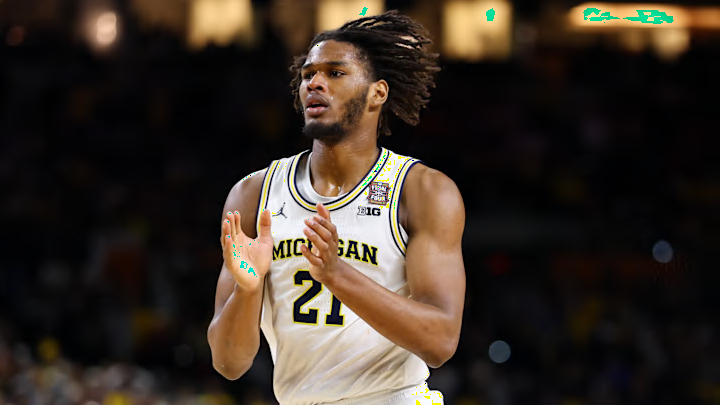
Winner: Morez Johnson Jr.

You can only gleam so much from open-gym workouts and noncontextual athletic testing, but Morez Johnson Jr. certainly made an impression. At 6-foot-9 barefoot with a gaping 7-foot-4 wingspan and a sturdy 251-pound frame, Johnson basically aced every test. He was among the fastest in the full-court sprint, he dominated the lane agility test, and he shot the ball well in drills, with a 39.0-inch max vertical to top it off.
Max Savin, who measures Combine performances holistically, gave Johnson a perfect 100 percent score.
Morez Johnson
— Max Savin (@supersayansavin) May 12, 2026
@ PF
Combine Score = 💯
Physical Score = 71.5 Agility Score = 91.5, Vert Score = 96.4 pic.twitter.com/0Vqz46YynI
Johnson was the third wheel in Michigan's supersized frontcourt, but he was nonetheless essential to their championship run. He's a hellacious defender and an efficient finisher at the rim, with solid 3-point results on low volume as a sophomore. Do not be shocked if he climbs into the lottery with a few strong workouts between now and the draft in June.
Loser: Yaxel Lendeborg

Yaxel Lendeborg was the second-best player in college basketball last season and the driving force behind Michigan's title run. There's more than enough film to establish him as a lottery-level prospect. That said, unlike his teammate Johnson, Lendeborg struggled to match the hype with his athletic testing. Any newfound concerns — plus the fact that he'll turn 24 as a rookie — could cause teams to second-guess picking him early on.
Yaxel Lendeborg
— Max Savin (@supersayansavin) May 13, 2026
@ PF
Combine Score = 64.7
Physical Score = 71.4, Agility Score = 73.7, Vert Score = 25.1 pic.twitter.com/PB3Rp7MLrz
The larger body of work in college should help Lendeborg win over scouts. Plus he's still massive, measuring 6-foot-9 barefort and 241 pounds, with a 7-foot-3 wingspan. The tape matters more than the Combine, but Lendeborg did raise eyebrows for the wrong reasons.
Winner: Cameron Boozer

None of the "Big Four" prospects at the top hurt their cause this week, but Cameron Boozer certainly did the most to combat bad narratives. Boozer is perceived by many as unathletic and old-fashioned, dependent on brute strength and footwork and too slow to hold up as a defender out in space.
Really, those concerns were always unfounded. Boozer measured well for a power forward at 6-foot-8 barefoot and 253 pounds, with a healthy 9-foot standing reach. He also crushed the lane agility testing, outperforming the supposedly more agile and explosive Caleb Wilson, who has been gaining momentum as a candidate to leapfrog Boozer for the No. 3 pick in certain circles.
Cam Boozer
— Max Savin (@supersayansavin) May 13, 2026
@ PF
Combine Score = 84.1
Physical Score = 63.3, Agility Score = 69.2, Vert Score = 59.9 pic.twitter.com/m1x8H0ySR8
Boozer is fluid and strong, with zero wasted motion. He's not a springboard athlete by any stretch, but he's also not a stiff. Factor in his historic productivity and efficiency as an 18-year-old freshman at Duke, and any doubts about his merits as a top prospect in this class should evaporate.
Loser: Kingston Flemings

Kingston Flemings predictably tested very well athletically, but that was after he measured a hair under 6-foot-3 barefoot with a mere plus-one wingspan. With the NBA increasingly focused on size and versatility across positions, there was a lot of chatter around Flemings' small stature. Darius Acuff, Mikel Brown Jr. and other top point guard prospects are longer and, in Acuff's case, stronger.
Kingston Flemings
— Max Savin (@supersayansavin) May 13, 2026
@ PG
Combine Score = 98.8
Physical Score = 51.8, Agility Score = 91.7, Vert Score = 91.1 pic.twitter.com/UTda6QbmGO
There will be teams who penalize Flemings for his underwhelming frame, especially given his struggles finishing at the rim in conference play. That said, the IQ, the intangibles, and his absolutely nuts run-jump athleticism should help balance the scale. For my money, Flemings is still the best non-Darryn Peterson guard prospect in this class.
Winner: Cameron Carr

Cameron Carr was arguably the biggest winner of Combine week. He posted a 38-inch standing vertical and a 42.5-inch max vertical, both second-best in the class. He also measured 6-foot-5 barefoot with a 7-foot-1 wingspan — a plus-eight reach that was put to full effect as a springy weak-side shot blocker at Baylor. The tape matches Carr's unique athletic advantages.
Cameron Carr
— Max Savin (@supersayansavin) May 13, 2026
@ SF
Combine Score = 96.6
Physical Score = 34.3, Agility Score = 89.9, Vert Score = 98.8 pic.twitter.com/jpceNnNpKn
Carr was also one of only a handful of projected first-round picks to scrimmage. He dropped 30 points in his first appearance, showcased his nuclear shot-making talent on the perimeter, and swiftly bowed out. Nobody helped their case more.
Loser: Labaron Philon Jr.

Labaron Philon Jr. was straight-up the most impactful two-way guard in the lottery range this past season. After thriving off-ball as a freshman, he took the controls as a sophomore and flourished, with improved lower-body strength that helped him absorb contact and finish more consistently at the rim. He also jacked up his pull-up shooting volume in a major, compelling way.
That said, Philon measured a smidge under 6-foot-3 barefoot and 176 pounds, a featherweight frame by modern NBA standards. Moreover, he struggled in the athletic testing, with a worse lane agility time than 7-foot-3 Aday Mara.
Labaron Philon
— Max Savin (@supersayansavin) May 13, 2026
@ PG
Combine Score = 48.5
Physical Score = 59, Agility Score = 43, Vert Score = 51.1 pic.twitter.com/uaCg7mkmZ7
NBA teams will think long and hard about Philon's limit strength, burst and agility, and how that might impact his ability to translate on both ends at the next level. Again, the college tape is far more important, and Philon's craft, IQ and touch should go a long way toward convincing scouts to take the plunge. He most certainly did not help himself at the Combine, however.
More NBA news and analysis:
 Add us as a preferred source on Google