
Key Points
Bullet point summary by AI
- Michigan's versatile power forward has evolved from a high school bench rider to a dominant March Madness performer.
- The 23-year-old's consistent improvement and two-way prowess have made him a top lottery contender.
- His ability to impact games on both ends of the floor makes him an ideal fit for contending NBA franchises.
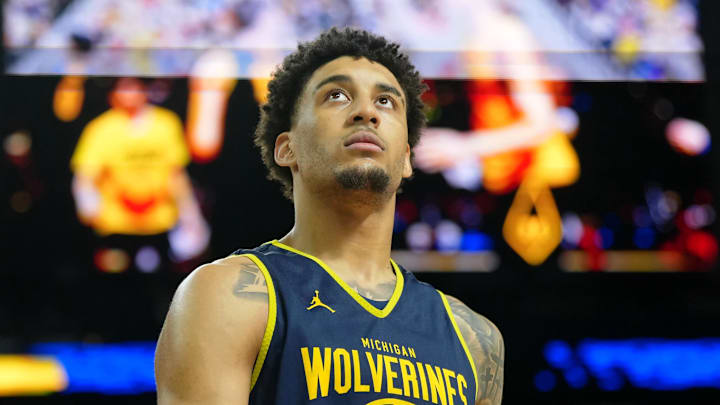
Yaxel Lendeborg took a long, winding road to the March Madness spotlight. He was cut from his high school varsity team as a freshman due to poor grades and didn't work his way back onto the roster until his senior year. After that, he spent three years at Arizona Western, a junior college, before spending two years at UAB. As a grad transfer, he leveled up to Michigan. He will probably finish second in Wooden Award voting behind projected top-3 pick Cameron Boozer.
Lendeborg has fully come into his own with the Wolverines, unlocking his perimeter shot-making and interior finishing, which is complemented by stellar toughness and versatility on the defensive end. He's a lot older than your standard potential lottery pick, but his late-blooming arc and sustained improvement — with multiple prospect-caliber seasons under his belt — makes it easy to trust him.
Who is Yaxel Lendeborg?

Position: Power Forward
School: Michigan
Height: 6'9
Weight: 230 lbs.
Draft Age, Class: 23, Senior
Offensive Role: Spacing and slashing wing
Defensive Role: Off-ball roamer
Lendeborg played a full three seasons for Arizona Western, where he became the NJCAA's all-time leader in rebounds. He was a fringe first-round prospect as a senior at UAB, but opted to return to school for a graduate season and transfer to Michigan, where he joined an loaded frontcourt alongside fellow transfers Aday Mara (UCLA) and Morez Johnson Jr. (Illinois), all potential first-round picks in this year's draft.
Like all great players, Lendeborg is in his villain era. He talked a lot of smack in March Madness and always backed it up on the floor. A dominant NCAA Tournament and Final Four run probably cements Lendeborg's status as a lottery-caliber prospect.
Yaxel Lendeborg's offensive strengths

- Consistent growth as shooter
- Improved at-rim finishing
- Quick passing reads off drives
- Low turnover rate
- Vertical athleticism to finish above the rim
- Dynamic transition athlete
- Bully-ball strength in the post
- Elite offensive rebounder
Lendeborg shot 57.9 percent at the rim 33.3 percent on 3s at UAB, facing primarily mid-major competition. In his final campaign at Michigan, Lendeborg shot 73.5 percent at the rim and 37.2 percent on 3s at significantly higher volume. As a late-bloomer, Lendeborg's steady growth — the ability to tweak and figure things out on the fly — is extremely encouraging, and a sign of continued improvement at the next level, even if he's an older prospect.
Michigan has featured Lendeborg as its centerpiece offensively, but he projects more as a ready-made role player in the NBA. He has the burst and physicality to attack closeouts, draw fouls and finish with authority in the rim. Out in transition, Lendeborg is a steamroller; it's damn near impossible for college defenders to halt his momentum.
Lendeborg's impressive assist (18.4 AST%) to turnover (9.4 TO%) ratio stands out for his position, and is yet another example of his rocket-like ascent over the years. The game has slowed down for Lendeborg in a real way. He a sharp processor on the move, consistently threading the needle through tight windows to set up a backdoor cut or spot-up 3. Like an older prospect should, Lendeborg looks to be in complete control of the college game. NBA competition is a new beast, but all signs suggest Lendeborg is equipped to handle it.
His scalability should play at the next level. Lendeborg can catch lobs in the dunker's spot and function primarily as a spot-up shooter. He's coordinated enough to set up shop at the elbow and facilitate the offense. The handle, the feel, the shot — it has all become damn near bulletproof. He's not a primary engine or even necessarily a future star, but Lendeborg should fit the modern NBA's mandate for dribble-pass-shoot role players who aren't easily schemed out of games.
Yaxel Lendeborg's defensive strengths

- Versatile and engaged on-ball defender
- Strong; near impossible to drive through or redirect
- Great free safety skills: interceptions and blocks
- Elite positional rebounder
- Effective low post defender with 7-foot-3 wingspan
Lendeborg frequently receives the toughest defensive assignments, tasked with heavy-lifting on both ends of the floor. With a less demanding offensive role in the NBA, Lendeborg should have even more energy to invest on defense, which is probably his professional calling card. Even if the shot does not fully translate — even if Lendeborg can't pop as an on-ball weapon — he is going to provide value with his rugged help-side rim protection and malleable point-of-attack defense.
There's not much Lendeborg can't do well on defense. He switches between four or five positions on the regular. He's a legitimate post anchor when called upon; his 7-foot-3 wingspan and 230-pound frame is quite the hill to climb, even for true centers. His flexibility in role — the ability to guard the perimeter, help on the weak side, or operate as a de facto big — is more valuable than ever in the NBA. Lendeborg has proven it across multiple teams and competition levels in college.
His hands are truly special. In addition to long arms, Lendeborg operates with sonar-like instincts, able to pinpoint weak passes and attack. He covers a ton of ground and fills various roles with enthusiasm. There's a chance he becomes a genuinely special defender at the next level.
Where Yaxel Lendeborg needs to improve

- Limited dynamism as ball-handler
- Struggles to defend twitchy guards in space
- Occasional lapses in attention off-ball
- Still needs to prove his shooting
For all of Lendeborg's skill and versatility, he's probably not a lead option in the NBA. He has the quickness and strength to burn closeouts and attack the rim on straight-line drives, but he's an upright ball-handler without a ton of wiggle. He can struggle to generate advantages against physically comparable defenders, which he'll see more of in the NBA.
The same can be said for Lendeborg's defense. While he's comfortable switching along the perimeter and fulfilling multiple roles, it's unfair to categorize him as a five-position skeleton key. He can get burned by quicker guards out in space and he doesn't always battle over screens the way you'd hope. He projects more as a power forward or small-ball five; the off-ball defense will translate easiest. That's not a problem, but it's a limitation worth noting.
Lendeborg will also need to sustain this shooting growth over a larger sample. He has always been an effective free throw shooter, so the touch indicators are strong. That said, his 3-point volume at Michigan is a recent development and Lendeborg tends to run hot or cold. His offensive impact can wane significantly when the jumper isn't falling.
Plus, it's worth noting the rocky track record of older prospects in Lendeborg's projected draft range. He will debut in the NBA at 24 years old. He profiles as a complete, win-now player, but he will need to prove he can continue to get better and add layers to his game. It's all good and well to produce immediately, but if Lendeborg's plateaus as a rookie, it does not bode well for his career-long outlook.
NBA player comparisons for Yaxel Lendeborg

Keegan Murray
Keegan Murray was an older forward prospect with a similar late-blooming arc. The metrics are eerily comparable from their senior campaigns. Murray is and was a more dynamic shooter along the perimeter; Lendeborg offers a lot more on defense. Still, as plug-and-play big wings/forwards in a defined role, there's common ground here.
Naji Marshall
If Lendeborg can improve his handle and flourish as a passing hub at the next level, Naji Marshall feels like a solid analog. He's a bulky, bullish forward who fills gaps offensively, able to hit spot-up 3s, attack the rim and deliver slick passes to open shooters. Lendeborg is more of an interior defender, however.
Noah Penda
A more recent comparison is Noah Penda, who has thrived in limited minutes for Orlando as a rookie. There are clear physical parrallels: both are strong power forwards with standout measurables and nifty connective traits. Penda and Lendeborg can both bludgeon defenders on straight-line drives and pass on move. Both exhibit extremely active hands on defense.
Best NBA fits for Yaxel Lendeborg

Oklahoma City Thunder
Lendeborg is everything OKC should desire in a prospect right now. He can deliver in meaningful minutes on a winning team, physically and mentally prepared for the next level. Lendeborg would thrive in the Thunder's swarming defensive scheme. He can space the floor, drive and kick and do the small things to accentuate OKC's stars offensively. Lendeborg's boisterous and competitive personality also aligns well with an increasingly villainous (complementary) Thunder locker room.
Charlotte Hornets
Charlotte made a point to draft winners last summer: prospects like Kon Knueppel and Sion James, with pro-ready frames and the basketball IQ to elevate a talented but wayward core. Charlotte still needs a long-term power forward, ideally with the ability to hit 3s and wreak havoc defensively while Moussa Diabaté and Ryan Kalkbrenner wall off the paint. Lendeborg fits the bill perfectly.
Philadelphia 76ers
Philadelphia is another win-now team looking for frontcourt depth. He's an upgrade over the Dominick Barlow or Jabari Walker types at power forward — a hellacious defender and rebounder who can also hit 3s and fill gaps next to a star-powered core of Joel Embiid, Tyrese Maxey and Paul George.
Yaxel Lendeborg's NBA Draft projection

Expected draft range: 10-25
Lendeborg has made a strong lottery case on productivity and two-way utility alone, but he's still an older prospect. Not every team will believe in the upside. That could mean Lendeborg falls somewhere in the middle of the first round, where an established contender can scoop him up and place the veteran-coded forward in a competitive environment. Lendeborg needs offensive structure and defensive purpose to fully maximize his skill set in the NBA, so such a fall wouldn't be the worst outcome. He won't look nearly as good trying to carry a shoddy team to 30 wins.
Why teams like him
A live-wire competitior who has done nothing but improve across his accomplished amateur career, Lendeborg will have plenty of fans at the next level. He can augment or perhaps even install a winning culture. He's already great at multiple things on both sides of the basketball. He needs to develop, but there's not a ton of projection or guesswork required. He can help a team straight away, which is always the goal when a 24-year-old goes as high as Lendeborg will.
More NBA Draft scouting reports from FanSided:
 Add us as a preferred source on Google