
Key Points
Bullet point summary by AI
- The Final Four features Illinois, UConn, Michigan, and Arizona, showcasing a deep talent pool for NBA scouts.
- Multiple prospects are emerging as potential high-impact NBA players, with some improving stock during March Madness.
- Key performances this weekend could significantly boost draft prospects' stock, altering their professional trajectories.
We have reached the end of the road in March Madness. It's the Final Four, with Illinois, UConn, Michigan and Arizona left to compete for the men's crown. All four teams deserve to be here. And for NBA Draft scouts, there will be several noteworthy names on the docket. this is a talent-rich pool.
Let's dive into the best prospects across all four teams. Your favorite NBA squad could find its next cornerstone piece or high-level role player on Saturday and Monday.
15. G Kylan Boswell, Illinois

Kylan Boswell is 6-foot-2, with middling 3-point numbers and little in-between game to speak of. Those factors work against him, no doubt, but he's also built like a tank and younger than most seniors. He's a steady hand in the pick-and-roll, with a bowling-ball frame that allows him to get downhill and carve out finishes near the basket. His low turnover rate and scalable approach should pique the interest of front offices looking for a complementary piece who can elevate those around him without sucking up too much oxygen.
Draft Range: Second round
14. F Alex Karaban, UConn
Alex Karaban has essentially been pegged as a potential second-round pick for four years now. He's in his third Final Four at UConn, so he'll bring unique winning pedigree to whichever NBA team grabs him. There are valid questions about what exactly Karaban's defensive role is at the next level, but he's a career 37.7 percent 3-point shooter on healthy volume. At 6-foot-8 with a solid, pro-ready frame, Karaban has fine-tuned his role-player traits over the years. He will bomb spot-up 3s, finish off of cuts, hammer the offensive glass and make quick decisions in the flow of the offense.
Draft Range: Second round
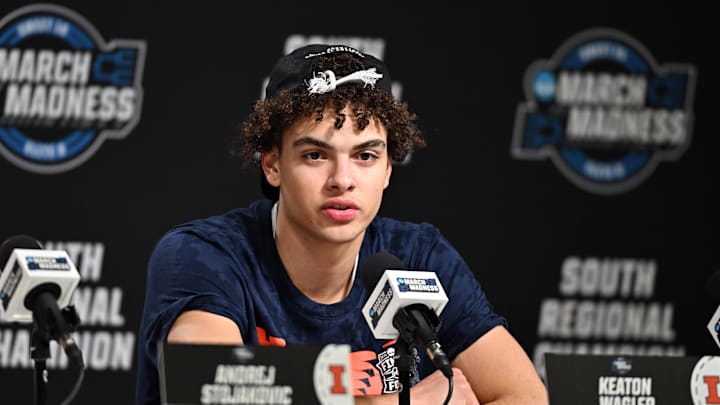
13. F Andrej Stojakovic, Illinois

The son of former NBA All-Star Peja Stojakovic, Andrej really isn't anything like his sweet-shooting father. Illinois' rough-and-tumble swingman is shooting 24.4 percent on 3s this season, but he's excellent at the rim (66 percent) and in the mid-range (45.1 percent). The defensive metrics aren't great, but Stojakovic is a dawg — he's bullish at the point of attack and eager to handle the opponent's toughest assignments on the perimeter. He probably goes back to school, hoping to showcase a bit more as a shooter and a passer as a senior. If he declares for 2026, however, Stojakovic's winning personality could land him on draft boards.
Draft Range: Second round
12. F David Mirkovic, Illinois
David Mirkovic is easily the most entertaining cult figure to emerge in March Madness this year. His interviews are gold, and he's a complete handful on the court, too. He will need to overcome significant defensive shortcomings at the next level, but Mirkovic is 6-foot-9 with the strength of a bull and a brilliant mind. He has completely taken over games this season, bludgeoning smaller defenders in the post, forcing slow-footed bigs to guard him out to the 3-point line and skillfully dissecting opponents with creative passes. He has an NBA brain, with a rare enough combination of shooting, playmaking and rebounding to really catch on with teams willing to look past perceived athletic limitations. There's a good chance he ends up returning to school with first-round aspirations in 2027.
Draft Range: Second round
11. C Zvonimir Ivisic, Illinois

Zvnonimir Ivisic spent two years under John Calipari in a limited role before joining his twin brother, Tomislav, in Champaign. He's 22 years old and has never averaged more than 19 minutes per game in college. That has made it hard to properly gauge his merits as a prospect.
That said, Ivisic is probably a second-round pick looking at a similarly niche role at the next level. In that context, it's hard not to appreciate a mobile, 7-foot-2 frame with elite rim protection instincts (12.9 BLK%) and efficient play-finishing skills (83.3 percent at the rim). He's only hitting 28.3 percent of his 3s this season, but he was up over 37 percent as a freshman and sophomore. Ivisic checks the 3-and-D boxes NBA teams really value at his position.
Draft Range: Second round
10. C Tarris Reed Jr., UConn
Tarris Reed Jr. has arguably been the best player in March Madness so far, or at least on the short list. UConn's senior big man put up 31 points and 27 rebounds against Furman, which is a preposterous stat line even against a mid-major. And in the Huskies' thrilling comeback victory over Duke in the Elite Eight, he dropped 26 points, nine rebounds and four blocks. Reed lacks traditional center size, but he's an elite rebounder and shot-blocker all the same. His slo-mo post scoring and flashy passing from the elbow both pop as potential NBA trademarks. His stock is rising, big time.
Draft Range: 20-40
9. F Koa Peat, Arizona

Koa Peat is easy to fall in love with. He's a tank-like athlete with a rugged motor and a winning pedigree. If this draft were taking place a couple decades ago, he'd be an easy top-10 pick. As things stand, however, Peat's lack of shooting and stocks (steals plus blocks) are unavoidable red flags for a 6-foot-8 forward who isn't an outlier point of attack defender.
Peat can struggle to contain quicker ball-handlers in space. He will throw his weight around and crash the glass, but he's not creating a ton of events on defense. Offensively, the Mack truck drives and impressive mid-range scoring should translate, and he's a smart cutter and connector. It just feels like he's missing a couple key attributes that would make him a potential lottery pick.
Draft Range: 10-25
8. F Ivan Kharchenkov, Arizona
Ivan Kharchenkov has slowly built up his first-round bonafides as Arizona's glue guy. He probably sticks around for a bigger slice of the pie as a sophomore, but every NBA team wants a strong 6-foot-7 wing can can dribble-pass-shoot.
Kharchenkov needs to iron out the shooting part, which is another reason to stay in school. But his body control and forcefulness on drives, paired with encouraging decision-making and a hellacious defensive appetite, has him looking like a future NBA player. If he can stand out in Arizona's last game or two, hopefully helping them cross the finish line, don't be shocked when he tests the NBA waters.
Draft Range: Return to school
7. G Braylon Mullins, UConn

Braylon Mullins hit the shot heard 'round the world to advance UConn to the Final Four — a remarkable 40-foot, deadeye triple up against the buzzer to complete the Huskies' comeback victory over Duke.
It has been a rocky freshman season for Mullins, but anyone wringing hands over his 32.8 percent 3-point percentage is missing the forest for the trees. Mullins gets up a ton of 3s, many of them off movement and with a hand in his face. The volume and versatility of his shot-making, paired with an incredible track record as a shooter dating back to high school, means you should absolutely buy Mullins as a knockdown, high-gravity shooter in the NBA. He also competes admirably on defense, despite a skinnier frame. Mullins' struggles getting to the rim and executing inside the arc are noteworthy, but a bankable elite skill, strong feel and a real competitive streak should carry him at the next level.
Draft Range: 10-20
6. F Morez Johnson Jr., Michigan
Morez Johnson Jr. transferred from Illinois to Michigan for his sophomore campaign, and now he could end up facing his former program in the championship game. The move certainly worked out for Johnson, regardless of how this weekend plays out: As the third wheel in Michigan's jumbo-sized frontcourt, Johnson's versatile defense, hard-nosed rebounding and efficient play-finishing have put him firmly on NBA radars.
He doesn't offer much as a creator or passer, but Johnson is hitting 36.4 percent of his 3s on low volume with positive touch indicators. Better yet, he's converting an incredible 72.9 percent of his attempts at the rim. Johnson knows how to leverage his 250-pound frame. He will clean up on cuts and offensive boards. On the other end, Michigan is comfortable sticking him on the perimeter or letting him roam for help-side blocks. There are a lot of clearly translatable NBA traits here.
Draft Range: 15-30
5. C Motiejus Krivas, Arizona

Motiejus Krivas is the anchor of college basketball's No. 2 defense, per KenPom. The hulking 7-foot-2 center has become a real enforcer for the Wildcats; his impressive block numbers (7.7 BLK%) are only part of the story. Most opponents simply opt against testing Krivas around the basket. He has allowed five field goals at the rim all season, per Bleacher Report. That is a comical number, and speaks to the physical and psychological advantage Krivas wields. There's plenty to like on the other end, too, as Krivas sets hard screens, rolls to the rim with a purpose and displays deft touch, which should translate to a viable 3-point shot eventually. He does all your standard big-man things at a very high level.
Draft Range: 15-30
4. F Yaxel Lendeborg, Michigan
Yaxel Lendeborg is putting the finishing touches on a dominant senior campaign. The UAB transfer didn't need much of an adjustment period against high-major competition. He has grown so much across three D-I seasons: Once a liability beyond the arc, Lendeborg is now shooting 37.2 percent on 3s at high volume, and he's an elite finisher around the rim.
He has the face-up scoring and playmaking chops to function as a legitimate hub for Michigan's offense. On defense, Lendeborg can handle tough assignments or wreak havoc as weak-side rim protector (4.6 BLK%). There are precious few holes in his armor. Lendeborg will turn 24 before next season, which puts him in worrisome company as a potential lottery or mid-first-round pick, but his arc of improvement and impact across multiple college seasons should alleviate those concerns.
Draft Range: 10-20
3. C Aday Mara, Michigan

Aday Mara continues to elevate his stock in March Madness, offering a unique blend of size, fluidity and IQ at 7-foot-3. There just aren't many players with Mara's length and dexterity at the five spot. His high center of gravity can get him into trouble against more physical opponents, and yes, there are times where Mara gets roasted by quicker ball-handlers in space. Still, he's able to recover quickly, and challenges at the rim don't typically end well for the challenger (12.5 BLK%).
Mara will need to add lower-body strength and impose his will more at the next level, but his defensive tape stacks up with anybody in the draft. On the other end, he's a productive rim-runner and interior finisher, with the sort of miraculous passing vision out of the post that will ignite the imagination of NBA scouts.
Draft Range: Lottery
2. G Brayden Burries, Arizona
It's becoming harder and harder to deny Brayden Burries. He's an efficient three-level scorer, with active hands and a stout defensive frame. Arizona hasn't asked Burries to create much, but he flashes impressive tempo and body control on drives, able to hit the brakes and use his strength to absorb contact at the rim. He did a lot more iso scoring in high school, with plenty of success.
His low turnover rate speaks to a high IQ, and should encourage teams hoping Burries can develop more as an on-ball weapon at the next level. He's an older freshman, but combo guards with Burries' across-the-board skill set don't grow on trees. He does the small things to impact winning and offers real upside as "the guy," too.
Draft Range: Lottery
1. G Keaton Wagler, Illinois

Keaton Wagler was unranked on many recruiting services and 150th at 247 Sports, the 26th-ranked shooting guard in his class. Now, as a freshman, he's the driving force behind college basketball's No. 1 offense with a chance to crack the top five on draft night. It has been a meteoric rise for a player who embodies so many of the traits "modern" scouts swear by.
Wagler is a 100th-percentile processer. He doesn't need to pound the rock into oblivion, although there's plenty of craft when he chooses to do so. Wagler reads the floor quickly and facilitates from a high vantage point, generating excellent results out of the pick-and-roll. He's a knockdown shooter, comfortable on- or off-ball. His 6-foot-6 frame also means he won't be a target on defense, unlike smaller guards in his tier on draft boards.
Draft Range: Lottery
More March Madness news and analysis:
 Add us as a preferred source on Google