
Key Points
Bullet point summary by AI
- The Final Four features dominant No. 1 seeds Michigan and Arizona battling alongside UConn and Illinois.
- Each team boasts a standout star, a crucial supporting player, and a game-changing wildcard.
- Performance from these key roles will determine which team lifts the national championship trophy.
The Final Four is set. On one side of the bracket, we have a battle of titans between two No. 1 seeds, Michigan and Arizona. On the other side, it's No. 2 UConn versus No. 3 Illinois — the March Madness buzzsaw of Dan Hurley against this year's greatest college basketball success story, Brad Underwood and his "Balkan Bloc" from Champaign.
All four teams deserve to be here. We should get plenty of great basketball over the weekend. Let's dive into each team, pinpointing their best players as well as under-the-radar stars and potential swing factors.
Michigan Wolverines
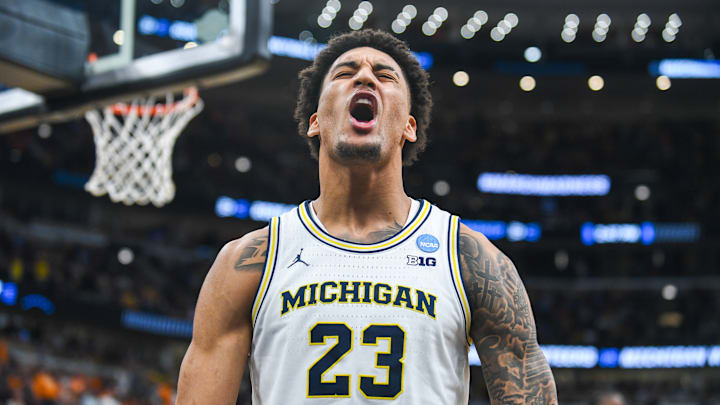
Best player: Yaxel Lendeborg
Yaxel Lendeborg ought to finish second in Wooden Award voting, behind only Duke freshman Cameron Boozer. A 23-year-old in his sixth year of college basketball, this is Lendeborg's first — and last — run with a high major program. It's safe to say he was built for this stage: Lendeborg is a hellacious defender and the skeleton key for Michigan's offense, with a chameleonic skill set that allows him to impact winning in a variety of ways, even when he's not scoring.
The man can score, though, and he's done so throughout the tournament. Lendeborg has 20-plus points in three of Michigan's four games thus far, including 27 points, seven rebounds and four assists in their Elite Eight beatdown of Tennessee. Lendeborg is converting 73.8 percent of his attempts at the rim and shooting 37.2 percent on a healthy 3-point volume. His sterling 3.0 assist-to-turnover ratio shows just how thoroughly he's mastered the college game. He can spot up, face up, bully mismatches in the post or operate as a connective hub in the middle of the floor. There are few more bulletproof talents in the sport right now.

Unsung hero: Elliot Cadeau
Elliot Cadeau spent two wayward years at North Carolina under now-former head coach Hubert Davis before arriving at Michigan via the portal with, shall we say, muted expectations. Cadeau was an exciting recruit once upon a time, but his smaller frame and inconsistent scoring made it hard to fully buy in. Those issues did not magically disappear in Ann Arbor, but the junior is shooting a career-high 37.7 percent from deep. His volume has almost doubled compared to last year at UNC, too.
Cadeau has always been a top-notch floor general, but when he can stretch a defense, it sets up more driving lanes and playmaking opportunities. It helps that Michigan has, by far, the best collection of play-finishers Cadeau has played with, a big reason why he's averaging 10.2 points and 5.8 assists with a healthy 2.5 assist-to-turnover ratio. Michigan's frontcourt grabs the headlines, but Cadeau is often the one setting the table.
X-factor: Aday Mara
Junior big man Aday Mara has emerged as a potential lottery pick, one of many transfer portal victories for head coach Dusty May this season. It's rare to find a 7-foot-3 center with Mara's fluidity and vision. He's a miraculous passer and one of the most dominant rim protectors in college hoops.
That said, Mara's high center of gravity and limited physicality can get him in trouble from time to time. He had four turnovers and four fouls in 18 minutes against Tennessee in the Elite Eight. In Michigan's loss to Purdue in the Big Ten Tournament, the Boilermakers consistently got him out in space and forced Mara into compromised positions. Arizona, UConn and Illinois all present unique challenges. Michigan will need Mara at his best.
Arizona Wildcats

Best player: Brayden Burries
Jaden Bradley won Big 12 Player of the Year in somewhat controversial fashion, but it has become clear over the last couple months that freshman Brayden Burries is Arizona's best player. He does so much to impact winning, efficient at all three levels on offense and active on defense (2.8 STL%). He doesn't carry a huge on-ball load, but he's effective attacking closeouts and slicing to the rim, able to mix speeds and use his strong frame to absorb contact and jail defenders.
Arizona's rotation, top to bottom, might be the most talented in college basketball. Burries began the season in a rut, but he locked in around late November and never looked back. He won't dominate touches, but Burries is a classic star in his role. He just finds ways to contribute and keeps mistakes to a minimum, with uncommon poise for a freshman.
Unsung hero: Ivan Kharchenkov
Ivan Kharchenkov is easily lost in the conversation around Arizona's talented freshmen, as Burries and Koa Peat — both potential lottery picks — tend to steal the spotlight. But Kharchenkov provides essential connective tissue for Arizona. He handles challenging assignments on defense. He rebounds well for his position. The inconsistent shooting is a common knock, but Kharchenkov is a talented slasher and a better passer than the numbers suggest.
He's still putting all the pieces together, but Kharchenkov is consistently swinging momentum in Arizona's favor. He dropped 15 points and five assists against Arkansas, then 18 points and eight rebounds against Purdue. A great many future stars have announced themselves on the March Madness stage. Kharchenkov has a bright future in the Wildcats program, if he sticks around.

X-factor: Motiejus Krivas
Motiejus Krivas has dominated the paint all season for Arizona. He's a skillful interior finisher on offense, a steady presence on the glass and, most of all, he's the defensive tone-setter for this Wildcats team. The numbers are great (7.7 BLK%, 1.5 STL%), but they only tell part of the story. For every shot Krivas blocks, he prevents a dozen from even happening; opponents just do not test the 7-footer very often. Facing a huge, physical Michigan frontcourt in the Final Four, Arizona will need Krivas in top form.
UConn Huskies

Best player: Tarris Reed Jr.
The conventional answer is probably Alex Karaban, a four-year staple of UConn's lineup who has started 148 of his 149 appearances for the Huskies. That said, Tarris Reed has stolen the crown this season. The 6-foot-10 wrecking ball is enjoying a dominant NCAA Tournament run: He dropped 31 points and 27 rebounds against Furman in the first round, and in the Elite Eight upset of Duke, Reed managed 26 points, nine rebounds, three assists, two steals and four blocks. A proper stat sheet stuffing.
Reed does so much for UConn. He's a blow-up artist on defense (9.1 BLK%, 2.1 STL%), a legitimately elite rebounder on both ends and a bonafide hub offensively, averaging 2.4 assists with a slo-mo post game that sees him weaponize both immense strength and underrated finesse. Illinois will attempt to space the floor and put Reed in space on defense; Michigan or Arizona can both blugdeon teams with physicality in the paint. If the Huskies are going to pull this off, Reed needs to meet the moment.
Unsung hero: Jayden Ross
Jayden Ross needed a few years to establish himself in Dan Hurley's rotation, but the junior wing's commitment to the Huskies program (and vice versa) is beginning to pay off. He went scoreless in 21 minutes against Duke last week, but Ross does not need to put points on the board to swing the outcome of a game. An explosive athlete at 6-foot-7, Ross is UConn's best specialist — a bullish defender who brings constant intensity and takes it upon himself to clamp the opponent's top scorer. If he can hit a couple 3s or get out in transition for a high-flying finish, that only helps to shift energy in UConn's favor.
X-factor: Braylon Mullins
Braylon Mullins hit an all-time shot at the buzzer to topple Duke in the Elite Eight. The freshman, a probable one-and-done candidate, has already etched his name in March Madness lore. That said, this has been an inconsistent campaign for the talented 19-year-old; It's been stop and start ever since his return from a preseason ankle injury. Mullins is an elite shooter on paper, but he's hitting only 32.8 percent from deep, with struggles inside the arc due to limited burst and strength.
If he can catch a heater in the Final Four, it makes this motion-heavy UConn offense extremely potent. If he's quiet, though, it places more pressure on the Huskies' upperclassmen.
Illinois Fighting Illini

Best player: Keaton Wagler
Who else? Keaton Wagler, the 150th-ranked recruit in his class at 247 Sports, has turned in a sensational campaign in Champaign. Wagler went from a completely unheralded freshman to the engine of college basketball's top-ranked offense and a potential top-five pick in June's NBA Draft. While he can struggle to turn the corner and put consistent pressure on the rim, Wagler is a shifty ball-handler, able to poke and prod the defense and create space with his refined footwork. The processing and shot-making, at his age, is special. He epitomizes the system Brad Underwood has built at Illinois.
Wagler is highly malleable, able to thrive as a lead guard, a spot-up shooter or as a connector. He's a reactive passer, processing the floor from a high vantage point and surgically exploiting lapses in the defense. For all his struggles at the rim, Wagler's elite shooting makes up for it. He's automatic beyond the arc and equally deadly in the mid-range. Illinois' offense is disciplined and unselfish on the whole, but it starts with Wagler. Whether he's simply setting the table or taking over a game, he is seldom not the most important player on the floor.
Unsung hero: Zvonimir Ivisic
While Zvonimir's twin brother, Tomislav, is typically "more important" — he starts and carries a higher usage rate — there is no doubting the younger (by a few minutes) brother's ability to swing the momentum of a game in small doses. Zvonimir is an elite shot-blocker (12.9 BLK%) and rebounder, with enough shooting touch to at least command respect when he pops out to the 3-point line. A small-minutes analytics darling, Ivisic is waiting for his moment in the sun this March. Matchups with UConn and Tarris Reed, then either the Michigan or Arizona frontcourt if the Illini advance, could give him the perfect stage for a career-making performance.

X-factor: Andrej Stojakovic
Andrej Stojakovic can't really shoot, he averages more turnovers than assists, and yet he feels so critical to every Illinois victory. The dude is a baller; he competes like hell on defense, often handling Illinois' toughest perimeter assignments. He's also a dangerous slasher, in many ways the inverse of his sharpshooting NBA All-Star father, Peja. The younger Stojakovic brings constant intensity, an edge this Illini team really needs. If he can avoid too many detrimental, overambitious decisions offensively, Stojakovic could be the force of nature Illinois needs to scale the mountaintop.
More March Madness news and analysis:
 Add us as a preferred source on Google