
Key Points
Bullet point summary by AI
- Masai Ujiri's new front office in Dallas is expected to reshape the roster around Cooper Flagg, putting the future of Kyrie Irving in question.
- Three teams emerge as strong contenders, each needing a veteran creator to address specific weaknesses in their current rosters.
- The potential trades highlight how Irving's unique skills could elevate young stars while providing Dallas with valuable draft assets and salary relief.
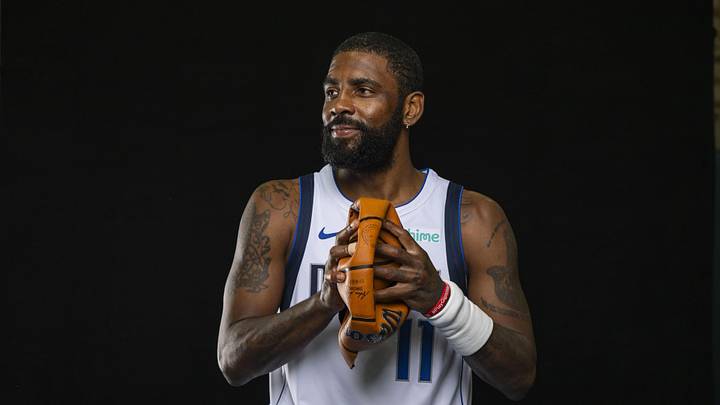
The Dallas Mavericks are setting the stage for major changes this offseason. Masai Ujiri was brought in to run the front office, with draft guru Mike Schmitz hired as his second-in-command. Jason Kidd was fired, which is probably the right move. Now, we can expect Ujiri to build a team in his image and around Cooper Flagg, which calls into question the future of All-Star point guard and former NBA champion Kyrie Irving.
Irving had a close relationship with Kidd, per NBA insider Marc Stein. And while Ujiri has said he's excited for Irving and Flagg to finally share the court, it wouldn't be completely shocking to see Dallas trade the 34-year-old in an effort to fully build on Flagg's timeline. So, here are a few potential destinations, just in case:
Kyrie Irving to the Timberwolves

Minnesota has documented interest in Giannis Antetokounmpo, but that's easier said than done given the Wolves' limited draft capital. If Giannis ultimately lands elsewhere, we should expect the Wolves to pivot. Donte DiVincenzo's Achilles injury illuminates a glaring need in the backcourt. A need Kyrie Irving can certainly address.
After Minnesota's Game 6 loss to San Antonio, Naz Reid told reporters that the Wolves need to fix their "moodiness." Somehow, Irving has become a viable solution to such problems. He has really matured as a leader off the court in Dallas, while on the court, few players are more cool, calm and collected than Irving when he's really cooking.
Anthony Edwards needs help. Mike Conley's days as an everyday rotation piece are over. Obviously DiVincenzo is hurt, with Terrence Shannon Jr. has struggled to earn the full trust of Chris Finch. Irving can come in and give Minnesota the perfect complement to Edwards in the backcourt. Irving and Ant are both elite off-ball scorers; both can create advantages, pressure the rim, and set things in motion. Edwards' blunt explosiveness and Irving's writhing creativity is a fun stylistic contrast.
Dallas probably does not want to introduce Julius Randle to its rebuild, so a third team may need to get involved. But Randle is still a highly productive player at the end of the day, and DiVincenzo's Bird rights aren't bad to have, even if he's effectively salary filler. A couple late first-round picks should get the job done for Irving, who's still a 34-year-old guard coming off of a major knee injury at the end of the day.
Kyrie Irving to the Raptors

Toronto really missed Immanuel Quickley in the playoffs, but in reality, Toronto needs to upgrade its backcourt wholesale. Scottie Barnes proved his mettle as a franchise cornerstone this year, while there's genuine excitement around what Collin Murray-Boyles can become. Until Toronto balances its spacing and adds a more reliable creator on the perimeter, however, their ceiling will be capped.
Let's see if Masai Ujiri in Dallas is willing to do business with his old associates north of the border. Irving does not fit Toronto's longstanding M.O. necessarily, but he's a proven winner and a damn near perfect fit, skill-wise. His ability to create from scratch or blitz closeouts, while jacking up Toronto's 3-point volume and scoring efficiently at all three levels, is something the Raptors need.
Toronto also has the length and defensive infrastructure to hide Irving on defense as he ages into his twilight years. On financial terms, he's only under contract for two more years, with a player option for 2027-28. Quickley has three years and $97.5 million left on his ledger, which Toronto probably wants to expel.
Ujiri traded for Quickley and drafted Gradey Dick, so if there's any lead executive who's confident in their ability, it's probably him. Moreover, Dallas gets another top-20 pick in a deep draft, with future compensation, to boot. Even if the contract is rough, Quickley is a strong stylistic fit next to Cooper Flagg (and a potential rookie point guard).
Kyrie Irving to the Pistons

Detroit's embarrassing Game 7 loss to Cleveland feels like a harbinger of change. The Pistons are a very good regular season team, but simply extending Jalen Duren and running it back — after needing to overcome a 3-1 deficit against the No. 8 seed and losing to the No. 4 seed — probably won't cut it.
Cade Cunningham proved himself in these playoffs, but he couldn't find much help. Tobias Harris predictably went M.I.A. in Game 7, while Duren and Ausar Thompson both had a white-hot spotlight shined on their individual shortcomings all postseason long. The Pistons will maintain a physicality edge against most teams, but Detroit needs a bit more flow on offense. Preferably another ball-handler who can draw attention away from Cunningham.
Irving has proven his ability to thrive as the second fiddle next to big guard/wing creators. He did it with LeBron in Cleveland and Luka in Dallas. He's potent as a movement shooter and decisive off the catch, able to manifest driving angles out of nowhere. Simply put, he is one of the most skilled ball-handlers and scorers of a generation. He does not set the table for teammates all that well, but those concerns are, of course, mitigated next to Cunningham in the backcourt.
For Dallas, there's less bad money here than with the other trades. Duncan Robinson is a serviceable role player on a modest, mid-tier contract. Ron Holland is a former top-five pick who could benefit from a change of scenery. Marcus Sasser can give Dallas decent minutes off the bench; he's a sharp connector, a bubbly shot-maker and a committed small-guard defender.
More NBA news and analysis:
 Add us as a preferred source on Google